In the ArcGIS GeoAnalytics Engine 2.0 release (March 2026), we have several exciting advances to expand the datasets that you can work with, and to enhance the analytic potential of your big data spatial workflows. The latest release includes a new raster data type, a variety of raster functions and tools, and several improvements in performance and usability. This 2.0 version also introduces some breaking changes that may impact your existing workflows established with the 1.x releases of GeoAnalytics Engine.
Let’s take a look at the new features and the major changes with the GeoAnalytics Engine 2.0 release:
Incorporate raster analytics in your GeoAnalytics workflows
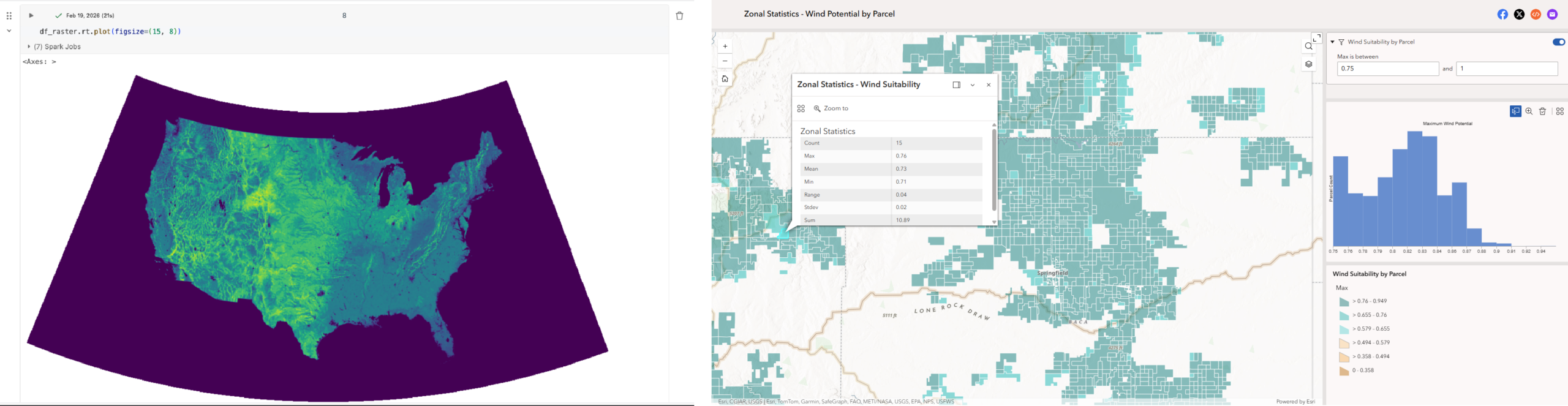
We’ve heard your feedback about the great analyses that can be done at scale with vector data in GeoAnalytics Engine, but what about your raster data? In GeoAnalytics Engine 2.0, we have introduced a new raster data type for storing both raster values and raster references in Spark DataFrames. With these additions, you can read from common raster file types (e.g., GeoTIFF, Cloud Optimized GeoTIFF, and PNG) and use more than 30 new raster functions and tools.
The new raster data type, along with the tools that support both raster and vector analysis, also make it easy to perform analyses like summarizing raster values within vector‑defined zones to support critical workflows such as computing zonal statistics. This enhancement helps you calculate metrics such as mean drought index per county, year to year variability in environmental conditions, or average risk scores for each parcel of interest. And it can be done at scale to support workflows from environmental monitoring to insurance risk modeling and beyond.
As organizations increasingly centralize their raster and vector analytics within big data platforms, efficient zonal statistics become even more valuable and offer a scalable, repeatable way to connect pixel-level information with the geographic units that drive real-world decision-making. With GeoAnalytics Engine’s ability to connect to your ArcGIS data stores, results from analyses at scale can be written out for use across the ArcGIS ecosystem.
Performance and usability improvements
In addition to the new raster capabilities, GeoAnalytics Engine 2.0 also introduces several performance and usability improvements. These include:
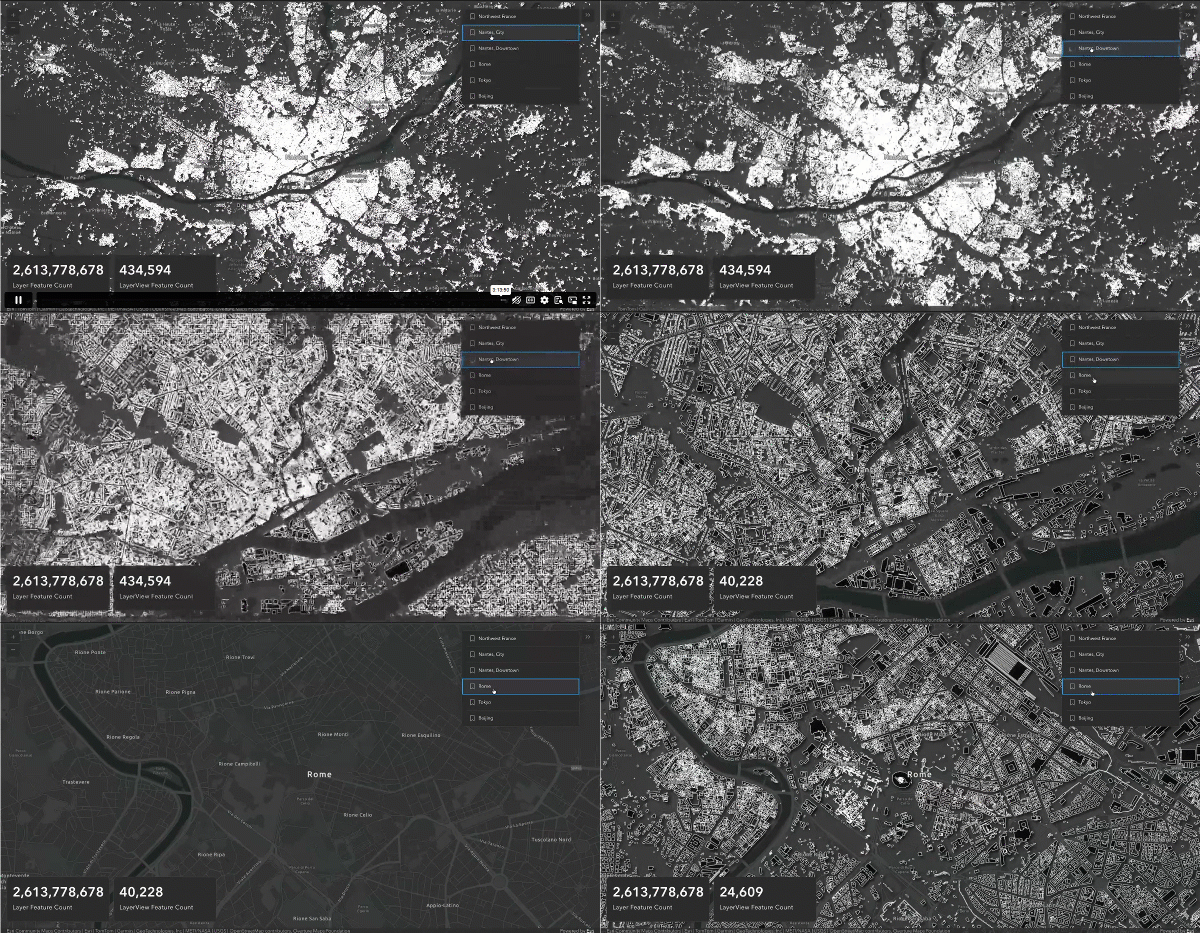
- Enabling generation of spatially optimized parquet for more efficient display of features for downstream visualization. Using the with_geodisplay() DataFrame extension, you can now generate and use large spatial datasets for optimized rendering with ArcGIS Maps SDK for JavaScript and other GeoDisplay-compatible mapping tools.
- Adding H3 hexagons as a binning option when working with the Summarize Within tool in addition to the existing options of either summarizing into Esri square/hexagon bins or polygon that you provide.
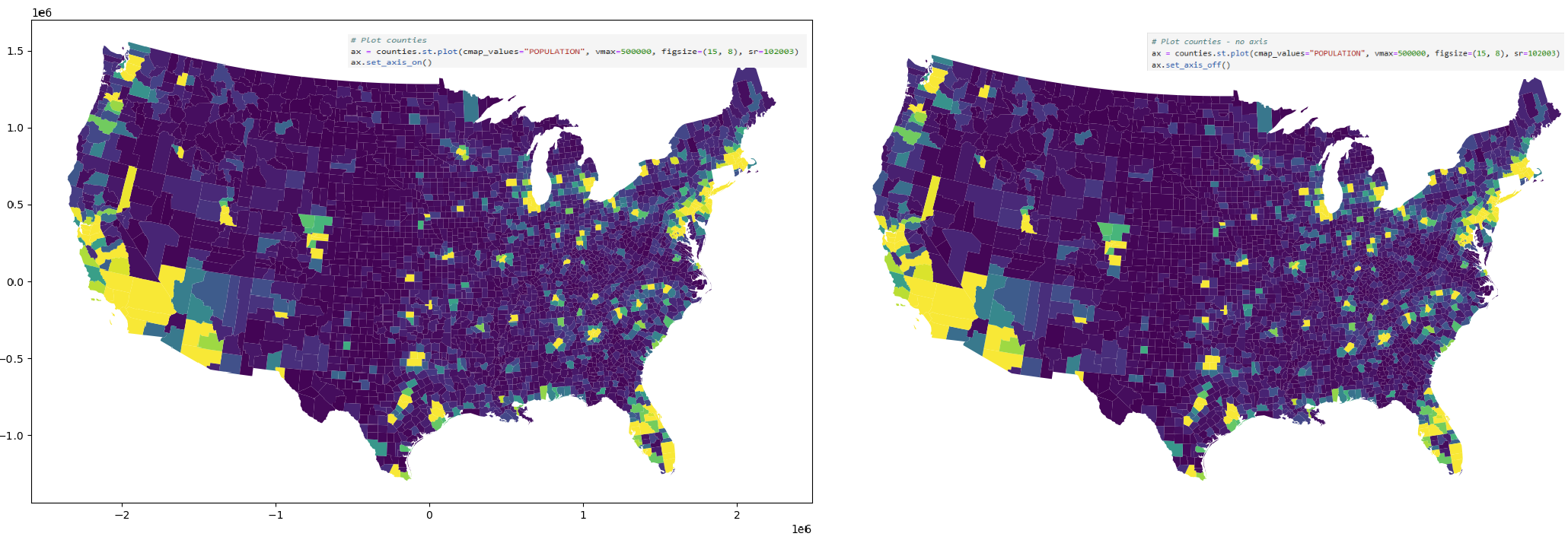
- Simplifying map formatting with the plot functionality so that the axes can easily be removed from the image.
- Adding support for new Apache Spark versions and related cloud runtimes. The GeoAnalytics Engine 2.0 release includes new compatibility with Spark 4.1.x, Databricks 18.0 and 18.1 (beta), and AWS EMR 7.11 and 7.12.
Breaking changes
With the release of GeoAnalytics Engine 2.0 there are some changes that may break workflows generated in the 1.x releases of the product. Many of these changes are related to legacy parameter naming so you may not notice many of these changes in your workflows. We have full documentation of the breaking changes, with examples of the mitigation steps, across the GeoAnalytics Engine documentation, the release notes, and in the GeoAnalytics Engine Community.
Get the latest updates
ArcGIS GeoAnalytics Engine is updated several times a year to make spatial analytics a seamless part of your data science workflows. We are always looking forward to hearing from you about the features you need for your big data spatial analytics!
For more information on the latest enhancements, check out the product release notes. For resources on getting started, tips and tricks with various tools, and much more be sure to check out the GeoAnalytics Engine Community Site.


Article Discussion: