
Image featuring a predominantly black background with a thin horizontal red line along the top edge.

Airport Safety and Regulatory Compliance

Support safer, compliant airport operations with GIS software

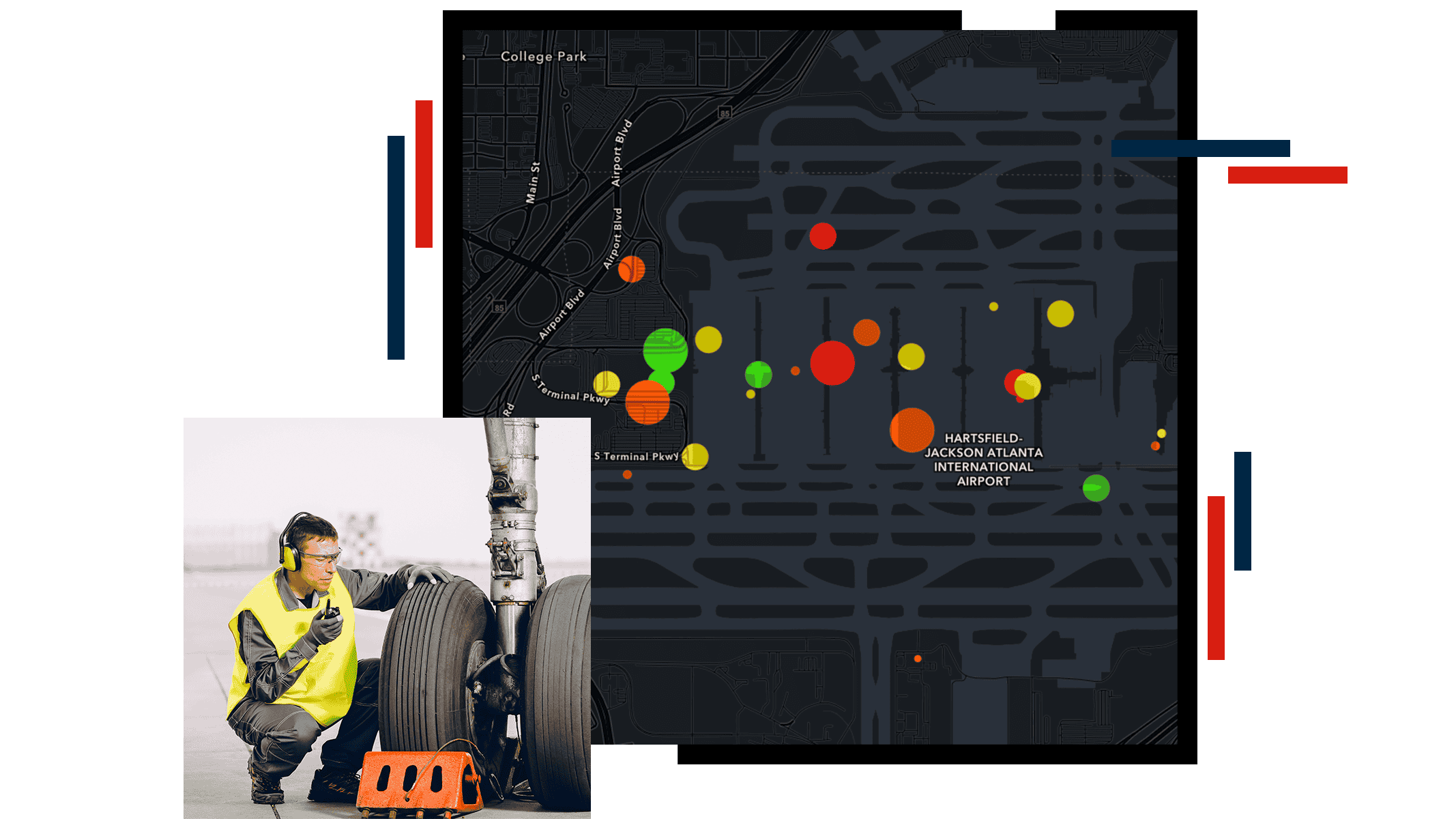
A ground crew technician in a high-visibility vest inspects an aircraft wheel secured with a chock.

Meet airport safety and regulatory obligations

Use ArcGIS as your airport safety management system (SMS) software to meet safety and FAA regulatory requirements. Support activities from airfield inspections to fueling operations and incident response with one comprehensive system.

ArcGIS is the SMS software that allows airports to seamlessly manage safety programs and help ensure compliance. It provides mobile reporting, web-based dashboards, and real-time situational awareness to enhance a common operating picture within Airport Integrated Operations Centers (AIOCs).

Enhance safety and compliance

ArcGIS software integrates airport data, maps, and real-time insights. Use it to improve situational awareness, enhance safety practices, and meet regulatory requirements with confidence.

Manage planned and unplanned operations with real time insights

ArcGIS software integrates real-time and historical data into a single common operational picture that includes data on inspections, assets, sensors, vehicles, passengers, and staff. 


This improves airport safety and security, and supports risk assessments by helping teams:

  • Proactively monitor asset condition and location across the airport.
  • Respond to incidents in real time using live operational data.
  • Coordinate incident response by sharing a common operational view with internal teams and external responders.

Dashboard displaying a map showing weather activity and information on a Southwest Airlines flight

Reduce risk and improve safety with analysis

Modernize your airport safety management systems (SMS), improve hazard mitigation programs, and log maintenance with ready-to-use field data collection apps.

  • Modernize hazard mitigation programs and infield maintenance with ready-to-use wildlife hazard data collection apps.
  • Track and assess tenant fueling operations using configurable field surveys and dashboards.
  • Enhance security policies and safety promotion initiatives with comprehensive spatial data and analytics.

A digital dashboard interface displays an aerial map of an airport runway with a pinpoint marking a discrepancy location.

Maintain nonnegotiable safety and regulatory requirements

ArcGIS helps airports improve safety management by standardizing inspections and unifying safety data.

  • Conduct airfield and terminal inspections, capture conditions, and record issues in real time.
  • Use configurable surveys to standardize audits, including tenant fueling oversight.
  • Leverage indoor maps for safety planning, inspections, and emergency drills.
  • Track performance metrics and communicate internally to educate staff and promote a positive safety culture.
  • Dashboards bring inspection data together to track risk, corrective actions, and compliance.

Map-based analysis reveals safety hot spots, recurring issues, and changing conditions across airfields and facilities—improving situational awareness and supporting faster, better-informed security measures and airport safety decisions.

Digital form interface captures details about an injury or illness event.

Real-world stories of innovation powered by ArcGIS

Products for airport safety and regulatory compliance

Previous
Next

Frequently asked questions

Find answers to common questions about using ArcGIS airport management software.

An airport safety management system (SMS) is a formal, organization-wide framework an airport uses to identify safety hazards, assess and control risk, and continuously improve safety performance.

In practice, an airport SMS ties together processes like inspections, incident reporting, investigations, corrective actions, and trend analysis so the airport can show risks are being managed and mitigations are effective over time. Geographic information system (GIS) technology addresses the four pillars of an SMS: safety policy, safety risk management, safety assurance, and safety promotion.

US airport safety management systems and compliance are governed by Federal Aviation Administration (FAA) 14 CFR Part 139 and Subpart E.

Internationally, this includes the International Civil Aviation Organization (ICAO) Annex 19 for safety management and SARPs that interface with aerodrome safety.

Airports use GIS to meet these regulations and maintain compliance through a location-based systematic approach to manage safety.

Airports manage safety by combining routine inspections with simple, standardized reporting workflows that capture what happened, where it happened, and what actions were taken. Most airports centralize these activities within an SMS and/or an Airport Integrated Operations Center (AIOC) so hazards and incidents are documented consistently and can be tracked to closure.

When reporting and follow-up are consistent and location-aware, airports can demonstrate due diligence, support Part 139/SMS compliance, and document that identified risks were mitigated and closed.

Contact sales

Please share your information and our sales team will contact you soon. We look forward to communicating with you.