
When Dr. Rebecca Cunningham joined the University of Minnesota as its president in 2024, she brought something unusual: extensive GIS experience from her work as a public health professor. Recognizing the university’s leadership in spatial analysis, she made GIS central to the institution’s strategic plan.
University of Minnesota professors Thomas Fisher and Len Kne are leveraging that commitment with the GeoCommunities initiative, which uses ArcGIS Knowledge to map the shared research questions and educational activities of the university’s faculty, staff, and students.
From Infrastructure to Innovation
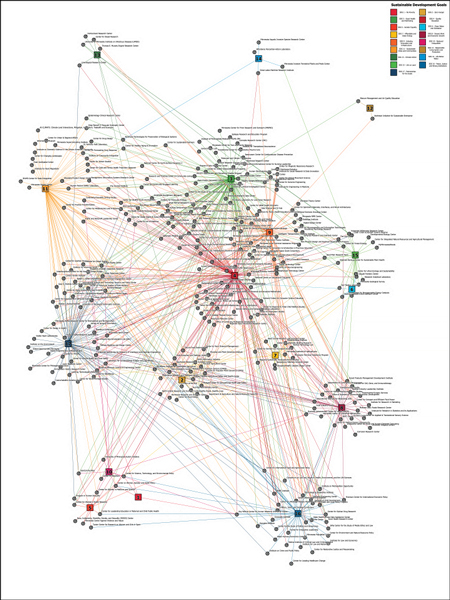
ArcGIS Knowledge allows users to create knowledge graphs—models that simulate real-world systems—in ArcGIS Enterprise. The professors’ team recently used ArcGIS Knowledge to map the university’s 341 research centers and institutes based on how their work relates to the United Nations’ 17 Sustainable Development Goals, or SDGs. The resultant knowledge graph provides a unified view of the scale and scope of the university’s research activities. By modeling relationships among researchers, topics, places, and goals, it reveals communities of practice, previously unknown connections, and opportunities for collaboration that would not be visible through traditional maps or databases.
Other applications for ArcGIS Knowledge are more local, such as focusing on faculty members’ goals as they relate to Minnesota’s Hennepin County, where the university’s main campus is located, or mapping university courses as they relate to the SDGs.
Building Global Communities with Shared Ecosystems
GeoCommunities is also developing tools to help create global communities based on the World Terrestrial Ecosystems maps—available in ArcGIS Living Atlas of the World—that Esri developed with the US Geological Survey, the United States’ largest civilian mapping agency for water, earth, and biological science.
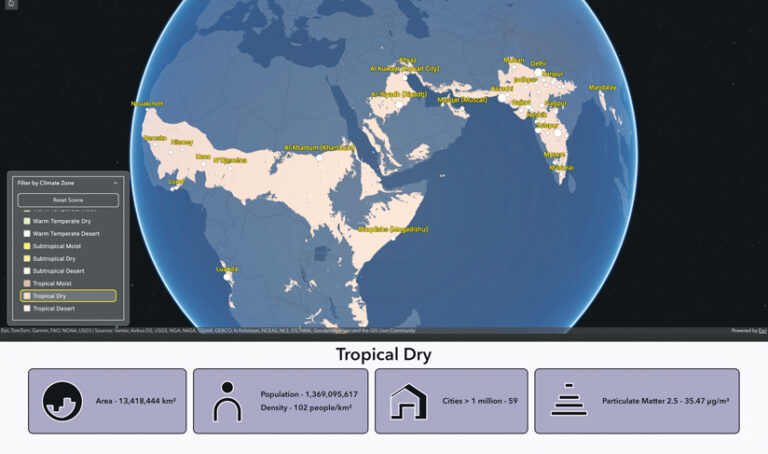
With an ArcGIS Experience Builder app that enables users to locate ecosystems on a 3D global map, the GeoCommunities team used ArcGIS Maps SDK for JavaScript to create an app called Connected Through Climate, which helps identify communities around the world that share ecosystems. With data on ecosystem areas, populations, population densities, and average particulate matter, the app’s dashboards allow communities to share common challenges, best practices, and effective policies to protect natural environments.
Sharing the Spatial Turn with Higher Education
Fisher and Kne have also coauthored a book for Esri Press. Scheduled for release before the 2026 Esri User Conference, the book describes how universities and industries use GIS technology for research, teaching, community engagement, facilities management, workforce preparation, and more.
Similar to the Guide to the Geographic Approach—a collaborative effort from educators and the GIS community to develop teaching modules for modern GIS—this book examines how different institutions make GIS available to their communities and what geospatial technology champions can do to expand the use of GIS.
For more information on the Guide to the Geographic approach, read the Scientific Currents column in this issue. For more information on GeoCommunities, email Len Kne at lenkne@umn.edu.