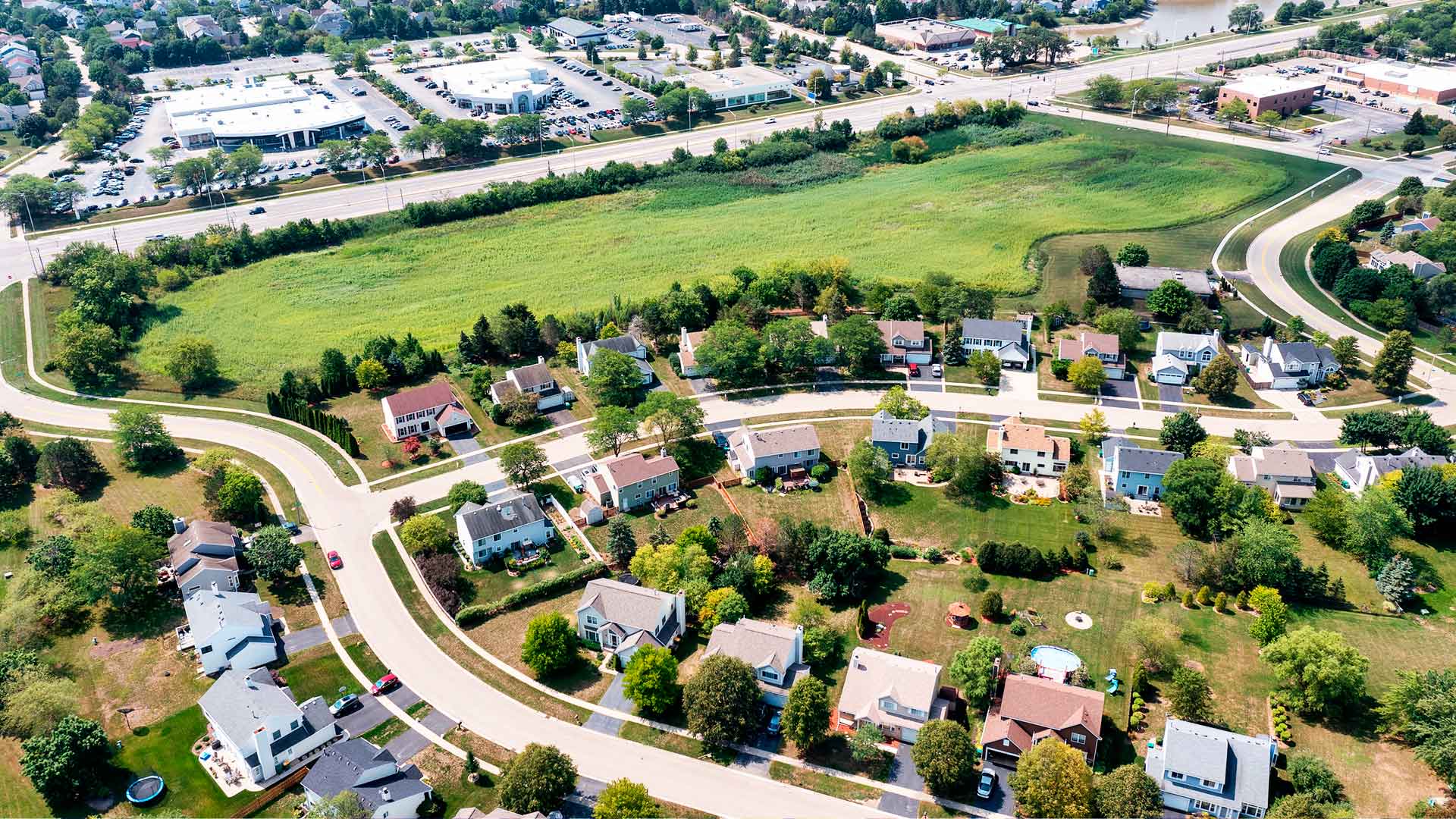
Land parcels are the foundational decision-making layer for governments and private companies alike. Not only do they serve as the basis for property taxation, determining who can build what where, and identifying infrastructure needs, but they are also crucial pieces of information when disaster strikes.
Maui County, Hawaii, has prioritized careful stewardship of parcel data for years. When a devastating wildfire ripped through the area in 2023, it underscored the value of land records and parcel data in ways no one could have imagined.
“When the wildfires hit, the critical nature of parcel data immediately became clear: Recovery would be impossible without it,” said Ellen Deleissegues, a GIS analyst in Maui County’s Real Property Assessment Division.
Many organizations struggle to keep their land information current, accessible, and accurate. Parcel maps fall out of date, discrepancies go unresolved, and staff across departments may lack consistent access to the records they need. Tracing a parcel’s history or verifying legal transactions often requires time-consuming manual research.

As Maui County learned, employees across an organization must be able to map, maintain, and access land records from a shared platform to prepare for the unexpected. ArcGIS Parcel Fabric—Esri’s GIS-enabled parcel management software for ArcGIS Pro, ArcGIS Enterprise, and now ArcGIS Online—is designed to do just that. Built-in tools support data quality checks, help resolve discrepancies, and establish consistent, repeatable workflows.
Capturing the Full, Accurate History of Land Records
Land ownership and administration are complex. Every land transaction begins with a legal record, such as a development plan, a plat, a deed, an easement, or a record of survey. And land records are cumulative. Each new transaction on a piece of land is added to its existing file to create a chain of title that catalogs the property’s entire history.
In Parcel Fabric, users create and edit land parcels in response to changes in the legal record, and all legal references get stored in the software. Unlike most traditional parcel management methods, which represent a snapshot in time—meaning all previous work and history are lost—Parcel Fabric is designed for users to enter a land record once and keep it indefinitely. This makes it easier to understand a parcel’s evolution over time and see its legal underpinnings. It also minimizes rework.
The flexible data model in Parcel Fabric comprises separate parcel types such as plat boundaries, lots, subdivisions, easements, rights-of-way, and tax parcels. Users can customize each parcel type. They can even manage parcels in 3D—both aboveground and belowground—and in 4D over time.
When data is redundant, inconsistent, or noisy, parcel managers perform least-squares adjustments—using statistical analysis to estimate the most likely coordinates where points in a network connect. Users can do this directly in Parcel Fabric, without importing or exporting additional data. This type of analysis helps improve the spatial accuracy of—and confidence in—land records data.

Parcel Fabric accommodates attribute rules and constraints, which streamline workflows and minimize data errors. Users can also automate the labor-intensive process of creating parcel geometry from deeds. Usually, this requires typing all the bearing and distance measurements from a deed—including straight lines and curves—into a computer program. But Parcel Fabric has the COGO Reader tool, which can extract text from a scanned image of a deed, find the courses, and plot them on a map to create parcel geometry.
“As someone who has spent many hours throughout my career manually entering courses from deeds and other land records, I see COGO Reader as a game changer—exponentially reducing input times and minimizing human errors,” said Linda Foster, Esri’s director of land records and cadastre solutions.
Scaling Parcel Management Across Organizations
Parcel Fabric works for organizations of varying sizes, from those that manage tens of millions of parcels to those with a few hundred. It can also accommodate different organizational arrangements—whether they need a single editor or concurrent editors, whether everyone works in the same system, and whether they access their parcel data on desktop or the web.
The Land Title and Survey Authority of British Columbia (LTSA) in Canada—which manages 2.4 million parcels—migrated its land management system, ParcelMap BC, to Parcel Fabric in ArcGIS Pro. It moved from an on-premises ArcGIS Enterprise deployment to cloud infrastructure while maintaining data continuity. Parcel Fabric’s scalability enabled the organization to minimize user impact while increasing efficiency.
Tooele County, Utah, is at the other end of the spectrum, managing about 35,500 parcels. Because Parcel Fabric can accommodate small organizations as well, the county used it to bring two departments into the same system, improving both accuracy and efficiency.
“We have confidence in our data because we’ve been able to clean up errors, perform maintenance, and publish updated data much more efficiently,” noted Emily Jones, director of operations for the county’s Recorder/Surveyor’s office.
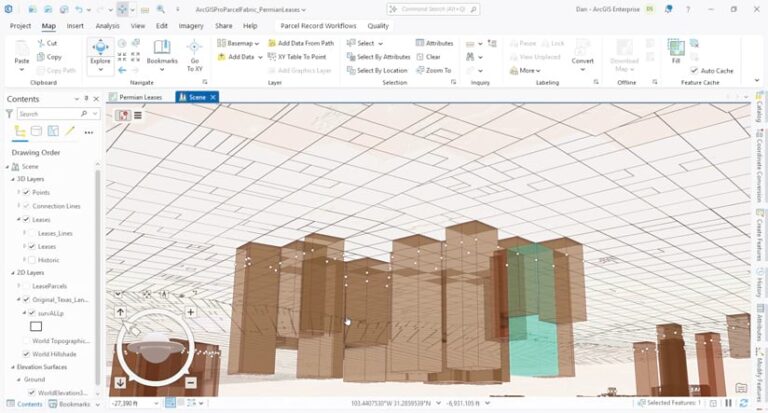
If an organization manages parcels using both CAD and GIS, Parcel Fabric can accommodate that as well. Users can leverage web and feature services and the ArcGIS for AutoCAD integration to work on the same dataset in the environment that’s most efficient for them.
Esri also recently released a new way to work with Parcel Fabric—in ArcGIS Online. Available now, this option allows users to manage parcels directly from a software as a service (SaaS) environment, minimizing on-site IT infrastructure and database administration tasks. Working with Parcel Fabric in ArcGIS Online supports the same record- and quality-driven workflows, administrative parcels, and multiple editors as Parcel Fabric in ArcGIS Enterprise. However, advanced geodatabase capabilities, such as branch versioning, attribute rules, and full geodatabase topology, are available only in ArcGIS Enterprise.
“Being able to leverage Parcel Fabric in ArcGIS Online makes modern parcel management accessible for many more organizations managing and maintaining land records,” Foster noted.
Better Land Administration for a Better World
Land is a finite and life-sustaining resource that everyone depends on. In a world of increasing demands and decreasing resources, it is imperative that organizations modernize how they manage parcels so they can improve sustainability and resilience in their communities and beyond.
Learn more about ArcGIS Parcel Fabric and how to implement it.