
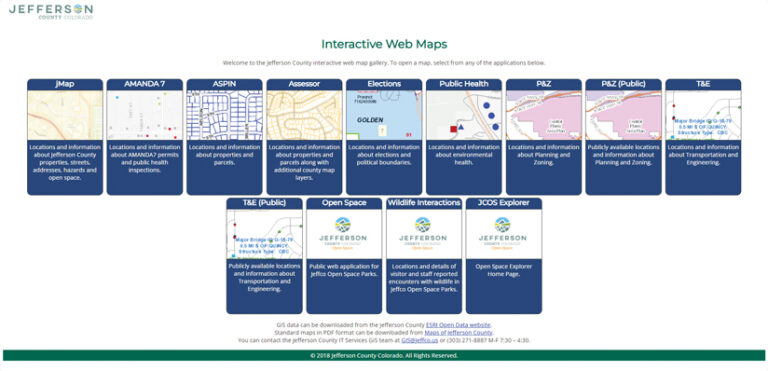
Jefferson County, Colorado’s Business Innovation & Technology (BIT) Department’s GIS team has used web mapping apps since the late 1990s. Around 2015, the department developed the county’s jMap gallery, a compilation of internal and external web mapping apps that became critical for both staff and the public to access information about the county and perform daily tasks. The apps averaged more than 5,000 weekly views in 2024.
But all technology evolves, as do the people and departments using it. Given that the jMap apps were initially built using stand-alone ArcGIS servers and the developer edition of ArcGIS Web AppBuilder (which is now retired), the apps’ underlying infrastructure was outdated. Changes in staff also caused a disconnect between end users and the GIS development team, making it difficult to know which app components were still needed, and by whom.
Considering all this, BIT GIS elected to modernize its GIS infrastructure and use this process to rebuild relationships with partners across the county.
A Move to Enterprise Technology That Focuses on Users
Leaders at BIT GIS determined that ArcGIS Enterprise would provide both the modern infrastructure for redesigning the jMap apps and enable county employees to gain greater access to GIS tools and data. Having a browser-based solution makes GIS accessible to more staff without needing to install desktop software and conduct extensive training.
So in 2023, BIT GIS received assistance from Esri Professional Services to deploy a multimachine instance of ArcGIS Enterprise, establishing the Jefferson County GIS Enterprise Portal. From there, the department connected with other staff to introduce them to the new system, learn about their typical workflows, and offer them greater efficiency.
In addition to managing Jefferson County’s GIS, BIT has what’s called the Innovation Lab, which supports change management, process improvement, and human-centered design. Human-centered design is “the radical notion that if you’re designing products, services, [or] processes for people, you should get those people’s input and use that to inform your design,” according to Sue Anderson, the Innovation Lab’s coordinator. The idea doesn’t categorize people simply as end users; it brings them in as stakeholders and partners who will be directly affected by the apps and solutions that get implemented.
The GIS team worked with Anderson to develop customized training for the rollout of the GIS Enterprise Portal. The human-centered design approach to the training aligned GIS staff with the project’s objectives early in the process and introduced tools that established or rebuilt relationships with stakeholders. The training also allowed the GIS team to collect information on employees’ daily needs and workflows to guide future redevelopment of the apps in jMap.
Drilling Down into Specifics for Each Team
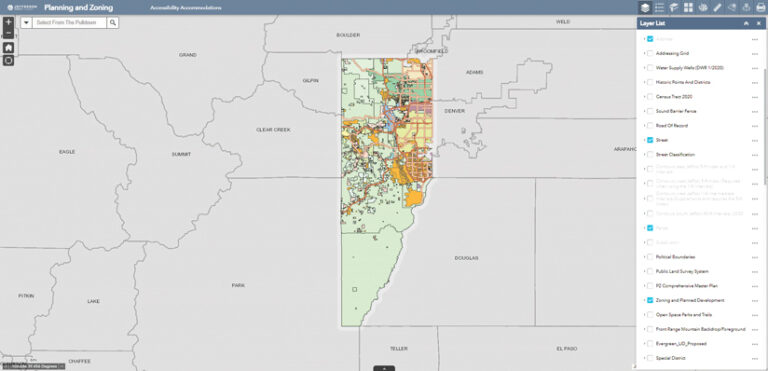
BIT GIS rolled out the Jefferson County GIS Enterprise Portal on a department-by-department basis. Within each department, a series of subgroups were identified. For example, in the planning and zoning department, subgroups included permitting, zoning inspections, and long-range planning.
Members of the BIT GIS team met with each of the subgroups to get an overview of their daily workflows, including how they use the current jMap apps, which datasets and custom tools they require, and what additional needs they had. The interviews were recorded, summarized, and documented in a place where all GIS team members could access them for reference and tracking.
The GIS team used the interviews to identify short-term fixes and long-term opportunities. One new solution that the team implemented is a browser-based editing app, built using ArcGIS Experience Builder, where users can directly edit a feature layer and have the updates reflected in real time in the associated map image layer in a jMap app.
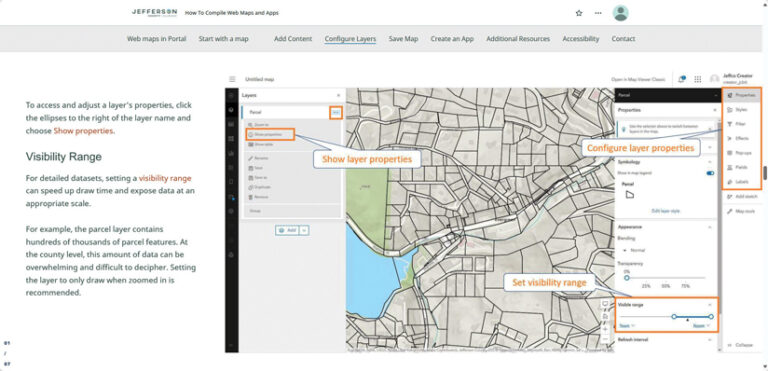
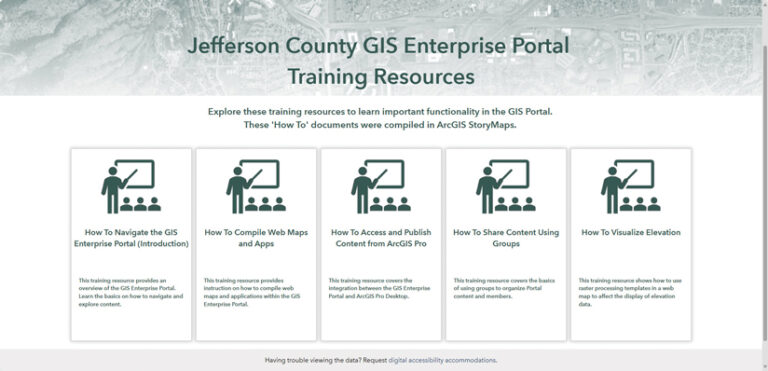
In addition to collecting feedback from the subgroups, BIT GIS team members used the information sessions to introduce the new system and provide training resources. These resources were designed in the GIS Enterprise Portal using ArcGIS StoryMaps and compiled in an Experience Builder app. Each story focuses on a different topic. One goes over how to navigate the portal and explore the content. Others show more complex workflows, such as how to compile web maps and apps, how to publish content from ArcGIS Pro, and how to use groups to organize and share content.
Having these resources available in the ArcGIS StoryMaps format—and accessible from a single Experience Builder landing page—also promotes the apps and tools that are available to all county employees in the GIS Enterprise Portal.
Considerable Demand and Strengthened Relationships
Although BIT GIS hasn’t started redesigning the jMap gallery yet, use of the Jefferson County GIS Enterprise Portal has taken off. It currently has more than 300 active users and over 1,700 items. The team had to federate an additional ArcGIS Server site in 2025 to accommodate the demand.
What’s more, the human-centered design approach that BIT GIS took to modernize its GIS infrastructure has strengthened relationships throughout Jefferson County. The team and its county partners continue to communicate and support one another in this and other endeavors.
To get more information on this project, email Andrea Santoro at asantoro@jeffco.us.