
In a democracy, voting is geography. The street someone lives on determines their congressional district, the school board candidates on their ballot, and the municipal races they vote in. If the geography is wrong, democracy can break down at a fundamental level.
In Oklahoma, this geographic information has been maintained for more than 20 years by a small team at the University of Oklahoma’s Center for Spatial Analysis (CSA). But by 2020, the team’s system was showing its age. Manual data processing, delayed quality checks, and a cumbersome workflow that took 11–12 hours every month left too much room for human error. And the stakes were about to get higher: Redistricting would redraw boundaries across the entire state.
CSA modernized its GIS by moving from ArcMap to ArcGIS Pro, creating a single database, and automating quality assurance and data processing workflows. Now, Oklahoma’s election data is easier to share and use.
A System Under Strain
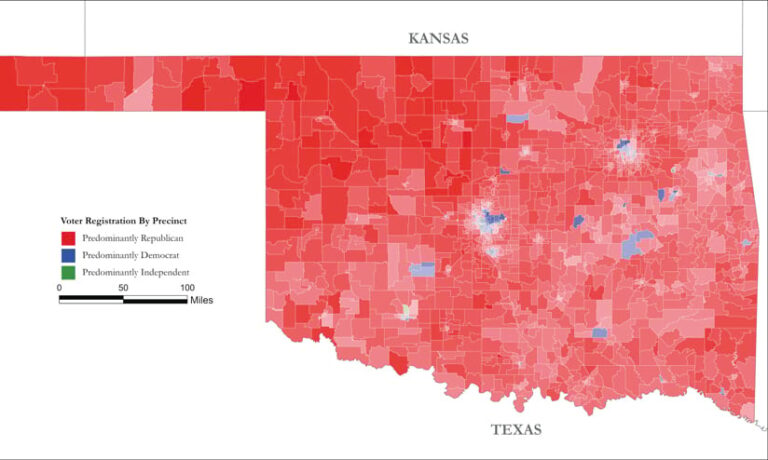
Established in 1994 as a research unit at the University of Oklahoma, CSA has supported the Oklahoma State Election Board since 1996. The center maintains spatial data for street records tied to voter precincts and jurisdictional boundaries across all 77 counties in Oklahoma.
Until a few years ago, CSA’s workflow relied on a database management system for data ingestion and validation, paired with ArcMap for spatial editing.
“It worked for a long time, but there were human error issues with data entry and delayed review and notification,” said Jacob Tillotson, senior GIS analyst at CSA.
Every month, CSA received data from Oklahoma’s counties and ran dozens of manual queries to process changes. Quality assurance checks happened at the end of each cycle, after CSA staff completed their edits.
“If there was an error, you’d find out about it about two weeks later,” Tillotson explained. “You’d have to go back and try to remember what you did and why you did it.”
Under the former process, onboarding was also a challenge because it relied on institutional knowledge and long manual sequences.
“The modernization simplified the monthly run and added redundancy,” Tillotson said, adding that now, “someone with a high-level understanding of the project can step in if one of us is out.”
The Tipping Point
In 2020, in addition to imminent redistricting, CSA was upgrading from ArcMap to ArcGIS Pro. This transition raised questions about the long-term viability of CSA’s aging database system.
“There was growing concern about relying on a legacy platform,” Tillotson said. “We didn’t want to be put in a position where we were forced to react.”
Dr. Todd Fagin, executive associate director at CSA, noted that the center’s role in a complex data ecosystem added urgency to the effort. CSA works alongside the State Board of Education, the Oklahoma Tax Commission, 77 county election boards, and other contractors—all maintaining parts of a system that must remain consistent and accurate.
Building a Modern Foundation
From their years as student interns to their current roles at CSA, Tillotson and Zakary Gipson, another senior GIS analyst, had accumulated deep knowledge of the project’s challenges and potential solutions. They spearheaded the system upgrade. Before beginning the redesign, they attended conferences; learned from the GIS community; and accumulated knowledge of PostgreSQL, Python, C#, and ArcGIS Pro SDK for .NET.
The modernized architecture centers on three major components.
First, CSA migrated from its legacy database system to PostgreSQL, with spatial database engine capabilities. This change enabled the team to consolidate 77 separate county file sets into a single statewide database that multiple users could edit simultaneously.
“The workflow is now a clear three-stage pipeline—ingest, report, and submit—not a long chain of manual queries,” Tillotson explained.
Second, the team used ArcGIS Pro SDK and C# to develop custom tools. The most significant is the checks button, which runs more than 80 quality assurance tests on the data.
The checks tool transformed quality assurance from an end-of-cycle bottleneck into an immediate safeguard. When analysts finish working on a county, the system prompts them to run the checks. Any problems are immediately flagged with an explanation, allowing analysts to fix errors on the spot rather than weeks later.
“The ArcGIS Pro checks tool validates entries against lookup tables, so mistakes are caught immediately,” rather than weeks after they occurred, Tillotson said.
Third, the team automated data processing using Python scripts.
The old report generation process required staff to manually create three PDF reports for every county with data changes, every month. This process took five to six hours. The new automated system generates reports and emails them to county election boards in a single run—all in less than 10 minutes.
“Monthly processing now includes automatic before-and-after snapshots and nightly backups,” Tillotson said, “so audits and rollbacks are straightforward without rebuilding anything by hand. Some codes are also autopopulated from lookup tables during processing.”
Enterprise Technology and Public Access
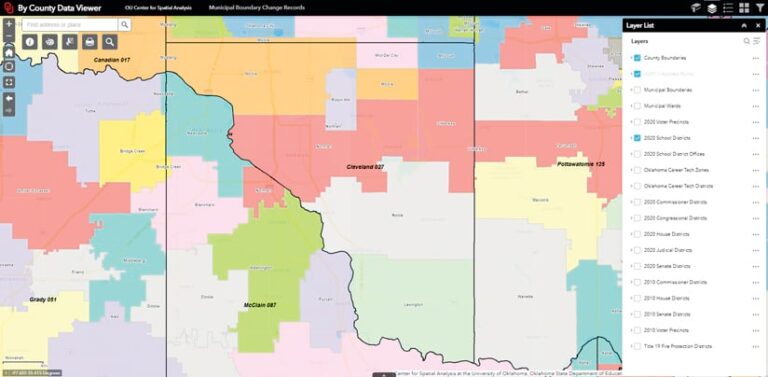
The new system leverages ArcGIS Online as its foundation. CSA maintains a 10-server infrastructure that hosts its enterprise systems and the State of Oklahoma GIS Data Warehouse. Powered by ArcGIS Hub, the warehouse provides free public access to precinct boundaries and other election-related datasets.
“If data can be shared, it should be shared,” Gipson said. “The data warehouse is a great way for us to do that, and it makes all this data more transparent and easier to access.”
The transition to ArcGIS Hub marked a significant improvement over CSA’s previous HTML-based data repository, which primarily served existing GIS users who wanted to download shapefiles.
“It wasn’t really designed for the general public,” Fagin noted.
The modern platform includes a viewer that allows anyone with a web browser to access and explore election data without specialized GIS software.
The publicly available data serves multiple constituencies. County election boards download updated precinct boundaries for their operations, news organizations use the data for election coverage, and members of the public can verify their own precinct assignments and polling locations.
A Seamless Transition
One of the most remarkable aspects of the modernization is what didn’t change—the State Election Board’s experience. CSA continued delivering its reports and met all regular deadlines throughout the transition. The only indication that something had changed came from CSA’s primary contact at the State Election Board, who noticed fewer errors than in the past.
“They never saw any changes on their end,” Tillotson said. “They never actually even knew that this was [happening] on our side.”
Lessons for Other States
Oklahoma’s election GIS modernization can be a model for other states facing similar challenges. The key takeaway, according to Fagin, is recognizing when a legacy system has outlived its usefulness.
“There’s good reason that anyone who’s still using a single-user database and managing multiple databases may want to go to a multiuser database,” he said.
For more information on CSA, email Fagin at tfagin@ou.edu or CSA director Dr. Chengbin Deng at cdeng@ou.edu.