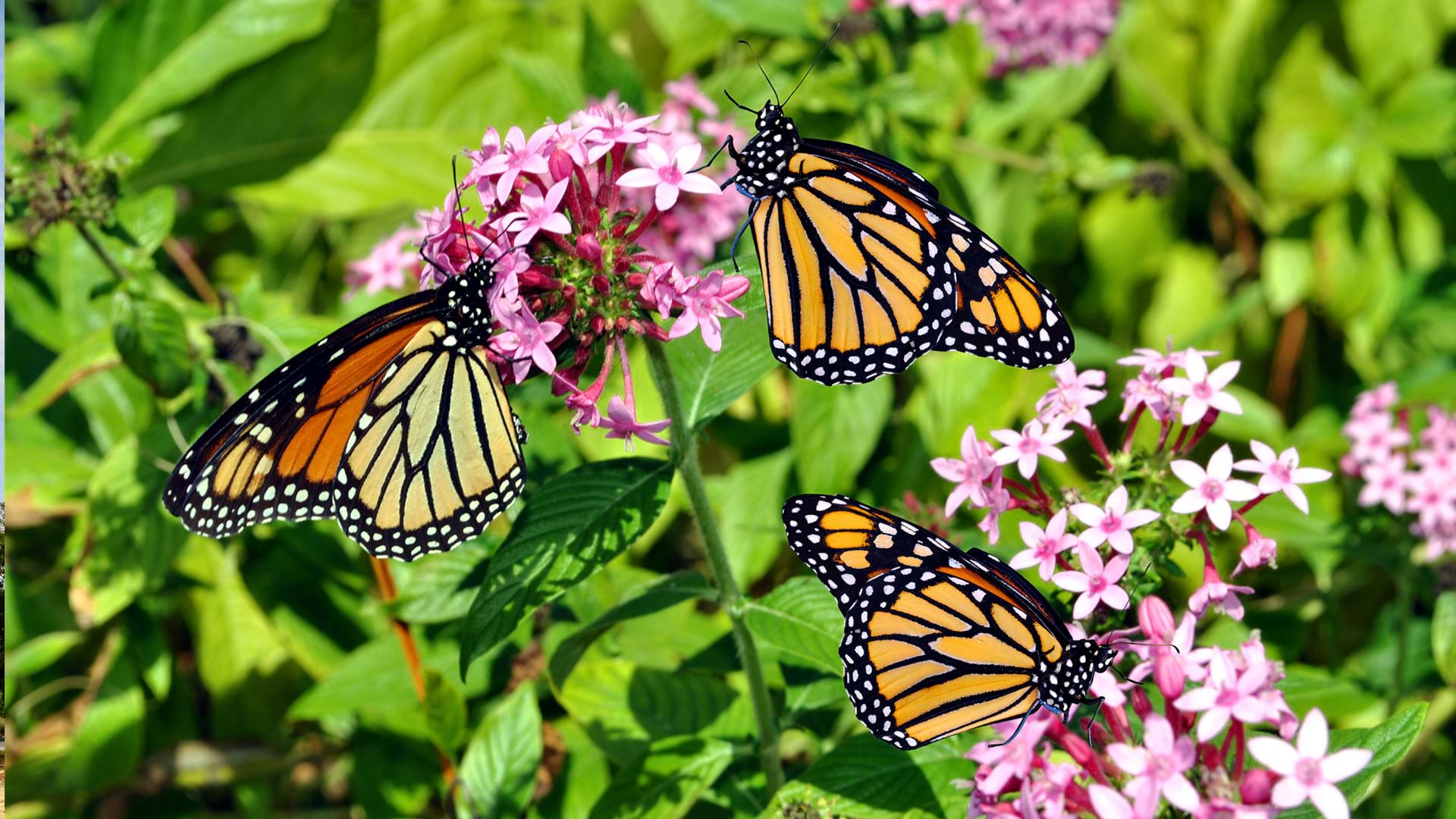
Development, intensive agriculture, and pollution routinely threaten the habitats of native pollinator species across North America. To mitigate these threats, John Ball Zoo in Grand Rapids, Michigan, established Habitat Hero in 2022. This community science and pollinator conservation initiative distributes over 2,000 native plants annually to more than 1,000 residents, augmenting pollinator habitat and engaging participants in active conservation. At dozens of community events, farmers markets, and other forums, Habitat Hero operates booths with a selection of native grasses, wildflowers, milkweeds, shrubs, and trees available for free.
As the program has expanded, so has the need for accurate, comprehensive geospatial data to assess its impact.
In 2023, John Ball Zoo began recording plant recipients’ ZIP codes to better understand the distribution of planting locations—which also aimed to shed light on pollinator habitat connectivity in western Michigan. However, the initial data collection method left something to be desired. Participants were asked to write their names, email addresses, and ZIP codes on a list, which required manual transcription and didn’t provide the precision and resolution needed to identify potential pollinator corridors.
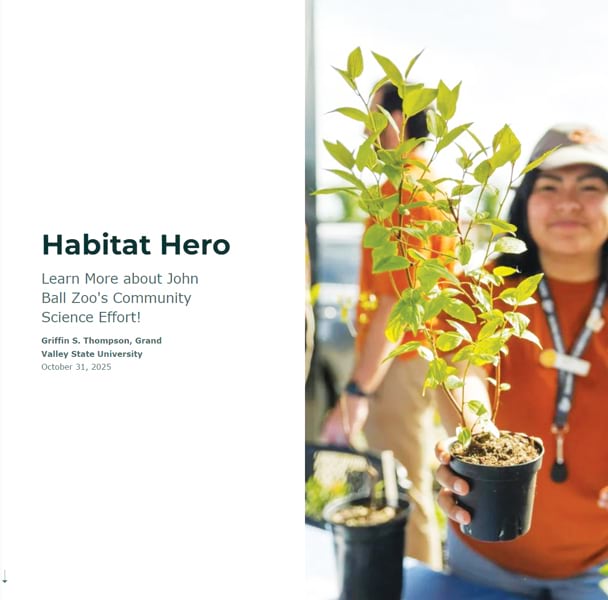
In collaboration with a research team from Grand Valley State University in nearby Allendale, John Ball Zoo reorganized the data process. GIS was already an invaluable mapping tool for Habitat Hero, but the zoo’s conservation team realized it could be a means for engaging community science through participatory data collection, analysis, and communication.
By January 2026, Habitat Hero expanded to 12 zoos and conservation organizations across the United States, largely drawn by the benefits associated with blending participatory and web GIS with community science. ArcGIS technology—including ArcGIS Online, ArcGIS Pro, ArcGIS Survey123, ArcGIS Dashboards, and ArcGIS StoryMaps—has enabled the team and its partners to collect and communicate a robust dataset and create easy-to-use apps.
Now, communities throughout the country can participate in Habitat Hero’s conservation efforts.
ArcGIS Enhances Community Science
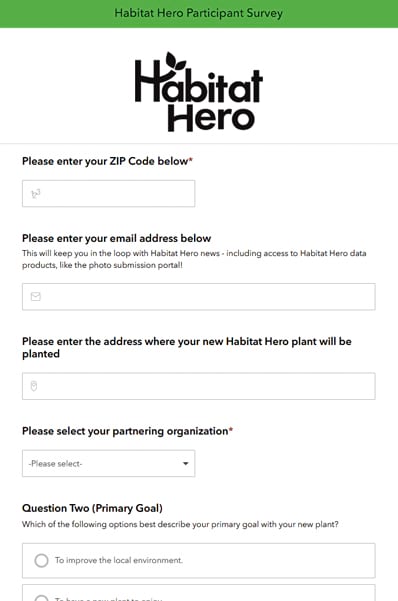
In April 2024, the John Ball Zoo conservation team used Survey123 to create the Habitat Hero Participant Survey. The survey has three sections: background information (such as ZIP code and email address), plant species, and intended planting location. It also includes some questions related to participants’ perspectives on and knowledge about pollinator species. Responses to these questions can be aggregated by school district to identify any cold spots, which are used to guide educational efforts in the region.
Approximately 85 percent of participants submit plant locations, forming the Habitat Hero Database. The rapid growth of Habitat Hero warranted a transition to Survey123 Connect—an app designed to create, publish, and manage surveys through XLSForm—beginning in spring 2026. This enables cascading selects with the list of native plant species, depending on the regional location of the participant, and streamlines data collection.
By creating a precise native pollinator host plant dataset, the conservation team can visualize the initiative’s results and assess its effectiveness in reaching target communities. Anonymized survey results are displayed on the Habitat Hero Dashboard, with dynamic indicators showing the area within corridors connecting plant locations. These corridors are formed by dissolving buffers around plant locations that represent the maximum foraging distance—how far they travel between food sources—of pollinator classes. It’s a simple and effective way to display contiguous areas formed by participants.
“Investigating corridors using foraging distance data from several pollinator classes will permit more realistic assessments of this program’s impact,” said Eric McCluskey, assistant professor of biology at Grand Valley State University.
One of the strengths of the Habitat Hero Dashboard is that it’s a living document. It is subject to change as new elements are added and existing elements are modified or removed.
But these aren’t the only ArcGIS tools Habitat Hero has incorporated successfully. In spring 2025, the team began using ModelBuilder in ArcGIS Online to anonymize survey results and automate dashboard processes. ArcPy scripting increased the replicability of ArcGIS Pro analyses. These changes streamlined workflows and generated an 80 percent reduction in time spent on data management.
In addition, ArcGIS Business Analyst provides a variety of highly specific data related to other socioeconomic variables that the team uses to analyze the impact of plant giveaways. Stories created with ArcGIS StoryMaps introduce participants to the impact of Habitat Hero and its GIS analyses. Publicly accessible web GIS applications are shared in the Habitat Hero monthly newsletter.
Spatial Data-Driven Conservation
As Habitat Hero has expanded nationwide, it has enabled other organizations that hadn’t yet taken advantage of geospatial tools to invest in GIS. Few of Habitat Hero’s partnering organizations had done so previously. But these organizations quickly found that GIS enabled them to better understand their efforts in the community and provide a source of data when applying for outside grant funding.
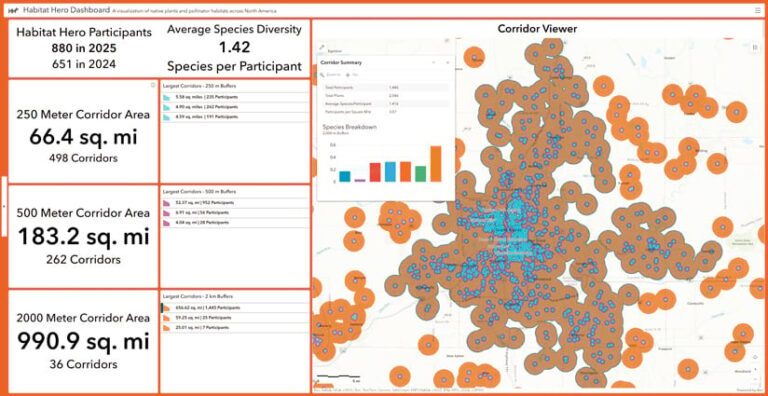
Susan Meyers of Monarchs Across Georgia, for instance, helped expand Habitat Hero into the southern United States in 2025.
“It was amazing to see the impact we had across the metro Atlanta community,” she said. “We could zoom in to identify where we created pollinator habitat corridors and to detect where we needed to do more work. The map was remarkably easy to use and share with our audience.”
Organizations like Meyers’s also discovered that ArcGIS Online, along with tools such as ArcGIS Dashboards and ArcGIS StoryMaps, can facilitate geographic and environmental public education efforts. Simple ArcGIS Online apps not only open the doors of geospatial analysis and meaning to the public but also serve as a form of geographic education for users. This emphasis on educational initiatives further develops a sense of place among participants and increases community investment in native pollinator habitats and native plants—especially as more regions contribute to the Habitat Hero Database. These apps increase the likelihood that participants provide plant locations and deepen their understanding of the world around them.
When embraced by municipalities, Habitat Hero can contribute to urban natural resource management plans and applications for outside funding. Not only does the distribution of native plants increase natural land cover without taxpayer burdens, but it also amplifies local capacity and support for green infrastructure in these areas. Additionally, as plants mature, carbon sequestration increases—a key resource for climate action plans.
Over the coming years, John Ball Zoo’s conservation team will seek new partners for Habitat Hero at zoos and conservation organizations across North America. Already, the number of people within 75 miles of a partnering organization has increased from just under 2 million in 2024 (in the area surrounding John Ball Zoo) to over 45 million in 2026 (around 12 partnering organizations collectively). As momentum continues to build, Habitat Hero combats the risk of extinction of threatened pollinators through active, collaborative community engagement.
For more information about Habitat Hero, email Travis Kurtz at tkurtz@jbzoo.org. For more information about GIS-related aspects of the initiative, email Griffin S. Thompson at thompgri@mail.gvsu.edu or Alexandra Locher at lochera@gvsu.edu.