

With 56 million travelers in 2024, Miami International Airport (MIA) ranked as the 10th busiest airport in the United States. Its passenger numbers are only predicted to grow, with an estimated 77 million travelers expected to pass through MIA annually by 2040. To meet the demand, the airport’s leaders know they must continue expanding traveler services, from upgrading facilities to offering more dining options beyond security.
In 2025, the Miami-Dade Board of County Commissioners unanimously approved a $330 million investment toward overhauling concessions at the airport, which is owned and operated by the county’s Miami-Dade Aviation Department. The investment aims to position MIA as a world-class gateway.
The airport maintains a great deal of data about its concession spaces, but until recently it didn’t have a way for staff, regardless of technical skill, to easily query and view the data spatially. Airport leaders wanted to not only see concession spaces on a map but also interact with them so they could see additional information, such as related lease agreements, and better plan for new space design. Airport officials approached the Miami-Dade County Communications, Information and Technology Department (CITD) for a solution to get a better view.
The airport first worked with CITD in 2022 to integrate ArcGIS software into daily airfield inspection workflows. CITD, longtime innovators in using GIS to improve operations across the county, saw the airport’s latest request as an opportunity to integrate the technology into even more of the airport’s workflows.
Jose Rodriguez, the division director of geospatial technologies for Miami-Dade County, and his team at CITD, proposed making a proof-of-concept model of the airport’s interior concession spaces using ArcGIS Indoors. CITD had previously used ArcGIS Indoors to map, in detail, seven floors of the Miami-Dade Government Center and two floors of the Overtown Transit Village in Miami to improve public wayfinding in the buildings.
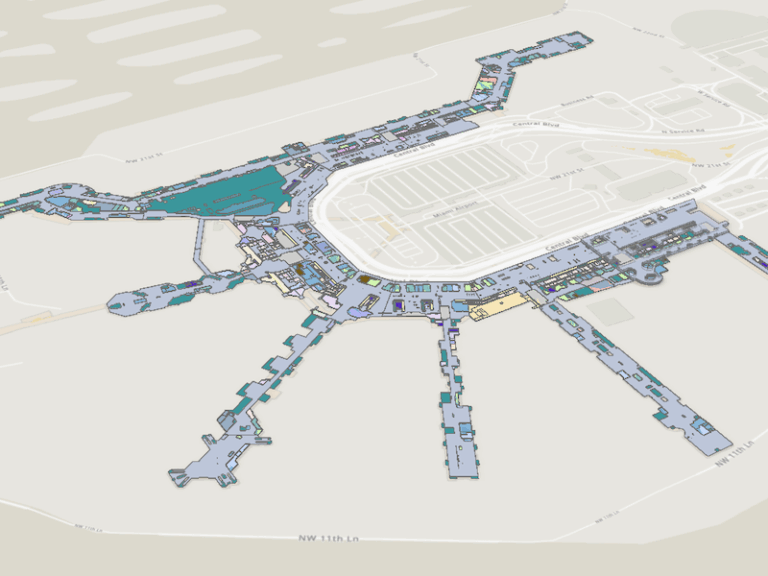
Monica Reyes and Jenny Vanegas, senior software developers on the CITD team, started by working closely with Martin Bonacia, senior software developer with the county’s aviation department and part of its Innovation Division. They first mapped Concourse F, one of six concourses at the airport, before expanding their work to the rest of the airport.
The larger goal is to eventually map everything inside the airport and turn the view into a 3D interactive digital twin, or digital model, to help operations and maintenance crews quickly answer questions about what’s happening inside the airport’s walls.
“Every asset that they have available, we would like it to appear in Indoors,” Rodriguez said.
A “Beautiful” View
For the map of concession spaces, the CITD and airport GIS teams started by importing existing computer aided design (CAD) files of the airport into the ArcGIS Indoors Information Model using ArcGIS Pro. In this case, topological data that displayed gaps and overlaps in the airport’s physical spaces needed to be corrected. Using the topology capability in ArcGIS Pro and ArcGIS for AutoCAD, an Esri plug-in application that allows users to create and edit data, they were able to highlight issues and correct them.
Initially, a single dashboard view displayed information about concession leases—including the detailed indoor model of the second and third floors of Concourse F showing the spaces. However, airport officials needed the information segmented: one dashboard to show currently leased spaces and another to show spaces available to lease. CITD tailored the dashboards to visualize both and worked with Bonacia to automate updates so the dashboard would have live data.

Until now, airport officials had primarily consulted spreadsheets they simply walked around to determine what stores may work best and where. Now they are seeing the data on a detailed, interactive map.
“The clarity in the way it was defined was just beautiful,” Pete Betancourt, chief of the airport’s concessions, said of the proof of concept made with ArcGIS Indoors.
The CITD team and the aviation department’s GIS team have since expanded the initial proof of concept of Concourse F to map the second and third floors of the entire terminal.
Seeing More Inside, in the Future
Airport officials are exploring additional ways to leverage this new indoor view. Potential applications include evaluating the performance of specific concession corridors, identifying the best locations for new businesses, and enhancing operational awareness by quickly addressing issues such as temporary gate closures.
“It will give us that additional insight that is difficult to get today,” said Jenny Deblois, chief of staff for the deputy director of operations.
It could also help as MIA continues a larger overall plan to spend $9 billion in capital improvements to grow the landlocked airport. Because the airport has little room to physically expand, it is even more critical to carve out as much interior space as possible for future development. “We need to get creative,” said Betancourt. Keeping track of planned developments can start small, like with the indoor map of Concourse F. Knowledge about the size, shape, and locations of airport spaces may help minimize disruptions during construction.
As part of the airport’s larger modernization, there are also plans to use reality capture to collect 360-degree images inside the terminals when work is completed. Rodriguez said the team hopes to incorporate the images into the indoor model to create a more realistic view of the airport’s interior that will eventually show where everything is.