Beginning with the release of ArcGIS Pro 3.8 (November 2026), we are updating the ArcGIS Pro product life cycle (PLC) to make software support easier to understand, simplify upgrade planning, and improve alignment with the ArcGIS Enterprise life cycle.
Over the past several years, ArcGIS Pro has offered four supported versions at a time which provided flexibility but also brought challenges. With multiple versions in General Availability simultaneously, customers are faced with several choices, and the distinction between versions receiving software support (i.e. eligible for patches which fix bugs and provide security updates) and versions receiving only technical support is not obvious.
The goal of this change is to simplify the product life cycle. The simplification will decouple technical support from the product life cycle, establish a pattern where there will be two ArcGIS Pro versions in General Availability instead of four, and improve alignment between the ArcGIS Pro and ArcGIS Enterprise life cycles, aiding understanding of cross-product compatibility and providing a well-defined framework for customers to establish long-term update plans.
Pre-ArcGIS Pro 3.8 Product Life Cycle Phases
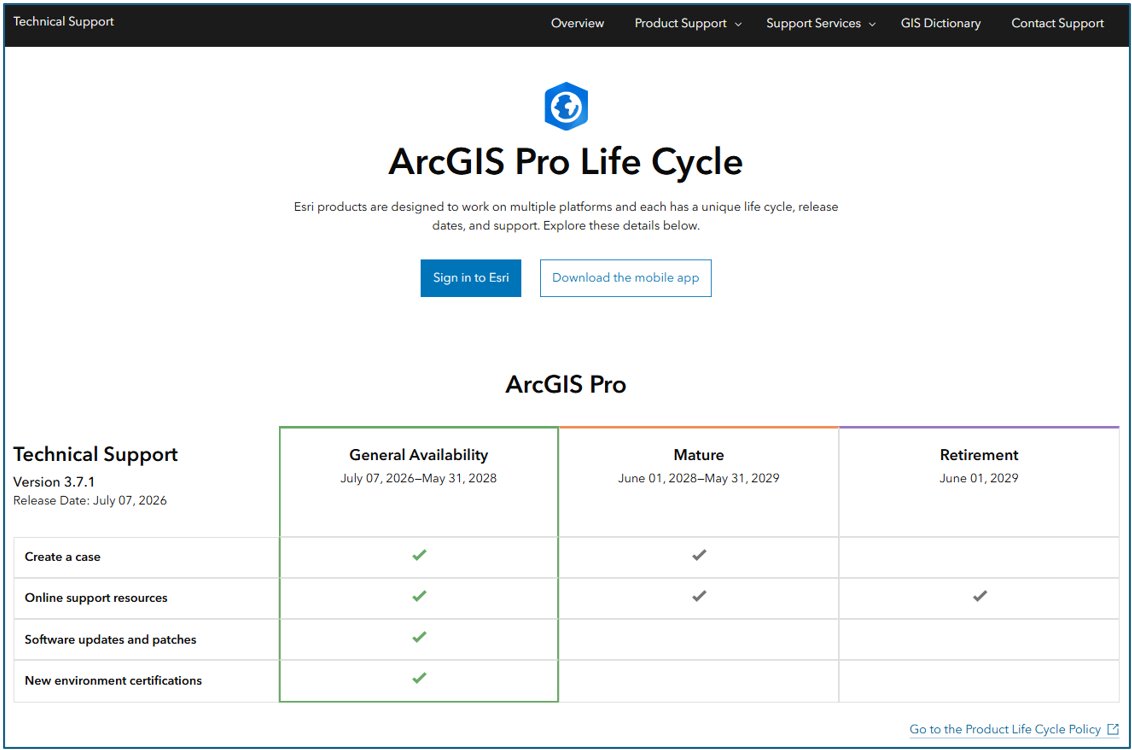
Knowing what each phase of the life cycle means before a version is retired is important to understand what is changing and what is staying the same. Today, ArcGIS Pro has two life cycle phases before a version is retired: General Availability and Mature.
General Availability is the first stage of the ArcGIS Pro product life cycle, starting with the release of a new version of the software. During this phase, the software is eligible for technical support, software patches, and new environment certification.
Mature is the final phase of the ArcGIS Pro product life cycle before retirement. In this phase, the software is eligible for technical support but does not include software patches. In other words, the software itself is not supported – rather, customers who are current on maintenance or have an active subscription have access to Esri Support Services.
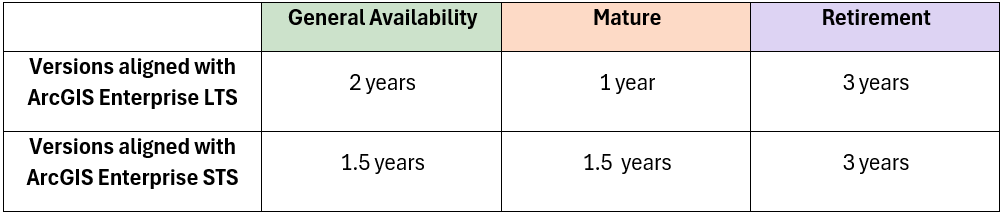
Post-ArcGIS Pro 3.8 Product Life Cycle Change
What is changing? When ArcGIS Pro 3.8 is released in November 2026, the Mature phase will be replaced with an Extended phase.
Extended is the phase of the ArcGIS Pro product life cycle before retirement. Software versions in this phase are eligible for patches. The difference between General Availability and Extended support is that once a version enters the Extended phase, Esri does not certify newer environments. Customers may use ArcGIS products with newer environments at their discretion; however, compatibility and functionality are not guaranteed. Review details about the Supported Environment Policy.
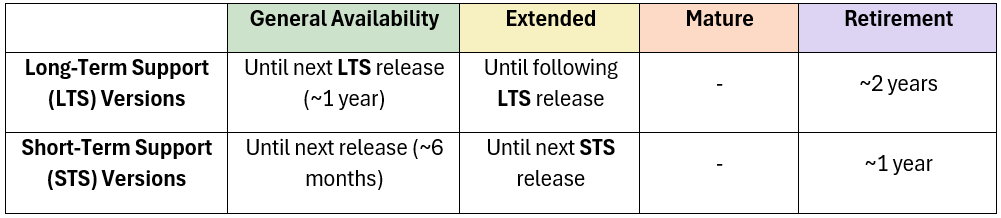
Versions in General Availability and Extended support are eligible for software patches. Short-Term Support (STS) versions will receive support for one year, shortened from 18 months. Existing versions of ArcGIS Pro through ArcGIS Pro 3.7 are not affected because their PLC timelines remain unchanged.
Will the replacement of the mature phase affect my ability to contact Esri Support Services?
No. This change marks the beginning of Esri bringing more clarity to the difference between technical support and software support. The ability to get assistance from Esri Support Services is a maintenance benefit that has no dependency on your software version. That is, if you are a customer with active maintenance or with an active subscription, you have access to Esri Support Services.
Software support is defined by the official product life cycle pages and is directly tied to software versions. When a version is supported, it is eligible to receive patches that deliver quality, security and performance updates. When a version is retired, it is no longer eligible for patching.
Long-Term Support versus Short-Term Support releases
With the PLC change in November, we are taking the opportunity to bring consistency to the terminology used between the ArcGIS Pro and ArcGIS Enterprise life cycles. Long-Term Support (LTS) versions are released together in the second quarter (usually May/June) of the year and Short-Term Support (STS) versions are released together in the fourth quarter (usually October/November) of the year.
What is the impact of this change on Network Management Releases (NMRs)?
Customers familiar with Network Management Releases (NMRs) will want to know if the November change will affect NMR updates. The ArcGIS Pro PLC change does not change the patch eligibility for ArcGIS Pro LTS versions; LTS versions remain eligible for patches for two years, with no change to the supportability of ArcGIS Pro NMR versions. ArcGIS Pro 3.8 will be an STS version (released with ArcGIS Enterprise 12.2) and the next LTS version will be 3.9 (released with ArcGIS Enterprise 12.3).
Update patterns
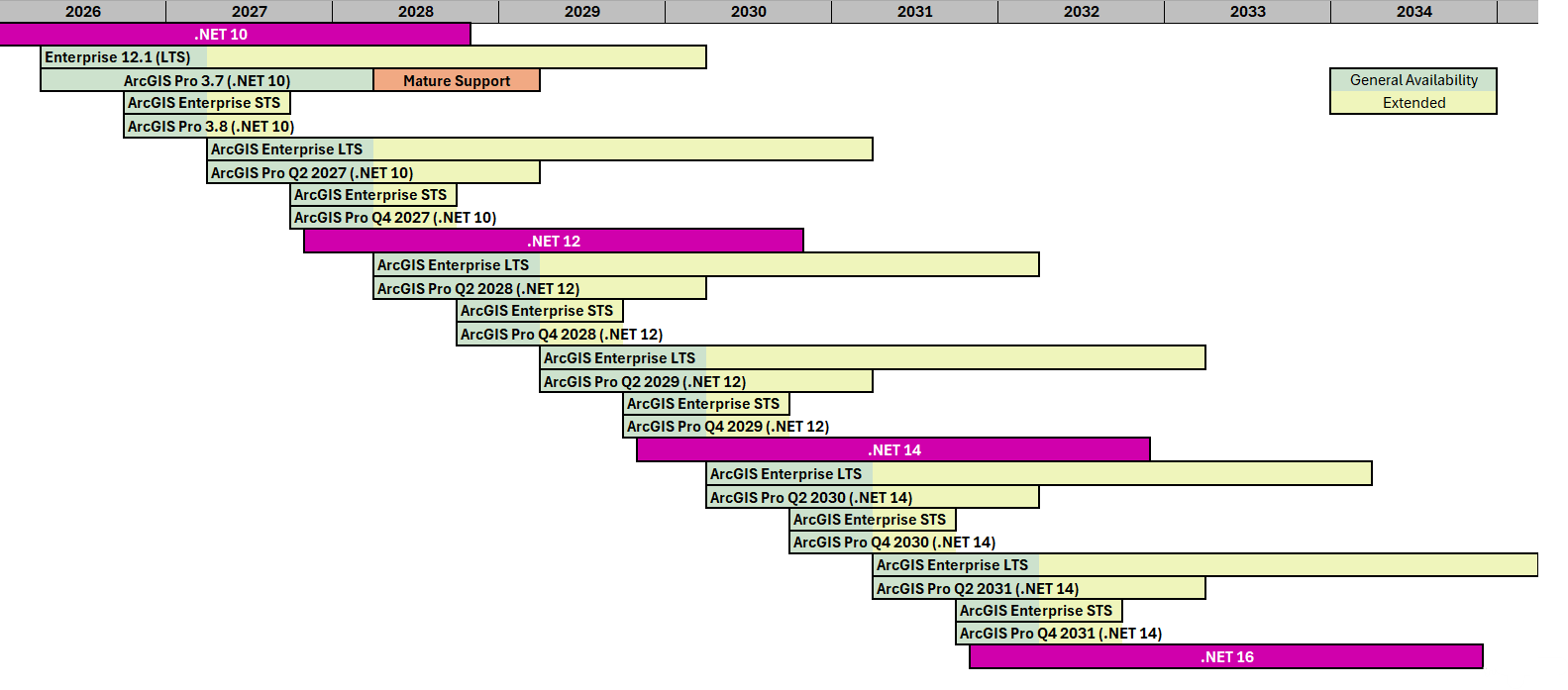
When the PLC change is initially made, it is not retroactive and will not impact the life cycles of already-released software. At that time, ArcGIS Pro 3.5, 3.6, 3.7 and 3.8 will be in General Availability. ArcGIS Pro 3.8 will be in General Availability for approximately 6 months until the next ArcGIS Pro release in Q2 2027, which will be an LTS version. At that time, ArcGIS Pro 3.8 will enter Extended support for another 6 months until the next STS version is released in Q4 2027, when ArcGIS Pro 3.8 will be retired. In total, as an STS version, it will be supported for approximately 1 year.
The next LTS version of ArcGIS Pro will be released in Q2 2027 (May/June). It will be in General Availability until the release of the Q2 2028 LTS version, and then in Extended support until the release of the Q2 2029 LTS version, when the ArcGIS Pro version released in Q2 2027 will be retired. In total, as an LTS version, it will be supported for approximately 2 years. The release cycle then repeats, with ArcGIS Pro STS versions released in Q4 (supported for one year) and LTS versions released in Q2 (supported for two years).
Common update patterns are as follows:
Every release – 2 times per year. There are ArcGIS Pro customers today that make every version of ArcGIS Pro available to their users. These customers will experience no change. Since they are always on the most up-to-date version, they are always eligible for patches.
Once per year. Some ArcGIS Pro customers may have reasons to only update their software version one time per year. Depending on the seasonality of their business, they might be updating at every Q2 release (e.g. ArcGIS Pro 3.5 to 3.7) or at every Q4 release (ArcGIS Pro 3.6 to 3.8). Regardless of their current update cycle, these customers will experience no change. Because they update one time per year, and even ArcGIS Pro STS versions will be supported for one year, they are always eligible for patches.
Less than once per year. A subset of customers have requirements that limit them to update their software less frequently than once per year. While it may have been possible for these customers to update to either Q2 or Q4 ArcGIS Pro releases in the past, under the updated life cycle, it will be necessary for them to standardize on the Q2 LTS releases since those are supported for 2 years. In practice, many customers in this situation have already adopted the Network Management Release versions. The ArcGIS Pro PLC change reinforces that moving from one LTS version to another LTS version is the correct pattern for these customers. Stated another way, customers who cannot update their version of ArcGIS Pro at least once per year must adopt ArcGIS Pro LTS versions to ensure they will always be eligible for software patches.
As noted previously, the PLC change better aligns the ArcGIS Pro and ArcGIS Enterprise product life cycles. We will be creating additional resources to enable customers to make more informed, long-term update planning decisions. Stay tuned!
Summary
The updated ArcGIS Pro product life cycle is intended to make support timelines clearer, simplify upgrade planning, and better align ArcGIS Pro with ArcGIS Enterprise. Starting with ArcGIS Pro 3.8, customers will see a more consistent distinction between LTS and STS releases, with LTS versions providing the best path for organizations that update less frequently. By using this new pattern for planning, organizations can stay eligible for software patches while choosing an update cadence that works for their business.



Commenting is not enabled for this article.