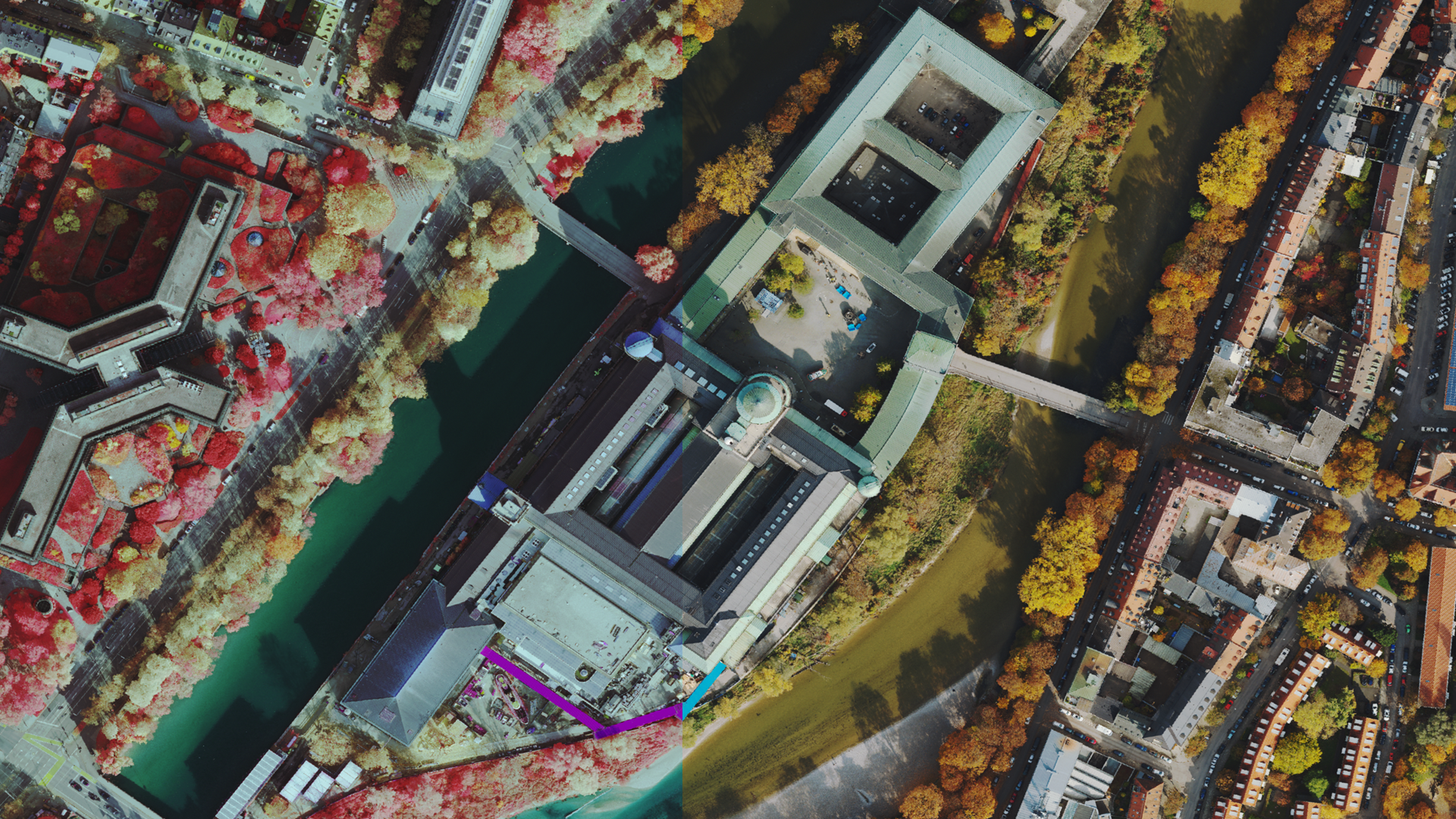
This post builds on our previous explainers on the different types of ortho images created in ArcGIS Reality, and the valuable True-Ortho product, taking the discussion one step further: when do these differences actually matter?
As geospatial workflows evolve toward automation and digital twins, AI-driven analysis, and higher expectations for geometric accuracy, the question is no longer just how orthophotos are produced but whether their pixels can be trusted for decision-making.
In this article, we explore what True Ortho really enables, why it’s increasingly worth the investment, and what you can do with it that simply isn’t possible with traditional orthophotos.
Why are traditional orthophotos reaching their limits?
Traditional orthophotos are reaching their limits because they were designed primarily for visualization, not for the precision and automation required in modern geospatial workflows. They project imagery onto a Digital Terrain Model (DTM), a bare-earth surface, producing a top-down view that works well in flat or rural areas. But as cities grow taller and workflows become more automated, the limitations of this approach are increasingly clear.
- Patch-based mosaics with low redundancy: Traditional orthophotos are assembled from image patches rather than individual pixels. Each patch is selected from a single “best” view, usually by manual editing, which means minimal redundancy. This limits the ability to detect outliers or correct inconsistencies and makes the process less repeatable for time-series analysis.
- Geometry distortion in urban areas: Buildings lean away from the sensor, façades displace, and occlusions hide streets and alleys behind tall structures. Scale varies with elevation, so features close to the camera appear larger than those farther away. Elements above ground are not in their true position and measurements are not reliable.
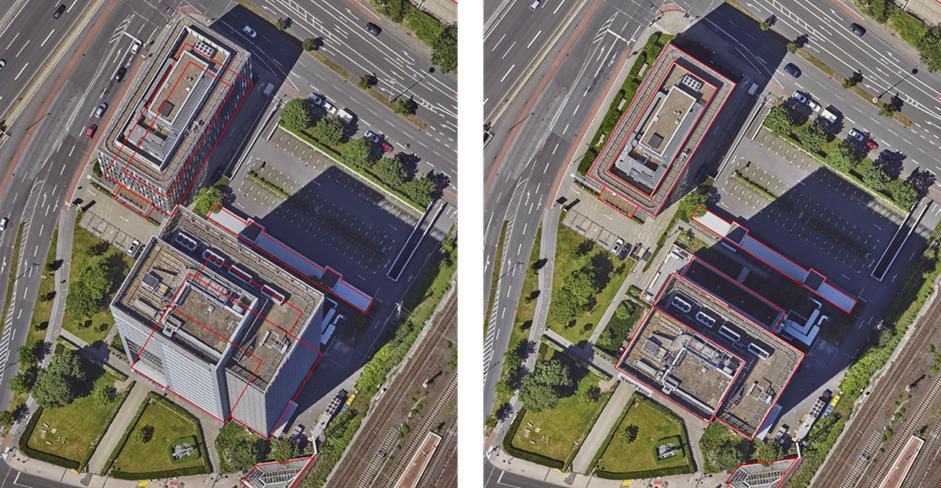
- Misalignment with vector and 3D data: Cadastral footprints, road centerlines, and BIM models rarely match the imagery without manual adjustments, creating costly QA cycles.
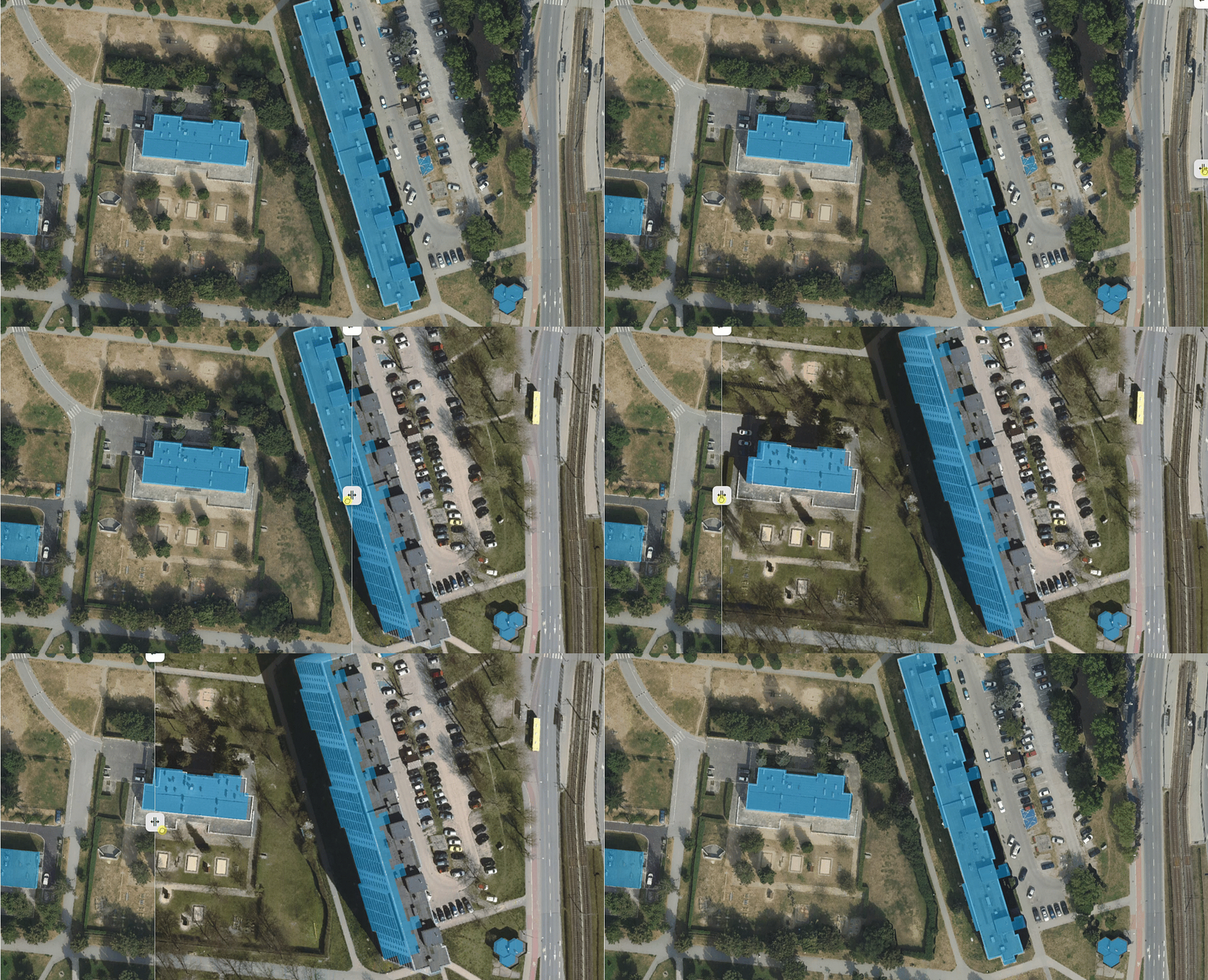
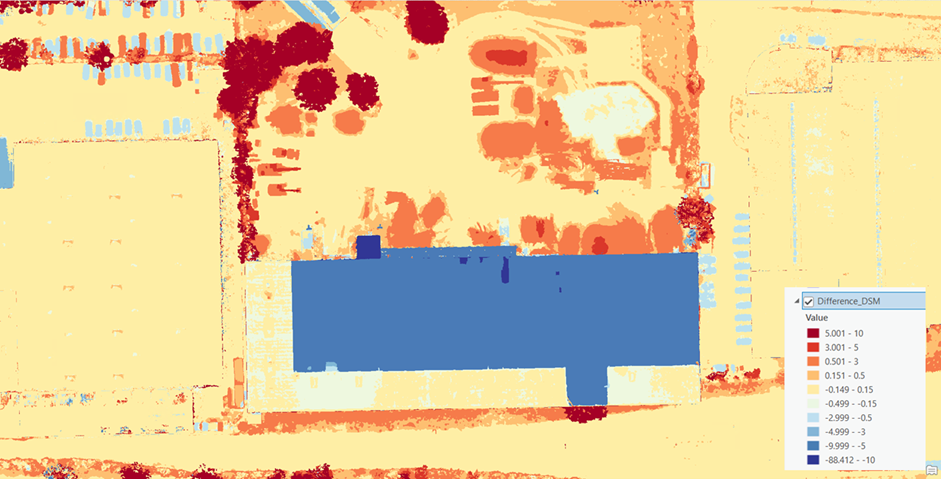
- No pixel-to-pixel link to elevation: Traditional orthophotos lack a direct correspondence between image pixels and surface heights, making it impossible to draw on the image and retrieve accurate elevation values.
- Not automation-ready: Geographic AI and feature extraction models struggle with perspective artifacts, leaning façades, and missing ground; leading to false positives, longer training times, and more manual intervention.
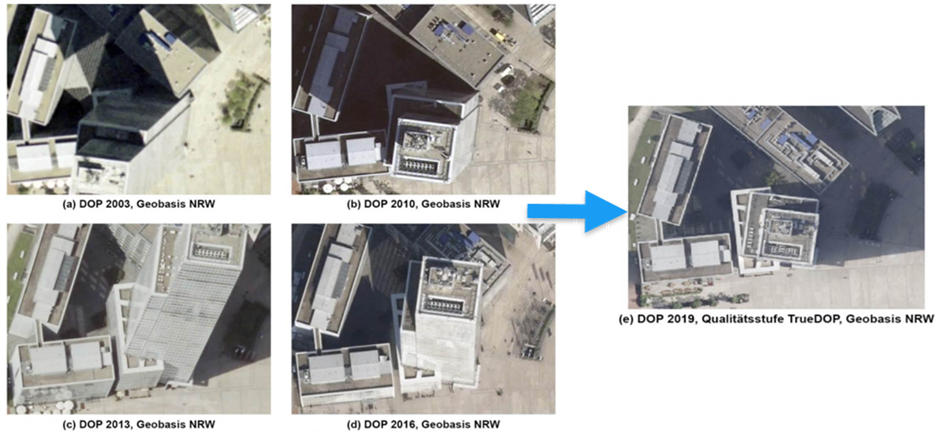
In short: traditional orthophotos were designed for visualization, not for the precision and automation demands of modern geospatial workflows.
When decisions are made off pixels, those pixels need to reflect reality. Traditional orthophotos increasingly fall short.
In an era where decisions are increasingly automated and data-driven, these limitations become bottlenecks.
How do True-Orthos overcome these limitations?
True orthophotos overcome these limitations by using a fundamentally different approach to image construction. Instead of patch-based mosaics, they use pixel-to-pixel process across multiple overlapping views, creating a dataset with high redundancy. This redundancy allows the process to detect and remove outlier values, improve consistency, and deliver a repeatable workflow, which is ideal for time-series analysis and change detection.
Key differences that matter:
- Projection on a Digital Surface Model (DSM): Every pixel in a True Ortho corresponds to a precise elevation value in the DSM. This pixel-to-pixel link enables workflows where you can draw directly on the image and retrieve accurate heights instantly. Traditional orthophotos cannot offer this level of integration.
- Vertical correction and scale preservation: Buildings stand upright, façades are corrected, and scale remains consistent regardless of proximity to the camera.
- Occlusion minimization and clean roof visibility: Ground and rooftops are visible across city blocks, enabling reliable planimetric references.
- AI and automation readiness: Distortion-free imagery accelerates feature extraction, change detection, and training for geographic AI, reducing false positives and manual QA.
In short: if your workflows involve precise geometry, urban mapping, or automation, True Ortho it’s a smarter foundation for everything downstream.
When decisions are made off pixels, those pixels need to reflect reality. True ortho does.
True orthos aren’t just a better image, they’re a smarter foundation for automation, AI, and authoritative mapping.
Can True Orthos be used at scale in real projects?
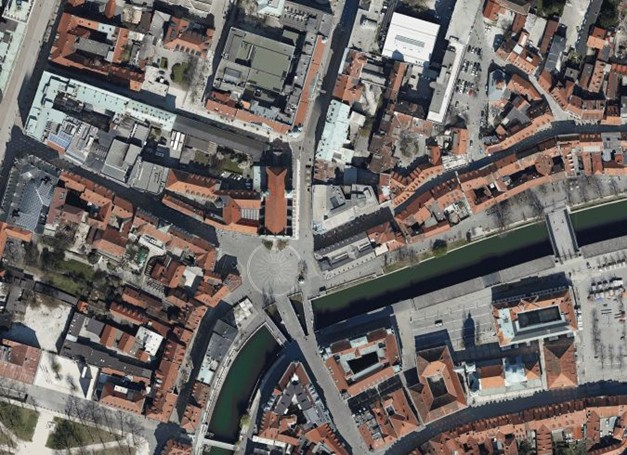
Yes, True Orthos has already been used successfully and deployed at city- and country-scale, as demonstrated by the Municipality of Ljubljana. They have successfully migrated from traditional to True Orthos for its entire urban area, demonstrating that a DSM‑based, pixel‑level fusion workflow can be both more accurate and more efficient than traditional patch‑based, traditional orthos. The project showed measurable improvements in geometric fidelity, roof alignment, occlusion reduction, and even production time.
Conclusion:
“The success of this large-scale project shows that the automatic production of a true orthophoto is already fully operational in real life. The resulting true orthophoto mosaic is of good quality and requires much less manual work than other approaches, thus enabling a substantial portion of the final project costs to be saved.”
When are traditional orthophotos still a good choice?
Traditional orthophotos are still a good choice in scenarios where geometric precision and automation are not critical.
- Flat/rural areas with low vertical relief and sparse structures.
- Quick visualization where high planimetric precision isn’t required.
- No or almost no need for automation and AI.
If your workflows are mostly rural and don’t involve AI/automation or tight geometry, traditional orthophotos remain efficient.
How do you decide between true and traditional ortho?
You can decide between true and traditional ortho by evaluating the complexity of your area and the level of accuracy your workflows require.
If you answer Yes to any of these, choose True Ortho:
- Is your area densely urban with multi‑story structures?
- Do you plan to apply automatic feature extraction, change detection, or AI?
- Do your teams invest lots of time editing seams, minimizing occlusions, or choosing “which leaning is the least bad”?
- Are decisions (permits, utilities, safety) made straight off imagery?
What can you do with True Orthos that you cannot with traditional orthophotos?
True orthophotos enable workflows that are not possible with traditional orthophotos, especially in dense urban environments and automation-driven use cases.
- Use rooftops as authoritative planimetric features.
With True Ortho, roof outlines are geometry you can build on. - Perform high-precision, object-level AI extraction in dense urban cores.
Models for solar panels, skylights, HVAC units, or rooftop vegetation perform better because their shape and size extents aren’t distorted. - Run cross‑block, corridor‑wide change detection with fewer false positives.
“Disappearance” behind buildings due to perspective is no longer masquerade as change. - Integrate with BIM/3D/City models while keeping planimetric truth.
True Ortho keeps 2D layers coherent with 3D assets due to its “true horizontal position”. - Trust your measurements (offsets, buffers, area) off imagery alone in complex cityscapes.
True Ortho enables you to do so. - Time series analysis in complex scenarios.
Analysis urban growth or infrastructure monitoring accurately.
FAQ from traditional ortho producers
Q: Will switching to True Ortho disrupt existing workflows?
A: Switching to True Ortho does not have to disrupt existing workflows, you can maintain a dual track approach: preserve traditional for legacy comparison while adopting True Ortho for all urban, sharp slopes, AI-heavy tasks. Clearly label services so consumers pick the right layer.
Q: My city has narrow streets and tall buildings. Will True Ortho still occlude ground?
A: It minimizes occlusion, but it can’t invent ground if hidden in all views. Capture planning (multi-angle, adequate overlap) is key. Still, roof visibility and vertical correction produce a far better urban base.
Q: How much better is AI on True Ortho?
A: Expect far fewer false positives/negatives for rooftop and road features, improved precision on edges, and faster training convergence. The exact lift varies by class and cityscape, but teams consistently find shorter QA and less manual intervention.
Q: Is True Ortho only about buildings?
A: No. Any vertical feature (bridges, elevated tracks, sound walls, natural sharp slopes) benefits. Road markings and curb delineation often become more stable as well.
Q: Is True Ortho worth the additional effort?
A: Yes. True Ortho is worth the additional processing effort when considering the total cost of quality, automation gains, and reduction in manual corrections. Expect a total cost of quality dropping due to fewer correction passes, tighter QA and usually no manual editing. Expect a higher AI payback as these cleaner inputs create better models, with fewer exceptions in faster iterations. Expect a decrease in operational risk by removing misalignments due to perspective distortion.
Experiment and Stay connected
In ArcGIS Reality, you can configure your next urban project for True Ortho and its underlying DSM, validate with AI pilots, and publish with clear metadata so consumers know they’re using the geometry‑faithful layer. Your teams, and your models, will thank you!
ArcGIS Reality also allows you to generate both traditional and true orthophotos, so you can make your own comparisons.
To learn more about ArcGIS Reality, you can visit our product page and check the resources. Contact us for more information.
If you have any questions, ideas or simply want to share the results of your experiments, we’d love to hear from you! Visit the Esri Community page and let us know what you think.

Article Discussion: