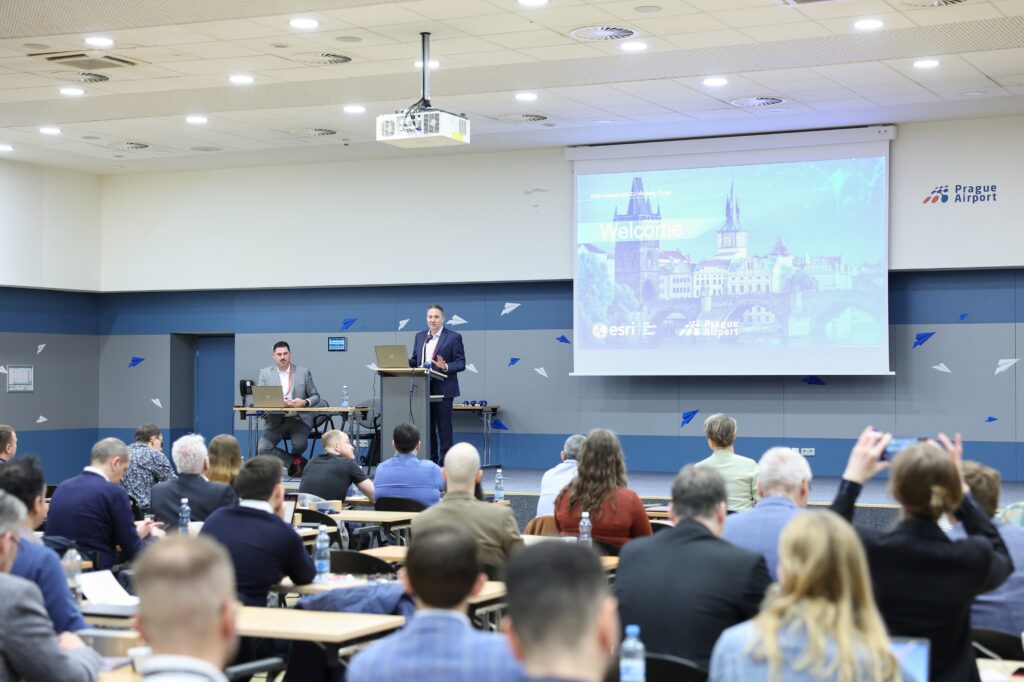
The European Aviation GIS Working Group took flight once again, bringing together aviation leaders across airports, civil aviation authorities, air navigation service providers, and industry for two days of focused discussions in Prague, Czech Republic. Hosted by Prague Airport, this working group created a space for the aviation community to come together, share challenges, highlight successes, and explore how geospatial technology supports the industry.
Growing the Community
Now in its fourth consecutive year, the European Aviation GIS Working Group has grown into a staple for major aviation stakeholders across Europe. What began with 15 attendees in Rotterdam in 2022 expanded to nearly 100 participants from 40+ aeronautical agencies and 20+ European countries this year.
That growth reflects more than rising attendance. It represents increased interest into how geographic information systems (GIS) can help aviation organizations address challenges, modernize workflows, and continuously learn from one another across agencies, roles, and regions.
The Role of Geospatial Data in Aviation
This working group reinforced what has become clear overtime: the aviation industry is constantly evolving, yet one constant remains. GIS continues to serve as a vital link uniting all aviation stakeholders. Location underpins the advancement of aviation, supporting progress while ensuring the highest safety standards are maintained in the industry.
Throughout the working group, airports, civil aviation authorities, and air navigation service providers delivered engaging presentations illustrating how the collaborative use of geospatial data empowers the aviation community to meet regulatory requirements across the EU. Presenters highlighted how tools like GIS have enabled organizations to harmonize processes across multiple divisions, further reinforcing the importance of documenting and developing workflows. By working together and sharing best practices, these diverse stakeholders are streamlining operations and reliably managing data, strengthening the foundation of European aviation.
Topics That Shaped the Conversation
The working group featured a wide range of applications of geospatial technology covering topics like:
- Aeronautical Data Quality (ADQ): Representatives from Prague Airport and Copenhagen Airport discussed enhancements made using GIS to meet Data Quality Regulatory Requirements. Copenhagen Airport further demonstrated how adopting step-based workflows with GIS has improved their ADQ processes and operational consistency.
- Data Preparation and Integration for UAS: Insights were shared on preparing and integrating data for unmanned aircraft systems (UAS), which is increasingly relevant as these technologies become more prevalent in European airspace.
- Authoritative Geospatial Data for a Nation: The significance of establishing authoritative geospatial datasets at the national level was explored, highlighting the value of reliable information for decision-making and regulatory compliance.
- GeoAI in Action: The integration of geospatial artificial intelligence (GeoAI) was demonstrated, showing how advanced analytics are driving innovation and operational improvements.
- Real-Time Integration for the Aviation Industry: The importance of real-time data integration was emphasized, showcasing how timely information can improve responsiveness and efficiency within aviation operations.
All together, these topics reflect many of the ways geospatial technology is being applied to the industry and how much the community gains from sharing that progress openly.
Why This Working Group Matters
What began as a small gathering has now grown into a valuable and collaborative community that brings together aviation stakeholders across Europe. As participation continues to expand, so does the opportunity for organizations to learn from peers, build connections, and discover GIS is being applied to modernize workflows.
This growth reflects a shared commitment to advancing aviation through geospatial innovation. We invite more agencies and stakeholders to join us in shaping the future of aviation in Europe. Your engagement helps strengthen this community, enabling safer skies and more effective collaboration. Together, we can chart a confident path forward.
To get involved or learn more about our EU Aviation GIS Working Group, reach out to us at aero@esri.com.