Customer Spotlight Story
PLN is laying the digital foundation for one of the most ambitious smart grid initiatives in the world.
As Indonesia’s state-owned electric utility, PLN operates across more than 17,000 islands, serving over 96 million customers through an extensive network of generation, transmission, and distribution infrastructure. Managing electricity across an archipelagic nation of nearly 2 million square kilometers presents extraordinary operational complexity, requiring a highly connected and intelligent utility network to support Indonesia’s long-term energy transition goals.
PLN’s modernization strategy focuses on building a nationwide super grid that connects renewable energy resources, balances supply and demand across islands, and supports future smart grid operations. GIS serves as the operational backbone of this effort by providing the network connectivity and visibility needed across generation, transmission, distribution, customers, and distributed energy resources.
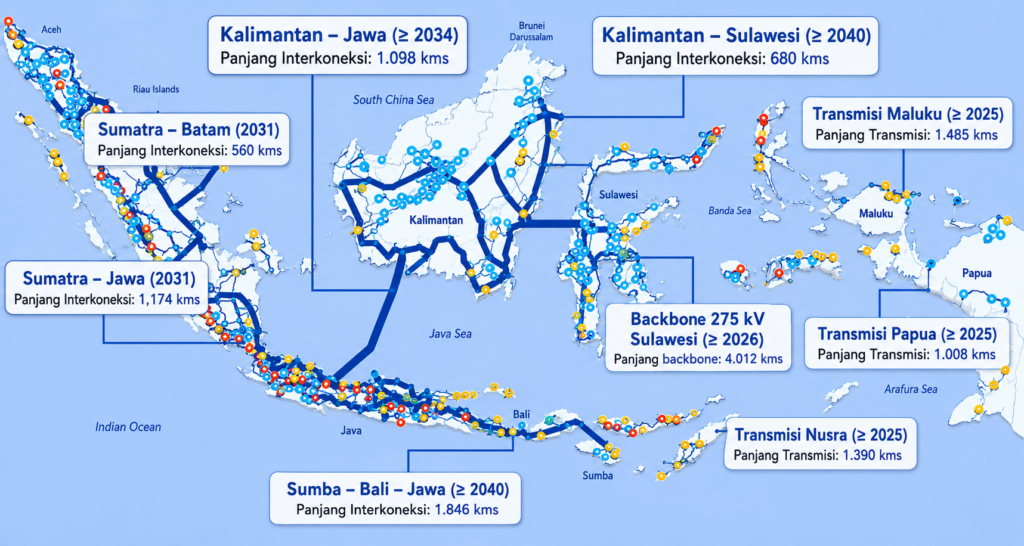
PLN’s super grid strategy is designed to connect renewable energy resources across Indonesia’s major islands.
CHALLENGE
PLN faced significant operational and technological complexity in modernizing one of the world’s largest geographically distributed utility systems, with more than 1 million circuit-kilometers of distribution lines and nearly 88,000 circuit-kilometers of transmission infrastructure across remote islands and diverse terrain.
Its existing GIS environment relied on legacy GIS with dozens of disconnected spatial layers and feature classes representing different asset types and voltage networks. This fragmented structure created slow queries, manual topology validation, limited tracing capabilities, and poor enterprise interoperability.
At the same time, PLN needed to integrate enterprise systems, including Maximo, SAP, SCADA, OMS, DMS, and customer applications, while supporting renewable energy integration and bidirectional power flow across increasingly decentralized energy networks. Existing systems lacked the network intelligence required to support distributed solar, microgrids, and future smart grid operations.
SOLUTION
PLN selected ArcGIS Utility Network as the strategic foundation for its smart grid modernization initiative. Following joint planning sessions with Esri Indonesia and benchmarking activities with global utilities, PLN developed a phased adoption strategy designed to modernize operations while minimizing operational disruption. A major component of the project involved consolidating PLN’s legacy GIS structure into a modern ArcGIS Utility Network data model. The organization reduced dozens of fragmented spatial layers into a smaller set of core feature classes using attribute domains and subtypes to support detailed asset classification and improved interoperability.
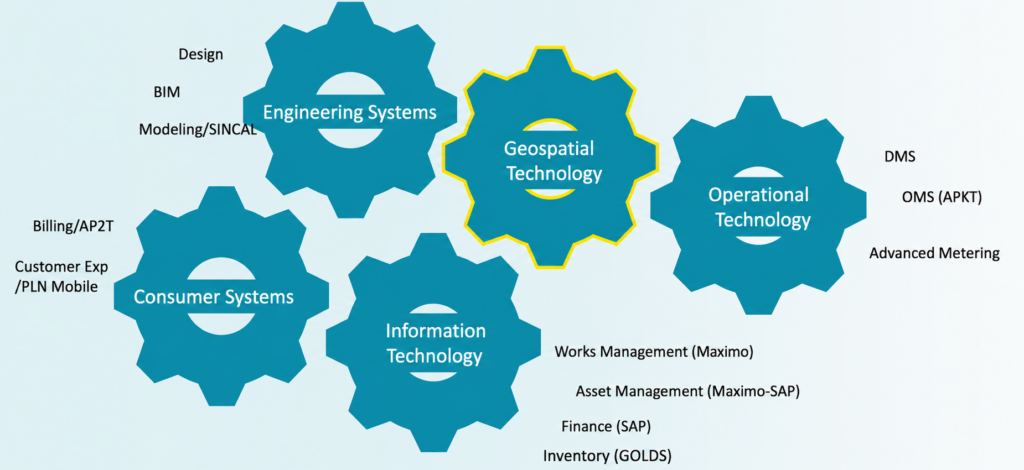
PLN positioned geospatial technology at the center of enterprise operations.
PLN repositioned GIS as the operational core of the enterprise. Rather than serving as a standalone mapping platform, ArcGIS Utility Network became the geospatial foundation connecting operations, engineering, customer systems, analytics, and asset management.
Implementation was structured into pre-migration, pilot migration, and post-migration phases, creating a scalable modernization framework that can be expanded nationwide.
“ArcGIS Utility Network is more than a technology upgrade. It is the foundation for modernizing Indonesia’s electric grid and creating a single source of truth across the enterprise.” — Very Fernando, GIS Manager, PLN
RESULTS
PLN established a scalable ArcGIS Utility Network foundation to support long-term smart grid modernization across Indonesia, transforming its fragmented legacy GIS environment into a standardized enterprise network model.
The migration simplified PLN’s legacy GIS architecture, reducing operational complexity while creating a more connected and realistic representation of the electrical system. ArcGIS Utility Network also improved tracing and connectivity analysis. While the legacy system supported only basic point-to-line relationships, PLN can now perform customer-level tracing, outage analysis, switching simulations, and maintenance impact assessments.

ArcGIS Utility Network enables customer-level tracing, advanced outage analysis, enterprise integration, and smart grid capabilities.
PLN also strengthened enterprise interoperability by integrating GIS more closely with operational and business systems across the organization. The new architecture supports stronger coordination between engineering, operations, customer systems, asset management, and enterprise analytics platforms.
The phased implementation strategy allowed PLN to modernize incrementally while maintaining operational continuity. By dividing the program into pre-migration, pilot migration, and post-migration phases, the utility established a repeatable framework for scaling deployment across additional regions and operational units nationwide.
BENEFITS
PLN’s ArcGIS Utility Network modernization initiative improved operational visibility and network intelligence across the enterprise. Engineering and operations teams now work from a more connected and accurate representation of the electrical system, improving tracing, planning, analysis, and operational coordination.
By positioning GIS as the central operational platform, PLN also improved interoperability among key operational environments. This centralized geospatial architecture supports faster information sharing and more consistent workflows across the utility.
ArcGIS Utility Network strengthened PLN’s readiness for future smart grid operations by supporting bidirectional power flow analysis, distributed energy resource integration, renewable energy expansion, and advanced grid capabilities required for Indonesia’s evolving energy landscape.
Improved tracing and network modeling also support outage management, maintenance planning, operational simulations, infrastructure resilience, and future digital twin and analytics initiatives.
The modernization effort additionally supports Indonesia’s sustainability and electrification goals by enabling more efficient integration of renewable energy resources across geographically distributed regions and strengthening PLN’s long-term operational resilience. While the transition presents significant challenges, the long-term benefits improve efficiency, enhanced asset resilience, and compliance far outweigh the risks. Embracing the ArcGIS Utility Network is the critical step that positions PLN to achieve its objectives for a smart grid and sustainable energy future.
NEXT STEPS
PLN plans to continue expanding ArcGIS Utility Network deployment across the organization while scaling pilot migration activities into broader operational rollouts. Future implementation phases will focus on additional data migration, enterprise integration, operational optimization, and expansion of advanced smart grid capabilities.
The utility also plans to continue strengthening interoperability between GIS, operational systems, customer platforms, engineering applications, and enterprise asset management systems. These efforts will support future digital twin initiatives, distributed energy resource management, and enterprise-wide operational intelligence programs.
As Indonesia advances its renewable energy and electrification objectives, PLN’s modernization program will continue to serve as the digital foundation for a smarter, more resilient, and more sustainable national energy infrastructure.
SUMMARY
Challenge: PLN needed to modernize a fragmented legacy GIS environment and integrate enterprise systems across one of the world’s largest and most geographically distributed utility networks.
Solution: PLN adopted ArcGIS Utility Network as the geospatial foundation for its smart grid modernization strategy, creating a centralized and scalable enterprise network model.
Results: PLN transformed disconnected legacy network data into a standardized ArcGIS Utility Network architecture, improving tracing, connectivity analysis, and enterprise interoperability
Benefits: The modernization initiative improved operational visibility, smart grid readiness, renewable energy integration, and long-term operational resilience across PLN’s nationwide electric infrastructure.
.