Customer Spotlight Story
Greer Commission of Public Works (Greer CPW) provides electric, water, wastewater, and natural gas services across a growing service area in the Upstate of South Carolina. The utility’s natural gas operations began in 1957, and today Greer CPW serves more than 33,800 gas customers, making it one of the largest municipal gas systems in the Carolinas.
CHALLENGE
Greer CPW’s natural gas operations faced a critical challenge: the utility’s gas operations manager, who had been with the organization for 47 years, was retiring, and much of the system knowledge was maintained through his extensive experience and departmental spreadsheets. The utility needed to modernize its GIS to capture institutional knowledge, improve downstream tracing for damage response, support regulatory compliance reporting, and enable field crews to rely on maps instead of calling supervisors for information.
Before the UN migration, Greer CPW’s natural gas operations relied on manual processes, static maps, and institutional knowledge to manage the network. When field crews needed to identify customers downstream of a gas line damage, they manually counted meters on a map or consulted departmental records tracking which regulator stations fed which subdivisions. Key network attributes, including pressure zones and cathodic protection systems, were maintained outside GIS through the expertise of long-tenured operations staff, and the existing data model did not support reliable network tracing. With the gas operations manager retiring, decades of institutional knowledge were at risk of leaving with him. Paper maps and direct supervisor consultation remained standard practice for field crews. Modernizing the network became essential to improve operations, support workforce transition, and sustain growth.
SOLUTION
Greer CPW migrated its natural gas network from a legacy geometric network to the ArcGIS Utility Network, completing the project in just over five months with only two internal resources and support from SSP Innovations. The project included updating the data model, enabling editing and tracing in ArcGIS Pro, supporting integration needs, and providing targeted training. SSP created a parallel GIS environment so Greer CPW could migrate, test, and validate before going to production.
“The number of people who are now generally enthusiastic about the UN and its mapping capabilities has grown significantly–far more than any point in the past. You would be hard pressed to find someone who cannot access their maps through mobile devices.”— Dan Espinosa, Technical Services Manager, Greer Commission of Public Works
The implementation followed a structured readiness process: data assessment, pilot migration, mock migration, and production migration. Greer CPW completed targeted data cleanup before migration. The team standardized attributes and domains while avoiding unnecessary structural changes. Training was tailored to Greer CPW’s needs, combining Utility Network editing, ArcGIS administration, and ongoing support. The project maintained weekly touchpoints and delivered comprehensive post-go-live support.
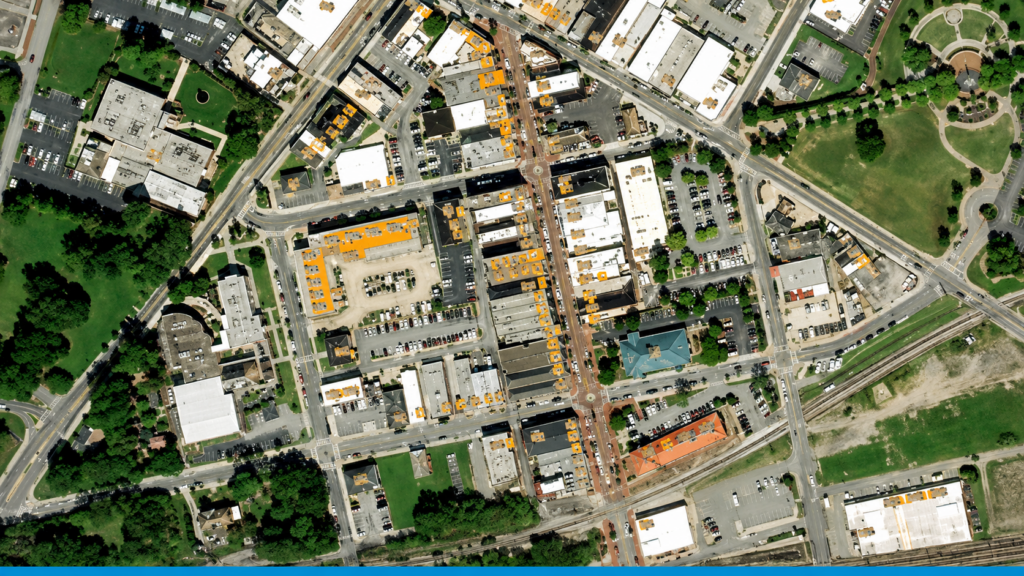
Aerial map details Greer CPW‘s gas network.
PARTNER
SSP Innovations provided end-to-end utility network migration support through the SSP Accelerate implementation approach, designed to make utility network adoption practical, fast, and affordable for utilities of all sizes. SSP’s role included data readiness assessment, migration methodology and execution, parallel environment setup for testing and validation, targeted training combining utility network editing and ArcGIS administration, deployment support, and continued post-go-live assistance. SSP works with utilities across North America, providing GIS managed services, consulting, and implementation support. The SSP Accelerate program uses a structured delivery model with defined guardrails and proven foundations to reduce complexity, shorten the path to production, and support lean internal teams.
PROJECT TEAM
Greer CPW’s Natural Gas Department, GIS team, customer service, and billing collaborated closely on the project. Dan Espinosa and Chris Wilson led internal coordination and readiness, with SSP Innovations supporting implementation and training.
RESULTS
Greer CPW completed its utility network migration in just over five months with only two internal resources through the coordinated efforts of its Natural Gas Department, GIS team, and SSP. Field adoption was immediate. Personnel who had relied on paper maps now use online maps on mobile devices for daily work. Supervisors and managers can run accurate downstream traces during damage events, eliminating manual meter counting and spreadsheet lookups.
“Many smaller utilities assume the Utility Network is only for larger organizations, but that hasn’t been our experience. We approached it as a modernization initiative rather than a simple upgrade, emphasizing future integrations with outage management, SCADA, and AMI. With strong leadership support, the benefits can be transformative regardless of utility size.”— Dan Espinosa, Technical Services Manager, Greer Commission of Public Works
When Greer CPW develops models for future growth, the improved network topology streamlines the modeling process, reducing planning costs and shortening the time from data delivery to actionable results. Information captured through the work order process now transfers back to GIS, giving management real-time visibility into system performance. As well, decades of institutional knowledge are now documented and preserved. Greer CPW is better positioned for future integrations, broader system modernization, and additional utility network migrations using lessons learned from the implementation.
SUMMARY
Challenge: Greer CPW risked losing decades of critical natural gas system knowledge with a longtime operations manager’s retirement, while manual maps, spreadsheets, and limited GIS tracing made field response and regulatory reporting manual and time-consuming.
Solution: Greer CPW migrated its natural gas system to ArcGIS Utility Network in just over five months, modernizing its data model, enabling reliable network tracing, standardizing key information, and training staff with support from SSP Innovations.
Partner: SSP Innovations guided the migration through its SSP Accelerate approach, providing data assessment, testing environments, migration support, targeted training, deployment assistance, and post-launch support for Greer CPW’s lean internal team.
Results: Field crews quickly adopted mobile GIS maps, supervisors gained accurate downstream tracing, institutional knowledge was preserved in GIS, planning and modeling became more efficient, and Greer CPW established a stronger foundation for future system integrations and modernization.