The Problem With How Multifamily Deals Get Found
The multifamily investment market has a sourcing problem that rarely gets named directly. Most acquisition teams operate deal-flow-first. They see an opportunity, underwrite the asset, and then validate the market around it. The question being answered is: is this deal good? The question not being asked is whether this location was the right starting point.
Those are not the same question.
Location has always been the defining variable in multifamily performance. Proximity to employment corridors, transit access, quality of nearby schools, trajectory of neighborhood composition: these are the factors that determine whether a property retains tenants and appreciates in value. The challenge is that those factors are distributed unevenly across geography, and that unevenness plays out at a grain finer than most analytical tools were designed to address.
The census tract is the right unit of analysis. Typically, a few thousand residents, small enough to have coherent economic character, large enough to carry reliable transaction data. Working at that resolution is harder. It requires integrating more data sources, processing more layers simultaneously, and maintaining analytical coherence across a national footprint. It is also, RiseSpot concluded, the only way to give investors an honest picture of what they are buying into.
What RiseSpot Built and Why Esri Was the Foundation
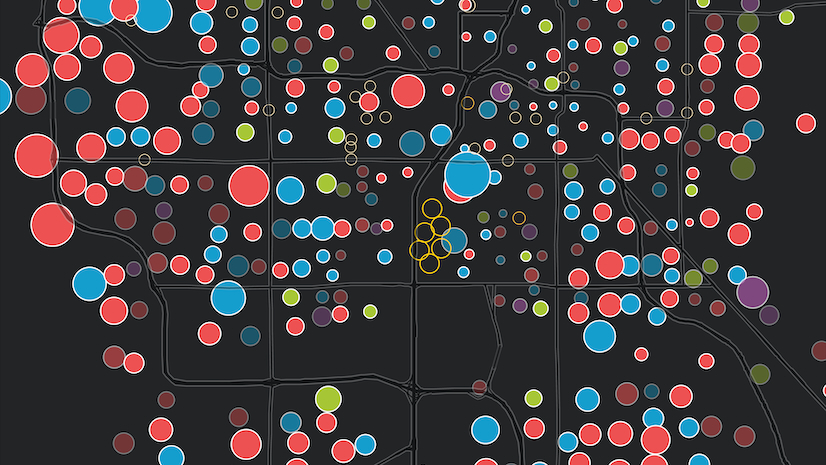
RiseSpot’s platform scores every US census tract by expected capital gains over the next three to five years. That score, which the company calls the CG Prediction Tier, consolidates inputs across more than a dozen data sources: employment growth, vacancy rates, planned transportation investment, demographic forecasts, rent dynamics. The result is a single, spatially grounded metric. The map is not illustrative. It is the product.
The choice of Esri’s ArcGIS as the platform’s spatial foundation was an architectural decision, not a vendor selection.
The most critical data sources RiseSpot needed to build its predictive models are native to Esri’s ecosystem. Metropolitan Planning Organizations publish transportation project data in ArcGIS formats. The Department of Housing and Urban Development distributes job proximity datasets through ArcGIS REST APIs. The Census Bureau’s geographic boundaries are designed for GIS integration. Building on Esri was about data interoperability at the level the model required.
Spatial reasoning is not a feature added on top of a financial model. It is the foundation the predictive models are built on.
“For RiseSpot, spatial reasoning is not a feature added on top of a mathematical model,” said Ruthy Dahan-Portnoy, founder and CEO. “We needed data interoperability, and GIS is the foundation the predictive models are built on, which made Esri’s ArcGIS technology the natural choice from day one
The practical implications show up in how the platform handles scale. Processing tract-level data for every county in the United States, harmonizing inputs from sources with incompatible formats and update schedules, rendering that analysis fluidly as users filter and explore: these are engineering problems that depend on a spatial infrastructure robust enough to support them. Esri provides that infrastructure. The analytical work RiseSpot does on top of it is entirely their own.
The MPO Signal: A Data Story Only Geography Could Tell
One of the more counterintuitive findings in RiseSpot’s model is the predictive weight carried by Metropolitan Planning Organization transportation projects. MPO plans represent prioritized, federally funded transportation investments. They are the places where state and local planning authorities have concluded that current transportation will not meet future demand.
The implication for multifamily investment is direct. An MPO decision to fund a light rail extension or a major interchange upgrade reflects accumulated intelligence about where population growth and employment are expected to go. It is a leading indicator. Most investors never see it, because most platforms are not built to integrate and surface it.
RiseSpot built the capability to ingest, map, and model that MPO data and found it to be among the strongest predictors in their CG Prediction Tier. That finding is only visible if you are working in a spatial environment sophisticated enough to connect planning agency data to investment-grade analytics. That connection is what Esri makes possible.
A Different Definition of Speed
The industry talks about speed-to-insight as a competitive advantage. The conversation usually stops at dashboards and data refresh rates. RiseSpot offers a different definition.
When an acquisition professional applies filters for vacancy rate, employment growth trajectory, and expected capital gains tier, the platform returns a national map showing only the tracts that satisfy all three conditions. Available deal flow within those tracts is immediately accessible. The workflow is faster not because the interface loads quickly, but because the starting question has changed. The investor is no longer asking whether a specific deal holds up. They are starting from the geography that performs.
That inversion is meaningful. And it is only possible because the spatial foundation underneath the platform can support that level of simultaneous analysis without degrading the user experience.
What This Means for the Broader CRE Ecosystem
RiseSpot’s story matters beyond its own product category. It is evidence of something the CRE industry has been slow to internalize: that Esri’s ArcGIS platform, in the hands of practitioners who understand both their domain and spatial reasoning, produces capabilities the market had no previous access to. Not incremental improvements on existing tools. New capabilities.
The commercial real estate industry is preparing for a different market environment. Rate trajectories suggest deal flow will accelerate. In that environment, investors who can identify high-probability locations before consensus forms will have a structural advantage. Investors who are still screening deals before screening locations will be playing catch-up.
RiseSpot is not the only company that has reached this conclusion. They are among the first to build a commercial-grade platform around it, at national scale, on a spatial foundation rigorous enough to support the analytical weight the problem demands. That is what Esri enables. And that is the argument this series intends to make, one company at a time.
If data is the language of real estate, geography is its grammar.

Read the full RiseSpot case study: https://www.esri.com/en-us/lg/industry/real-estate/stories/risespot-uses-location-intelligence-guide-multifamily-real-estate-investment
About This Series
Some of the most compelling demonstrations of what Esri’s ArcGIS makes possible are being written by PropTech startups and real estate practitioners who have discovered that location intelligence is not just a feature. It is a business model.
Powered by Place is a blog series dedicated to those companies and the people building them. Each installment profiles an organization that has built a differentiated product or service on the Esri platform and, in doing so, created capabilities the commercial real estate industry had no previous access to. This series examines what they built, the problem they solved, how Esri’s capabilities made it possible, and what their success reveals about the untapped potential of geospatial technology in CRE.
Whether the use case is predicting the next high-growth neighborhood, identifying climate-exposed assets at scale, or overlaying foot traffic patterns with demographic forecasts to guide retail expansion, the companies in this series share a common insight: the most powerful innovations in commercial real estate are built on geography.