

Homelessness is a public welfare crisis impacting over 777,000 people in the United States as of 2024. More than 24 percent of people experiencing homelessness are in California. This complex issue is driven by housing shortages, inflation, and other factors.
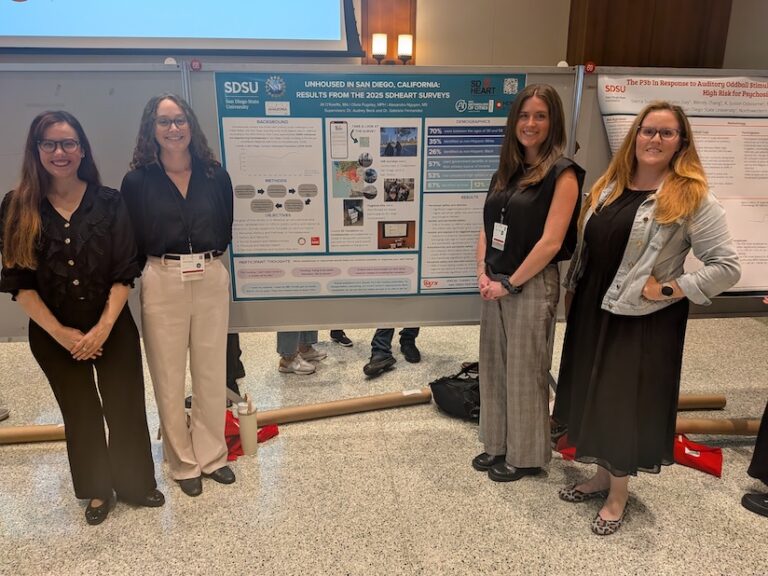
A new project from the San Diego Homeless and Health EquAlity Research Team (SDHEART) consortium is investigating the underlying factors that contribute to homelessness. Using GIS to map homeless encampments and geospatial AI to track their movement over time, researchers are exploring the social and environmental factors that play a part in people’s experiences—encouraging collaboration with other stakeholders and community members to provide targeted support.
A Hub for Research and Collaboration
SDHEART was created by faculty from the Center for Human Dynamics in the Mobile Age (HDMA Center) at San Diego State University (SDSU). Founded in 2019, it serves as a hub for interdisciplinary and collaborative human dynamics research projects. The latest project from the HDMA Center, funded by the National Science Foundation, is designed to address homelessness in the San Diego area.
The project seeks to understand the socio-environmental factors that influence the movement patterns of homeless encampments. The goal is to generate data that informs policy and targeted interventions for those experiencing homelessness in San Diego County. A key part of this project was the creation of SDHEART.
This timely initiative brings together a multidisciplinary consortium of city and county agencies, nonprofit groups, students, and academic partners to develop data-driven solutions to homelessness. Participants address this serious issue through dashboards, workshops, research hackathons, exhibitions, and educational initiatives.
Exploring the Dynamics of Homelessness with AI
HDMA uses advanced geospatial AI to analyze patterns affecting people experiencing homelessness in San Diego County. This methodology applies deep learning models to large GIS datasets to better understand the patterns and factors impacting specific populations over time. In the center’s project, changes detected in homeless encampment locations were linked to factors such as economic hardship and lack of affordable housing. Understanding these trends can help mitigate the underlying causes that contribute to homelessness.
“Our findings can inform targeted interventions such as where to place services, how to design mobile health programs, and which populations are most at risk. They can also support proactive, data-driven policy and planning,” says Dr. Gabriela Fernandez, faculty and graduate adviser of the Master of Science in Big Data Analytics Program at SDSU. Fernandez is also coprincipal investigator at the HDMA Center and director of the Metabolism of Cities Living Lab within HDMA.
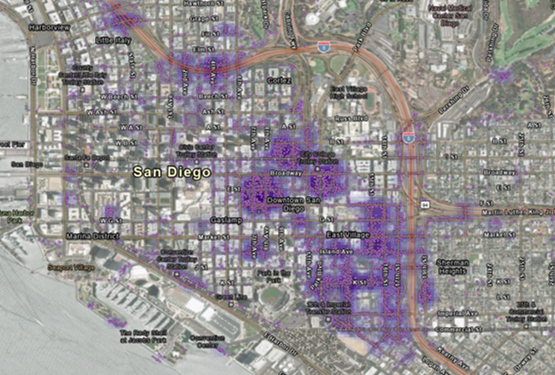
The project integrates AI, GIS, and big data fusion methodologies that combine spatial, environmental, and socioeconomic data to generate actionable insights for decision-making. Qualitative methods such as interviews, focus groups, and observation also helped researchers map and analyze the dynamics of homeless encampments in San Diego from 2014 to 2025.
Deep learning models are used to identify where encampments shift within the city and how they evolve over time. To train the models, SDSU students labeled images to identify visual features such as tents, makeshift structures, and the locations where people who lack housing congregate. This allowed the models to detect and classify those features accurately.
The deep learning models support large-scale visual surveys in which imagery is consistently analyzed to detect, map, and monitor encampments. These tasks would otherwise be too resource intensive to conduct manually, according to Fernandez.
Analyzing Data with ArcGIS
SDHEART used ArcGIS Online to manage and integrate spatial datasets, including geocoded survey responses and mapped encampment locations. The team also visualized data through interactive dashboards that display maps, statistics, and survey indicators to track progress and changes. The dashboards—built with a combination of ArcGIS Online, ArcGIS Experience Builder, and ArcGIS Dashboards—were initially made to help SDHEART identify high-density areas with larger concentrations of unhoused people and services so the consortium could conduct in-person outreach.
The dashboards and data are shared with key stakeholders in the SDHEART consortium, including the San Diego Metropolitan Transit System and the Regional Task Force on Homelessness San Diego. The results are displayed in the Homeless Density and Resources Dashboard.
The team deployed ArcGIS Survey123 during outreach events to collect survey data in real time—in both Spanish and English—from unhoused individuals using a custom digital form. ArcGIS Pro was then used to analyze the collected data, including geocoded survey responses, reported needs, access to essential services like health care, and conditions observed in encampments.
The analysis compared neighborhoods by combining data within defined areas to show how conditions, access to services, and lived experiences differ across the county. Data for the project includes a mixture of open-source datasets covering land use, zoning, socioeconomic data, and the locations of services for people experiencing homelessness. Mapping was then used to visually highlight locations with recurring challenges, helping guide targeted support and planning efforts.
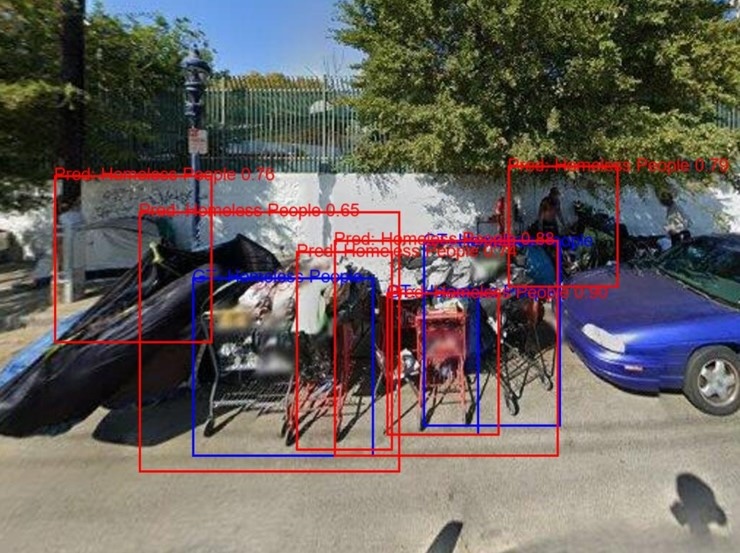
The preliminary findings of the project show a shift in encampment locations away from traditional downtown neighborhoods to more dispersed suburban and industrial areas. This shift correlates with factors like city housing development patterns and policing strategies. The results also highlight urgent needs around food access, shelter safety, and health care, especially among women. By analyzing photos along with survey responses and displaying results in maps and dashboards, the team made these patterns easier to see, using them to guide more targeted support.
Increasing the Project’s Impact
SDHEART plans to extend this project to other parts of San Diego County and present its findings at the 2026 Esri User Conference. The HDMA team is developing geospatial AI workflows that help visualize important patterns like spatial trends and neighborhood-level disparities, explains Fernandez. For example, maps can highlight forced displacement following encampment clearances or service deserts where people relocate without access to support services. These visual outputs help agencies and nonprofits prioritize interventions and coordinate responses.
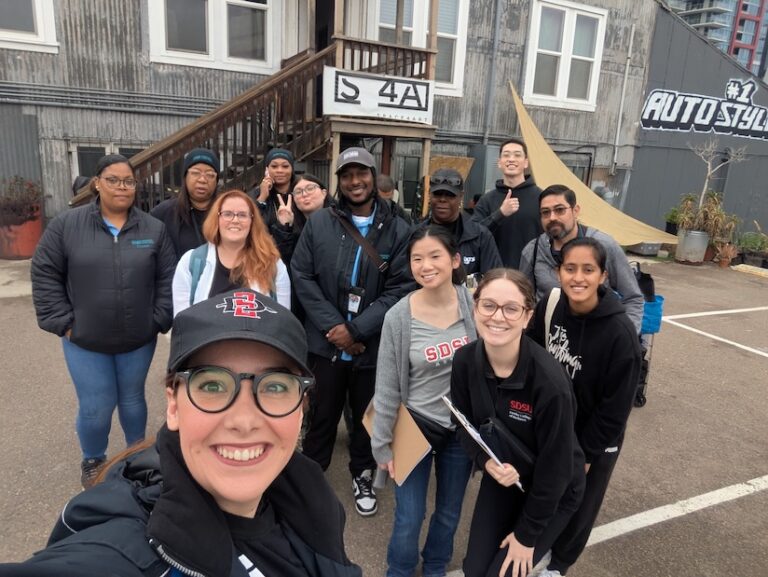
Homelessness in San Diego is both a spatial and systemic issue, says Fernandez. She and her team invest in other community engagement and education efforts to combat homelessness, such as the countywide San Diego Big Data Hackathon developed in November 2025. The event brings together high school, community college, and university students from across San Diego to work alongside government agencies, academics, and nonprofits to develop practical technological and social solutions.
“While visible encampments are often treated as isolated problems, they are part of broader socio-environmental inequalities,” says Fernandez. “[Geospatial] AI and community-engaged research allow us to reframe homelessness as a public health and equity challenge—one that requires coordinated, data-informed policy responses.”
