Andrew Turner is a Chief Technology Officer (CTO) at Esri, leading the team that builds and maintains ArcGIS Hub. The mission of ArcGIS Hub is simple: connect people with the information they need to take action. With the introduction of a new developer documentation site, developers can begin building audience-focused platforms that support collaboration, community engagement, and various kinds of shared initiatives.
In this Developer’s Lounge interview, Andrew explains why he believes data discoverability and shareability are critical for developing platforms that empower end users to improve their world.
"When I am building an application, I want easy access to useful and reliable data." - Andrew Turner
1. Hello, Andrew! What’s the story behind your first line of code, and how did it lead you to where you are today?
I was fortunate that my parents had an engineering mindset and provided ample opportunities for me to explore building and creating with technology. In elementary school, we had a Radio Shack TRS-80 ‘microcomputer’ with a whopping 4 KB of RAM and a voice synthesizer. I was immediately fascinated with how to write BASIC code that could draw graphics and speak to me. I saw computers and programming as a way to interact with the world and people.
From those initial encounters, I learned how to build more advanced sensor systems, leading me to develop AI-based software for solar-powered airships and later, earth-sensing spacecraft with the ESA in the 2000s. To bring it full circle, I wanted to connect data from the spacecraft back to how it could provide people with the information to make better decisions in their lives and communities. That’s why I build ArcGIS Hub – to ensure more data is available to people to understand and improve their world.
2. How would you describe ArcGIS Hub to someone who is new to the world of Esri?
ArcGIS Hub makes it easy for anyone to find and use trustworthy data from authoritative organizations like governments, utility companies, and non-profits. They are already using Esri’s software to manage the data for their operations, and now they have an “easy button” to make it available for residents, business developers, researchers, journalists, and partners to also use.
What I find particularly exciting is that ArcGIS Hub, as the name implies, brings together information from across departments and from different governments about the places you care about.
Right now, as you read this, the square meter of space you occupy probably has over a dozen organizations that measure and share spatial data about that location. Hub allows them to share their data with you, and also integrate and re-use data from others. Ultimately, you are able to see the entire stack of data about your neighborhood, park, or business from the local city, county, state, national agencies, international research organizations and more.
The purpose of this is to truly democratize societies – where everyone has access to the same tools and information to make their own decisions, coordinate with other groups, and advocate for how to work together with their governments. The same is true for more sensitive divisions within a company or organization. Their work efficiency and outcomes benefit from discovering and accessing appropriately shared internal data, combined with publicly available or partner-shared data.
A Hub starts with a branded website which serves a digital space to find and discover information. We have increasingly added more features to also bring together the people who are working in similar areas or topics across disparate areas so that they can discuss their ideas with data, maps, and analysis. We also know that most people do not visit their government websites often. Therefore, Hub has built in excellent search-engine optimization to ensure the data can be discovered through different web search engines, and increasingly through AI clients. Over the coming year you will be able to connect to any Hub within your favorite AI client or app to query, analyze and create – which is truly exciting to allow more people to use the authoritative data while requiring less detailed technical knowledge.
3. Why should a developer care about ArcGIS Hub?
When I am building an application, I want easy access to useful and reliable data. Historically, it has been difficult to find the data, integrate with unique or esoteric data formats, and know that the data will be maintained.
In one of my first hackathons, I built a public safety dashboard app using the local police crime data. After a month, the app broke because the data API went offline. When I emailed the contact at the police department, they literally said “Yeah, that server fell off the desk and broke. It was just our ‘open data’ server and because it isn’t used by the officers, we haven’t had time to fix it.”
Experiences like this motivated my work on Hub. Hub shares the same operational data and automatically provides all of the other functionality that benefit developers. There are multiple developer APIs that you can use to find Hub sites and search for data and code by topic, geography, time, and more. Each dataset API endpoint has the same common set of APIs, which makes it incredibly easy to build and maintain integrations. Whether you are integrating with public safety data, trees, ocean currents, or points of interest –from any agency around the world – it’s the same API!
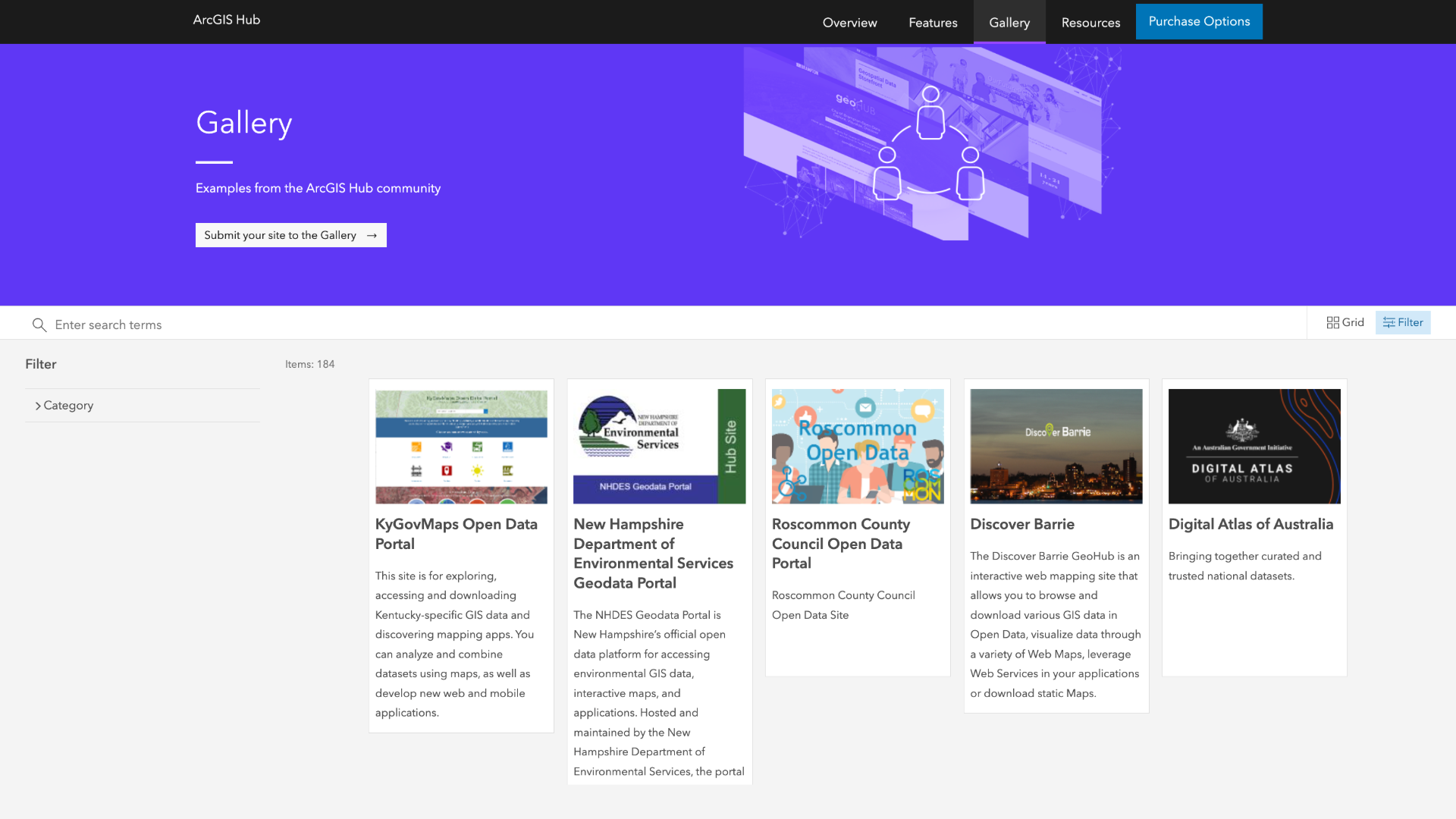
These create powerful opportunities for developers to build apps that integrate business data with environmental, policy, regional, and scientific data quickly and consistently. Apps can then be shared back into their own Hubs to increase the discovery and usage by their colleagues or constituents.
ArcGIS Hub Premium also adds collaboration capabilities across data, apps, and between people. The discussions feature allows groups to share posts with one another, providing feedback on data, inquiring about planning and operations, or sharing knowledge. These discussions are spatial, linked to the content, and private to the people and groups involved.
4. How can developers access ArcGIS Hub offerings?
There are over 28,000 public Hub sites that any developer can use in their work. If they have an ArcGIS Online or ArcGIS Enterprise account (Creator or above user type), they can create their own Hub sites for development, testing, and sharing.
ArcGIS Hub extends the ArcGIS platform with APIs for catalog-based search engines, geospatial discussions, events, and newsletter subscriptions. These are discoverable through the ArcGIS Developers website, and each include an OpenAPI definition for easy integration with different frameworks.
There are also libraries in Python and JavaScript which make it easy to automate and integrate with these APIs as well as more complex logic for creating, copying, and analyzing Hub content. Because ArcGIS Hub is built on the ArcGIS platform, any of the other APIs, SDKs, and hundreds of open-source projects work with ArcGIS Hub. Every dataset shared through Hub includes an API explorer and additional API resources to get you started.
And a very unique aspect of Hub is that each Hub site has its own API endpoint. That means as you discover Hub sites from different organizations, each has their own “Explore feeds” link that provides focused and curated API access to its content. This is useful both as a developer in your own apps, as well as for building and sharing APIs from your organizations.
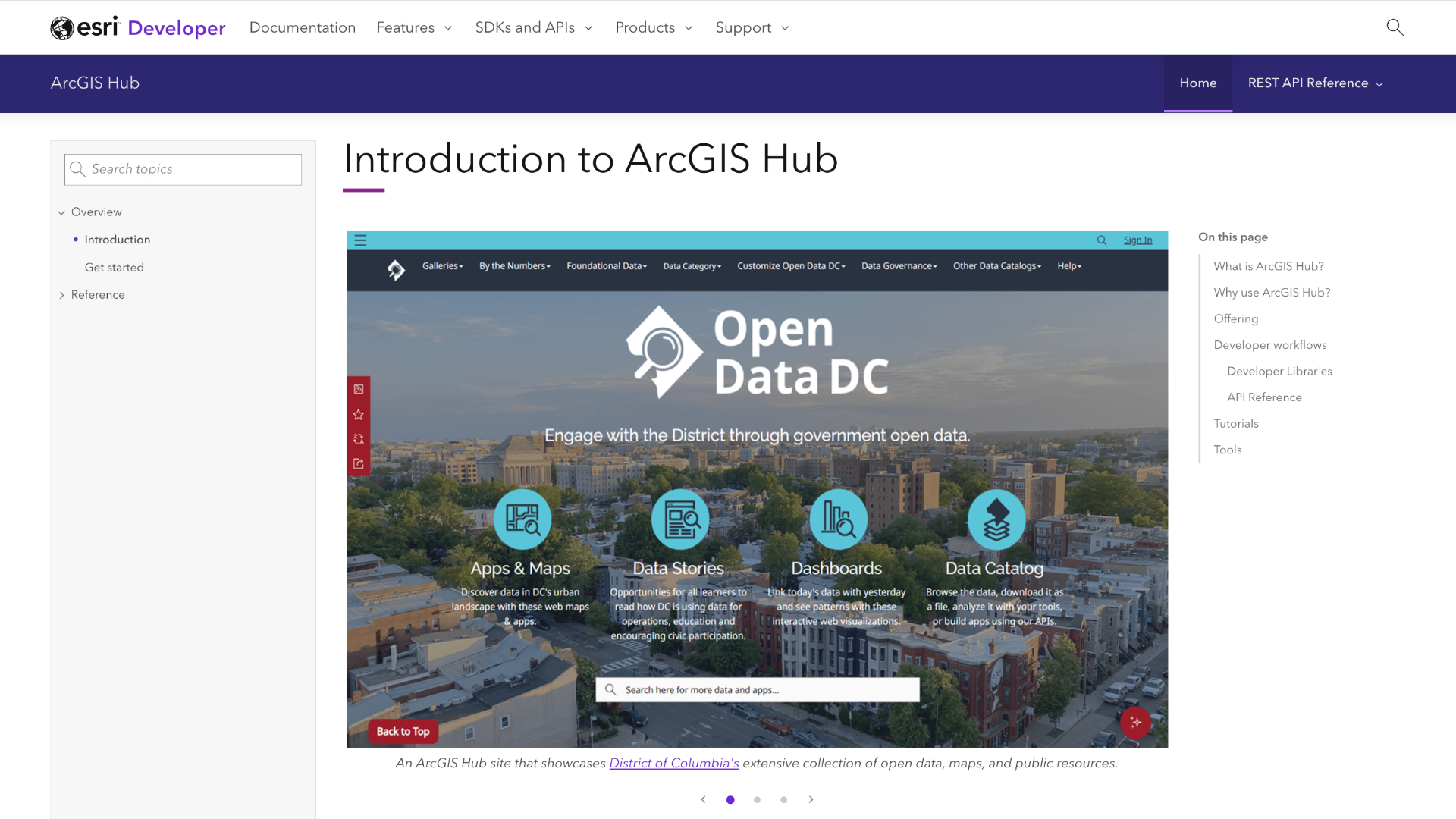
5. Your team has just launched a new documentation site for developers looking to work with ArcGIS Hub. What will developers find on the site?
The new ArcGIS Hub developers site is the best place to get started, see what is available, and learn how to use it. Hub is a large product with many features, so the conceptual overviews will help developers understand the different building blocks of Hub, how they align with the ArcGIS platform, and suggestions for getting started.
Currently, there are four Hub APIs available:
- Search API – find trusted content through curated content catalogs
- Events API – schedule in-person and virtual events for gathering people
- Discussions API – geospatial group conversations on your maps and content
- Feeds API – subscribe to Hub content for delivery into common aggregators and repositories
We’re also planning to provide a suite of example apps and components that developers can use for inspiration in their work or integrate directly into their applications and scripts.
6. What more can developers expect from the documentation site in the coming months?
We will be adding documentation on our Newsletter API, Telemetry API, and Model Context Protocol (MCP) services. We are also releasing a major update to the Hub Python library, which will be available both as part of the ArcGIS Python library and as a separate module that is updated more frequently with interim releases.
There will be a preview of MCP connectors to Hub for automation in AI clients like Claude, ChatGPT, and others. We envision these being used by developers, administrators, and anyone increasingly relying on AI-supported interfaces for building with ArcGIS Hub. These MCP connectors will align and work with other ArcGIS MCP connectors and third-party services. This should dramatically improve workflows for creating and managing Hubs.
7. What can developers do if they have additional questions that come up while building with ArcGIS Hub?
Developers can post questions on the ArcGIS Hub community site. Our team is alerted to new posts and we love hearing from people who have questions and ideas.
Look out for more interviews in our Developer’s Lounge series!

Don’t forget to subscribe to the Esri Developer Newsletter and follow Esri Developers on LinkedIn to discover more developer offerings and updates.





Article Discussion: