This article is part of the Rethinking Humanitarian Action with a Geographic Approach blog series.
The bottom has dropped out from under the humanitarian sector. The logic of what follows hasn’t changed since then, only the urgency. This current crisis makes one thing clearer than ever: Future humanitarianism must be more locally and nationally owned, and more accountable to the people it serves.
Humanitarianism Needed a Shake-Up (Just Not Like This)
Read through the excellent commentary emerging on the humanitarian funding crisis. You can’t miss the underlying notion. In some ways, we’ve brought this upon ourselves.
We’ve danced around reforming the humanitarian sector for years. But to quote Lars Peter Nissen in the Trumanitarian episode titled, “Shaken Not Stirred”, we’ve merely stirred it. What it really needs? A fundamental shake-up that reduces its vulnerability to the whims of major donors and creates an improved, more resilient, and more accountable system.
Future humanitarianism will hinge on building up human resilience to shocks in a more effective, efficient, and accountable manner. It is always worth asking ourselves: are we as effective as we could be? Are we delivering what needs delivering? Most importantly, who gets to decide on these questions?
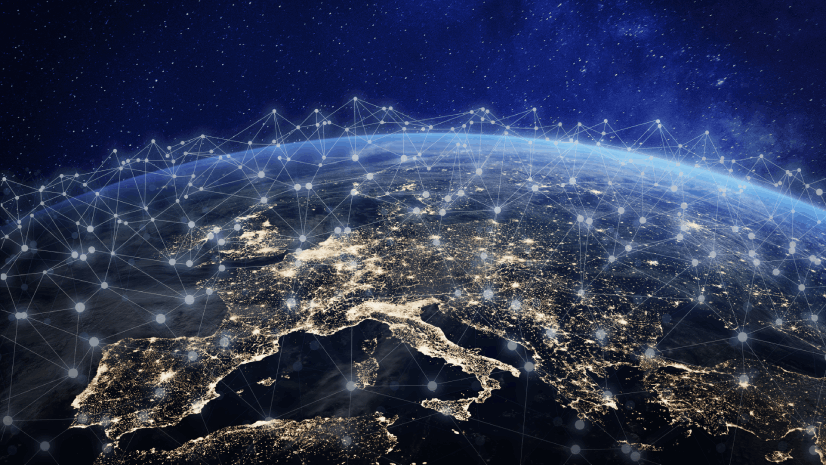
The shake-up we need doesn’t merely reduce financial dependency on a single donor. We must radically restructure the sector from its current top-down, hierarchical logic to a more evenly distributed “mesh” of interconnected capacities, resources, knowledge, and agency.
Picture this: An earthquake pokes a hole in that mesh somewhere? The mesh pulls itself back together, drawing first from the most proximate resources. Resilience from the inside out.
Who Owns the Narrative?
I’ve spent more than 20 years in the humanitarian sector. Specifically, promoting information management systems (IMS) and geographic information system (GIS) technology to support evidence-based decision-making. It’s a concept I still believe in passionately. And it’s one of the ones most affected by the funding crisis, leading to countless shutdowns of fundamental datasets the sector relied on to navigate.
But here’s the thing. We largely failed to understand that good data isn’t enough to bring about efficiency, effectiveness, and accountability.
It’s all about the narrative the data spells out. Who gets to own and shape it? How does it interact with other narratives in the same space? The future of humanitarian effectiveness will be determined as much by who gets to frame the narrative as by the volume of data we collect.
That overarching narrative will define everything. The decisions we make. The programs we design. The support we deliver. It might rest on good data. But if you build it external to the primary stakeholders, especially the affected communities, even the most data-driven programs will miss the mark.
You’ll be doing the job right. But you won’t be doing the right job.
Instead, we need to build a fine mesh of local-to-global capacities that can connect, share information, and communicate knowledge at all scales. True partnership.
We have the tools to make this happen. Modern IMS and GIS technology platforms are built to do exactly that: connect knowledge at all scales, from local, through national, to global. And stellar examples of capacity and knowledge-exchange networks have emerged over the last decade. The Flying Labs. Humanitarian OpenStreetMap Team. NEAR (Network for Empowered Aid Response). Start Network.
So, some of the key building blocks for this localized mesh already exist. What’s missing? A collective vision of what could be, and a road map to get there. One that redefines the roles and responsibilities of actors according to what they each do best.
Restoring and Strengthening Local and National Ownership
Localization of the humanitarian and disaster risk management (DRM) sector amounts to asking ourselves two questions: “How far do disaster-impacted communities in location X need to search to find the support resources they need?” And, “How can we continuously elevate existing local capacity so that this radius shrinks over time?”
Localization implies stronger ownership of the narrative and DRM processes by those affected. Rather than external assessments determining need and resource requirements, a localized humanitarian model enables affected populations to define and voice these needs. They become the driving agent for selecting, sourcing, and overseeing support.
That said, we should still be careful to avoid a full pendulum swing. Otherwise, we’ll simply shift from a chaotic and unaccountable international system to an equally chaotic and unaccountable hyperlocal system. A singular focus on local organizations would create its own set of problems if it sidesteps national DRM frameworks and undermines national cohesion and development goals.
More focus on strengthening national disaster management authorities’ capacities would have several effects:
- It would provide a coherent framework for local action.
- It would create new loci for funding and resource mobilization efforts closer to the need.
- It would deliver more context-specific normative guidance.
- It would link DRM efforts with broader national development goals.
- And it would establish a sovereign coordination framework to which external and internal actors could align.
Localization should seek to connect and integrate knowledge and capacity from local, through national, to international levels. To quote Sonja Betshart of WeRobotics, we should not be thinking in terms of ‘local OR global’, but ‘local AND global’.
WeRobotics’ “glocalization” concept offers a useful model for how this works in practice. A network approach that connects local capacity to global knowledge without subordinating one to the other. The humanitarian mine action sector offers another example, imperfect but instructive: national mine action authorities have achieved meaningful ownership over planning, coordination, and accountability, with international actors playing a supporting role. The Geneva International Centre for Humanitarian Demining has documented this well. There’s no inherent reason why national disaster management authorities shouldn’t enjoy the same level of agency.
The funding crisis has exposed how fragile a top-down humanitarian model can be when it rests on a narrow base of power, resources, and narrative control. If we want something more resilient, we need a finer mesh of local, national, and global capacities that can hold together when shocks hit.
That starts with asking who owns the story. Who sets priorities? How far do people have to reach to find support? But narrative and ownership are only half of the equation. The other half? Understanding that risk itself is fundamentally geographic, shaped by where hazards occur, how vulnerabilities concentrate, and which capacities exist in proximity to need.
In the next article, I’ll turn to this geographic dimension: why location matters for every aspect of disaster risk management, and how GIS technology and integrated geospatial infrastructures can help us build the kind of connected, resilient system this moment demands. In the meantime, you can find out more about how GIS supports humanitarian action here: go.esri.com/humanitarian.