Introduction
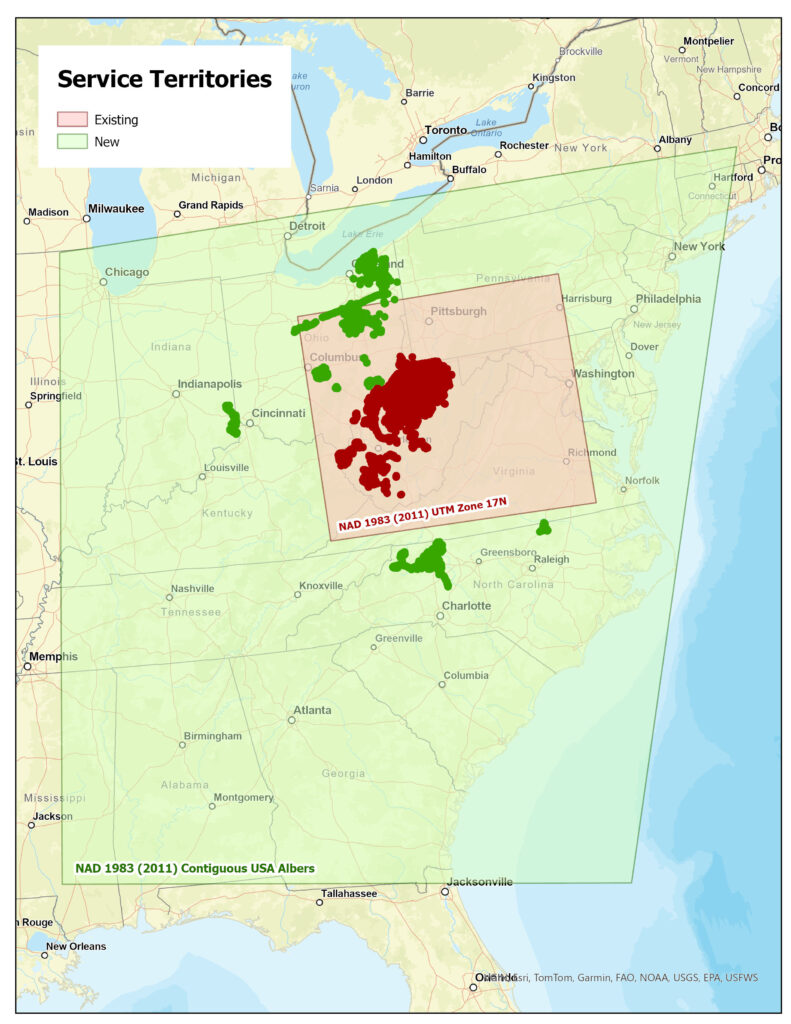
When utility companies expand into new territories, they often face significant challenges in maintaining consistent workflows, accurate data, and reliable field operations. Hope, a leading gas utility provider, experienced this firsthand during its expansion beyond West Virginia into North Carolina, Ohio, and Indiana. The company’s existing Geographic Information System (GIS) was designed for a single service area, limiting scalability and operational efficiency. To overcome these challenges and prepare for future growth, Hope partnered with RAMTeCH to implement a comprehensive GIS integration solution that would unify its operations across all territories and provide a foundation for long-term success.
The Challenge
Hope’s original GIS environment consisted of a single Esri utility network focused exclusively on West Virginia. This system relied on localized spatial references and workflows tailored to one region, making it incompatible with new territories. As the company carried forward its integration, several critical issues emerged. The existing database could not accommodate additional assets or future acquisitions, creating a bottleneck for growth. Spatial references varied across regions, leading to inconsistencies and integration hurdles. The schema lacked provisions for the seamless migration of newly integrated gas networks, requiring significant manual effort to incorporate new assets. Field operations faced their own set of challenges. New crews from acquisitions had no mobile GIS access, limiting their ability to work efficiently in the field. These limitations threatened operational efficiency, data accuracy, and the ability to scale for future growth. Hope needed a solution that would consolidate its GIS data, standard.
The Partner
To address these challenges, Hope turned to RAMTeCH, a trusted leader in GIS integration and utility network solutions. RAMTeCH worked closely with Hope’s team to understand the company’s operational goals, technical requirements, and long-term vision. This partnership was built on collaboration and innovation, ensuring that every step of the process, from data migration to mobile deployment, aligned with Hope’s objectives, ultimately to have efficient systems in place to provide safe and reliable service to customers.
RAMTeCH brought deep expertise in Esri ArcGIS Enterprise, ArcGIS Utility Network implementation, and mobile GIS solutions. By leveraging its proprietary tools and proven methodologies, RAMTeCH designed a strategy that addressed Hope’s immediate challenges while creating a scalable platform for future acquisitions. The partnership focused on building a unified system that would streamline workflows, improve data accuracy, and empower field crews with reliable access to mission-critical information.
The Solution
RAMTeCH implemented a comprehensive GIS integration solution that transformed Hope’s fragmented system into a unified, enterprise-grade platform. The project began with designing and implementing data model updates to accommodate newly integrated assets from the additional territories while maintaining compatibility with the existing West Virginia utility network. This step ensured that the consolidated system could support both current and future operational needs.
To create a strong foundation, RAMTeCH deployed a new SAP HANA Enterprise geodatabase that served as the central repository for all six service areas. This centralized system eliminated duplication and ensured consistent data management across territories. Spatial references were standardized to ensure compatibility across regions, and the schema was updated to accommodate newly integrated assets. These changes were critical for maintaining data integrity and supporting future growth.
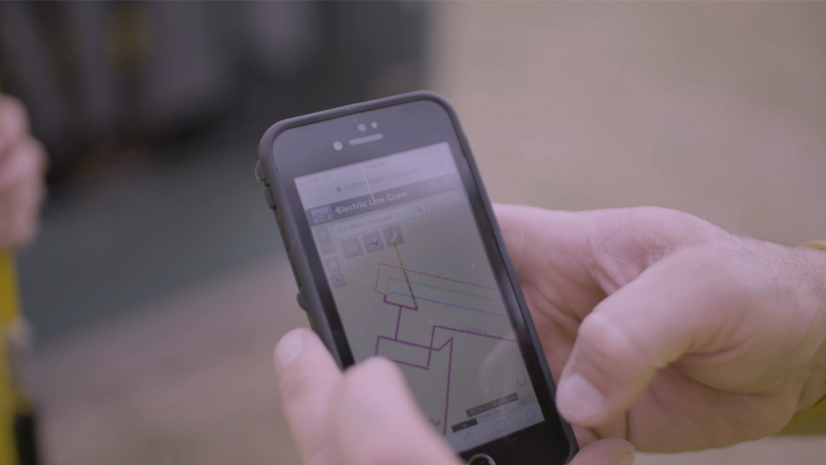
RAMTeCH utilized its proprietary uNet™ data migration tools to migrate the existing West Virginia utility network and integrate assets from new territories into the consolidated geodatabase. This process ensured a seamless transition without disrupting ongoing operations. Field crews continued using gMobile™ for Windows, while a new gMobile™ for iOS solution was deployed to support crews from the acquisitions. These mobile solutions provided offline access to mission-critical data, enabling crews to collect, update, and manage operational information even in areas without network coverage.
The consolidated system allowed Hope’s GIS data maintenance team to efficiently edit and manage assets using ArcGIS Pro and ArcGIS Utility Network tools. This unified workflow improved collaboration and reduced duplication of effort, creating a more efficient and reliable operational environment.
Results
The implementation of RAMTeCH’s GIS integration solution delivered transformative results for Hope. The company now operates on a single, consolidated geodatabase that eliminates redundancies and streamlines workflows across all service areas. Standardized spatial references and updated schemas ensure consistent, reliable data for decision-making. Field crews benefit from gMobile™ for Windows and iOS, which provide offline access to critical data and enable uninterrupted field operations in remote areas.
“By unifying all six service areas into one Esri ArcGIS Enterprise geodatabase, Hope has reduced duplication, cut maintenance costs, and improved data consistency. Our field crews now operate more efficiently with RAMTeCH’s gMobile™ offline access, enabling faster, more efficient operations across all territories.” – Nagy Nagiub, Vice President of Corporate Services, Hope Utilities
The new platform is designed to integrate future acquisitions without significant additional effort, supporting Hope’s long-term expansion strategy. Centralized data and unified workflows allow teams to respond quickly to operational needs, improving customer service and reliability. This unified system not only addressed Hope’s immediate challenges but also positioned the company for sustained success in an increasingly complex utility landscape.