Waste collection is one of the most essential services for any community, yet managing it efficiently has become increasingly complex. Roanoke County is a community of fewer than 100,000 residents nestled in the Blue Ridge Mountains of Virginia. The county provides essential services including trash pickup and bulk and brush collection to its citizens, but lacked the real-time visibility needed to run these operations efficiently.
Challenge
Before implementing a modern tracking solution, Roanoke County’s waste management department was operating with outdated methods. The department had evolved from using paper notebooks for routing to Microsoft Word, and eventually to Microsoft Excel spreadsheets. However, these manual systems left operations managers without critical information about their fleet’s activities.
David W. Wray, GIS Manager at Roanoke County, described the situation: “A lot of the pain points is that we didn’t really know where the trucks were at, where they were going, who had been served, who had not. So you were sort of flying blind in a way”. This lack of visibility created multiple operational challenges.
When residents called to report missed trash pickups, customer service had no way to verify whether trucks had actually serviced their street or whether the resident had simply missed putting out their trash can. Staff could not provide accurate information about when trucks would arrive or had already passed through neighborhoods.
Route management during holidays presented additional complications. When the county compressed its normal four-day collection schedule into three days to accommodate holiday closures, such as Christmas week, managers had no reliable way to track progress and ensure all routes were completed on time.
The department needed a solution that would provide real-time operational awareness, improve customer service capabilities, enable better fleet management, and help staff make data-driven decisions throughout each workday. For a government entity focused on serving citizens efficiently, these limitations were increasingly unacceptable in an age when real-time tracking had become commonplace in private sector logistics.
Solution
Roanoke County partnered with NV5, a consulting firm with whom they had worked for over 12 years, to develop a comprehensive real-time tracking solution called TrashView. The solution integrated Samsara GPS and sensor technology with Esri’s ArcGIS platform to create a powerful waste management monitoring system.
The technical foundation of TrashView combined multiple technologies working in concert. Samsara provided the hardware backbone with onboard units installed on each truck and sensors connected to critical vehicle components
These sensors captured multiple data streams including GPS coordinates, activation of the robotic arm (nicknamed “one-armed bandit”) that lifts and empties trash cans, engagement of the packer that compresses trash inside the truck, oil temperature, engine diagnostic lights, and driver safety metrics. Every time the robotic arm activated to pick up a trash can, a sensor event was recorded and transmitted in near real-time.
On the software side, Roanoke County leveraged its existing Esri ArcGIS Enterprise infrastructure. The county implemented ArcGIS GeoEvent Server to connect to the Samsara API and stream sensor data into their geographic information system. NV5 developed custom JavaScript to facilitate this integration, ensuring data flowed smoothly from the trucks into the county’s spatial database.
The development team encountered initial challenges with the API integration. The team discovered they were experiencing data loss because their initial API calls declared updates only when GPS coordinates changed. They refined the integration to trigger updates based on sensor activations directly, eliminating the data loss and capturing complete information from every route.
The county used Esri’s ArcGIS Experience Builder to create the TrashView application interface. The application displays real-time truck locations on a map, shows historical trails of where each truck has traveled, marks every point where the robotic arm was activated to pick up a trash can, indicates packer activations for compressing loads, and provides filters to view specific trucks or time periods.

TrashView was designed as an internal customer service tool accessed by approximately 25 General Services department staff members. Customer service representatives can quickly search for any address in the county and immediately see whether and when trash collection occurred at that location. The system tracks all truck types including bandit trucks with robotic arms, knuckle boom trucks for bulk collection, and rear loader trucks.
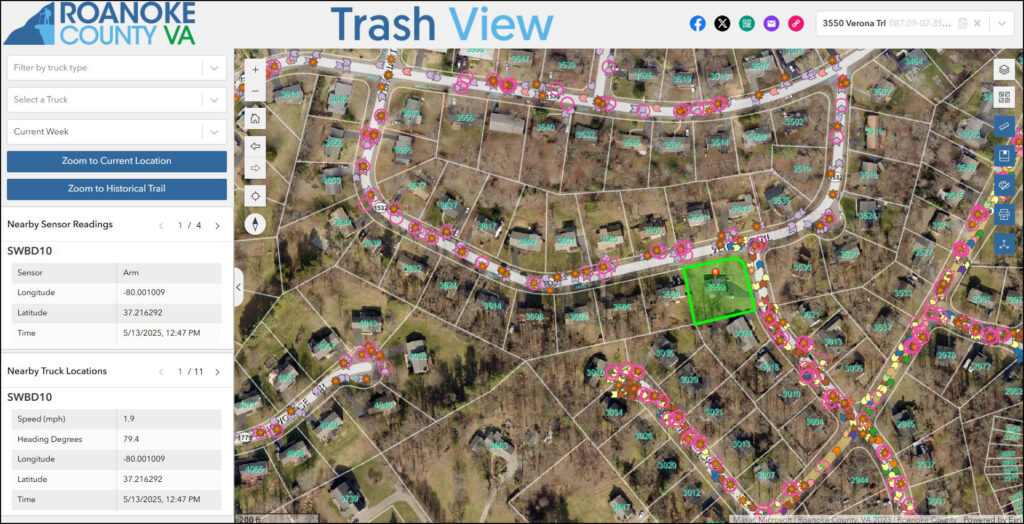
The solution was piloted in September 2024 and officially launched in October/November 2024.
Results
The implementation of TrashView has transformed Roanoke County’s waste collection operations, delivering measurable improvements across multiple dimensions while gaining enthusiastic adoption from both management and field staff.
Most significantly, TrashView established what Wray calls a “common operational picture” of waste collection activities. This real-time visibility replaced the previous “flying blind” approach and enabled data-driven decision making throughout each workday.
Customer service capabilities improved dramatically. When residents call to report missed pickups, representatives can immediately access TrashView, search the address, and see the precise locations where truck sensors recorded trash can collections. In many cases, the data reveals that the truck did service both sides of the street, indicating the resident likely did not have their can out rather than being missed. This objective data transforms difficult customer conversations and enables staff to provide accurate, evidence-based responses instead of defensive speculation.
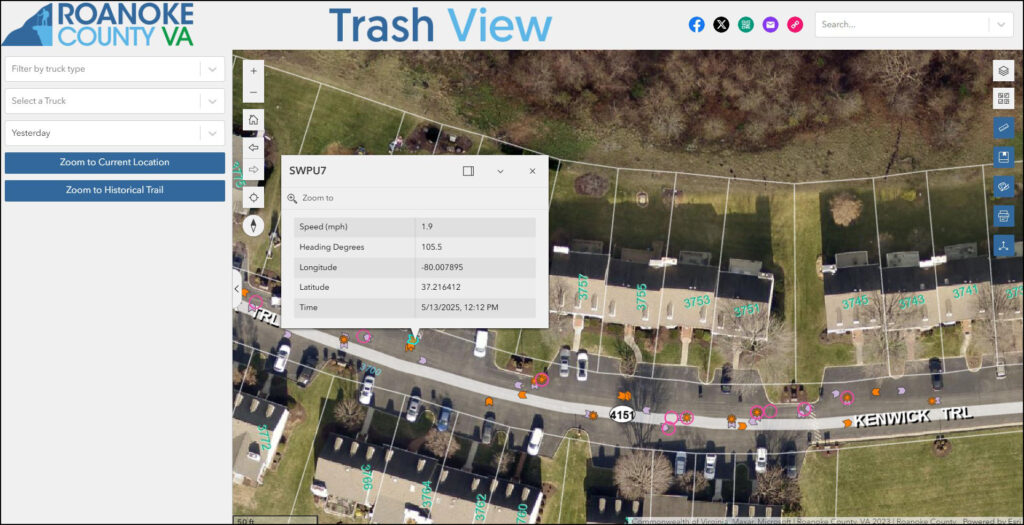
The system proved particularly valuable during holiday schedule adjustments. When Christmas week in 2025 required compressing four days of collection routes into three days, TrashView enabled managers to monitor progress in real-time and ensure all areas received service despite the compressed schedule, while maintaining visibility into completion status throughout each day.
Operational efficiency gains included tangible cost savings. The county achieved a 10% reduction in truck repairs compared to the previous year. Additionally, tow aid (assistance when trucks break down) was reduced by 72%. These improvements resulted from the system’s ability to provide proactive maintenance insights. Real-time sensor data on engine performance, oil temperature, and other mechanical indicators allows the maintenance team to address potential issues before they result in breakdowns.
The solution also established a maximum of 450 stops per route, providing a data-driven standard for route planning. This metric, developed in collaboration with industrial engineering students from Virginia Tech, helps ensure routes are appropriately sized for completion within scheduled timeframes.
Perhaps most remarkably, the system achieved enthusiastic adoption from truck drivers, a group that might have been expected to resist tracking technology. Wray noted this was “quite the opposite” of anticipated resistance. “They see how it’s helping them. It’s not Big Brother looking over and seeing what they’re doing. It’s more of, hey, we’re here to help make your job easier”. Drivers recognized that the tracking system benefits them by providing documentation of their work, enabling faster emergency response if needed (one truck fire was quickly addressed because dispatch knew the exact location), and supporting fair evaluation of route completion.
Communication improved across all levels of waste collection operation. Wray identified this as the top benefit.
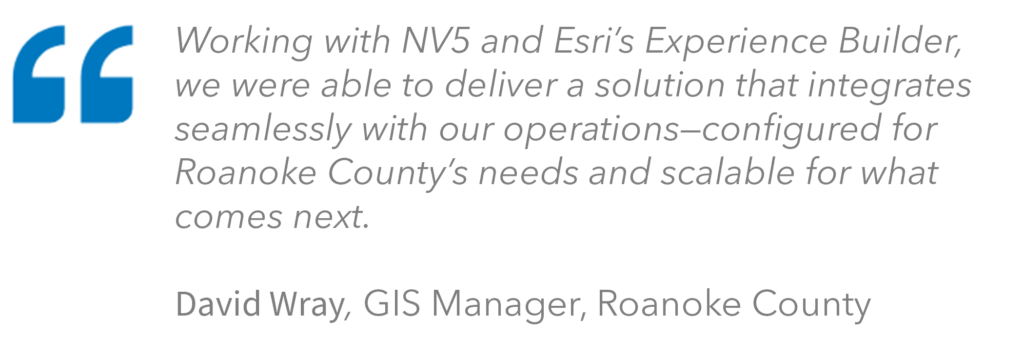
Roanoke County’s successful implementation demonstrates how local governments can leverage Internet of Things sensors, cloud-based APIs, and enterprise GIS platforms to transform essential services. By partnering with NV5 and building on existing Esri infrastructure, the county created a solution that improves customer service, reduces costs, enhances operational efficiency, and gains enthusiastic staff adoption, all while serving as a foundation for continued innovation in waste management operations.
Looking Ahead
Roanoke County is expanding the system’s capabilities, planning to implement automated email alerts using geofences for collection routes. These will notify managers when trucks complete routes and move between morning and afternoon collection areas.
The county views TrashView not as a final destination but as one component of an evolving enterprise GIS strategy. Future enhancements include implementing automated geofence alerts to notify managers when trucks complete route segments, integrating the ArcGIS Pro Waste Problem Solver tool for optimized route planning at a fraction of the cost of traditional trash routing software (the county spent $3,000 on Esri custom roads data versus six-figure costs for specialized routing systems), and exploring ways to deliver routes directly to driver smartphones via Esri ArcGIS Navigator rather than printed route sheets.
Learn more about location intelligence for AEC:
GIS for Architecture, Engineering, and Construction.
Stay Connected with Esri’s AEC Team:
Subscribe to the AEC industry newsletter “Esri News for AEC”.