“Au inveniam viam aut faciam.” – Hannibal
After 20 years in public transit and now at Esri, I still believe location is the golden thread that connects all of our great work across departments. It can transform how agencies deliver their promise of safe, reliable service. Every day of service, transit finds a way—or makes one—to serve communities in an increasingly complex environment. To keep pace, agencies must elevate operations with location intelligence, through GIS: not just maps, but an enterprise strategy that unites departments, breaks down silos, and drives measurable outcomes.
Transit agencies continue to face growing challenges: aging assets, workforce shortages, shifting ridership patterns, severe weather and natural disasters, and rising expectations for real-time customer information and to keep service intact. These all require decisions that draw from multiple data sources. Too often, those data live in fragmented systems. When decision makers must stitch together siloed information, key patterns and relationships get missed which impact the decisions being made.
Imagine what your agency could look like and how it could function, if it were fully integrated. It truly is possible – with the help of GIS! GIS is no longer just a cartography tool. When adopted as an enterprise approach, location intelligence becomes the connective tissue across departments so teams can work from the same authoritative geography and contextual data. That unlocks faster, smarter decisions and better outcomes for riders and other important stakeholders.
Currently, many transit agencies use GIS, but just for route planning and performance analysis. However, the potential benefit of a geospatial approach extends far beyond that. In fact, any department can leverage GIS for its unique challenges and opportunities. For example, your HR team can utilize GIS for workforce planning, using demographic data to understand where employees live and how best to serve them. They can also benefit from understanding where to find potential employees, and can create targeted recruitment strategies that reflect community needs and demographics.
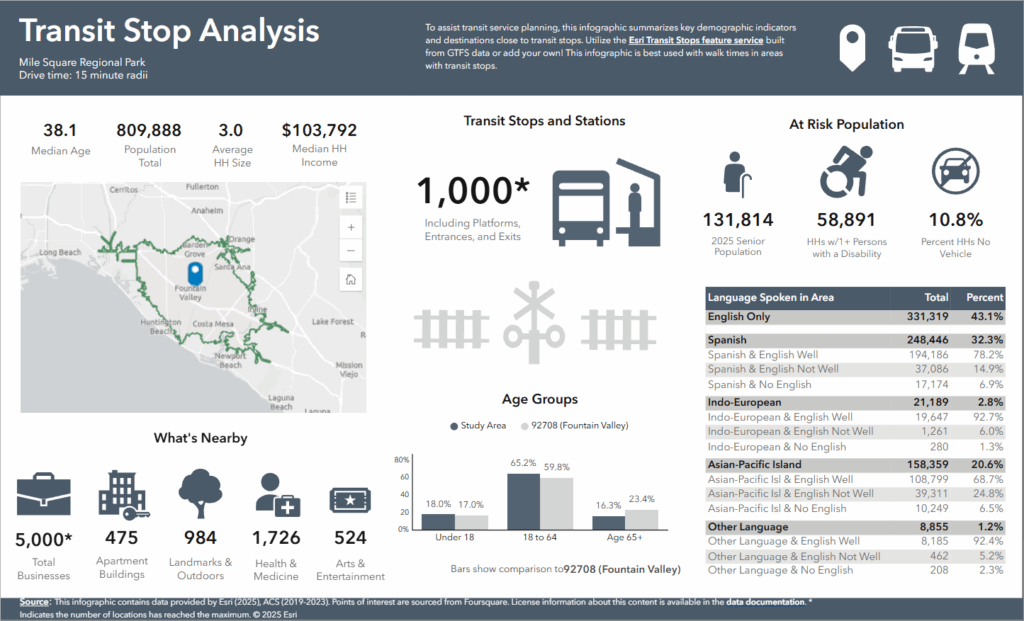
During an emergency – a wildfire, an earthquake or a hurricane, GIS can support viewing and selecting affected employees on a map that concurrently shows real time event data, making it easier to proactively support your workforce. This is what GIS can do for you today, truly only limited by your imagination. GIS is a strategic initiative that positions transit agencies at the forefront of innovation with one platform.
In my time as a GIS professional, I’ve witnessed – and driven – the amazing ability of GIS to transform transit. However, I’ve learned no clearer lesson than this: a successful enterprise GIS requires more than technology; it needs a culture that values cross-department collaboration, shared authoritative data, and continuous learning. This sometimes requires a cultural shift —one that embraces innovative thinking and recognizes the importance of location intelligence. This also involves increasing geospatial competence and helping individuals understand how geographic data can benefit not just their own work but the agency as a whole. We’ve made good progress in changing the understanding of GIS over the years, but there is still plenty of work to do.
The mantra of “good data, better technology, best practices” can guide transit agencies toward embracing GIS as a fundamental tool. When there are too many systems to consult, especially when a decision needs to be made quickly, the risk of missing something critical increases exponentially. With Esri’s enterprise approach, GIS can be integrated seamlessly into operations, allowing for the analysis of vast data sets in real time. This capability provides the foundation for making smarter, data-driven decisions that prioritize public service.
As we look ahead, the need for transit agencies to adapt and evolve has never been more pressing. Rethink the business model of transit around a geospatial framework that drives innovation, equity, and operational resilience. Start with the 3-step pilot above, track one clear metric, and expand once you prove value. GIS can be the backbone that enables smarter, customer-centered decisions across your agency.
By harnessing location intelligence, my dear transit colleagues, we can find a way or make one as the quotation encourages, rethinking the business model of transit around a geospatial framework that drives innovation, equity, and operational resilience. GIS can be the backbone that enables smarter, customer-centered decisions across your agency.
Good data, better technology, best practices—for all. That’s where our journey with GIS will take us, ensuring that transit services continue to deliver.
Let’s go, transit!

![Hello [Transit] World!](https://www.esri.com/en-us/industries/blog/app/uploads/2026/01/googleshareimage_helloworld.png)