Geospatial professionals—the analysts and managers who work with GIS software—are coveted in the business world. They bring context to decisions about where their company has been, where it stands, and which roads it should pave into the future.
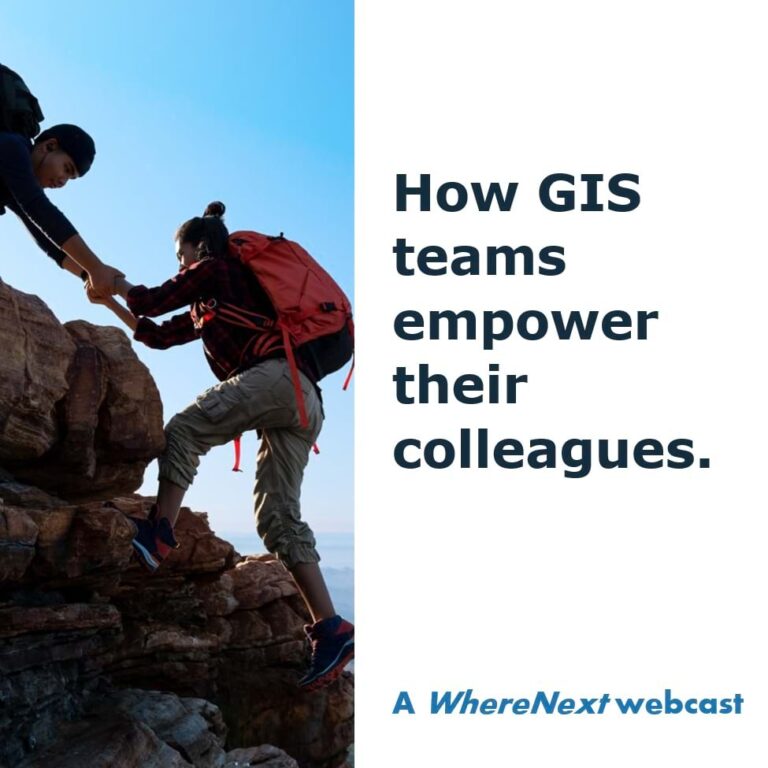
For a technical profession, GIS also requires significant soft skills. As they advance in their careers, high-achieving GIS practitioners learn how to step outside their technical comfort zone and meet the challenge of delivering business value, not just maps.
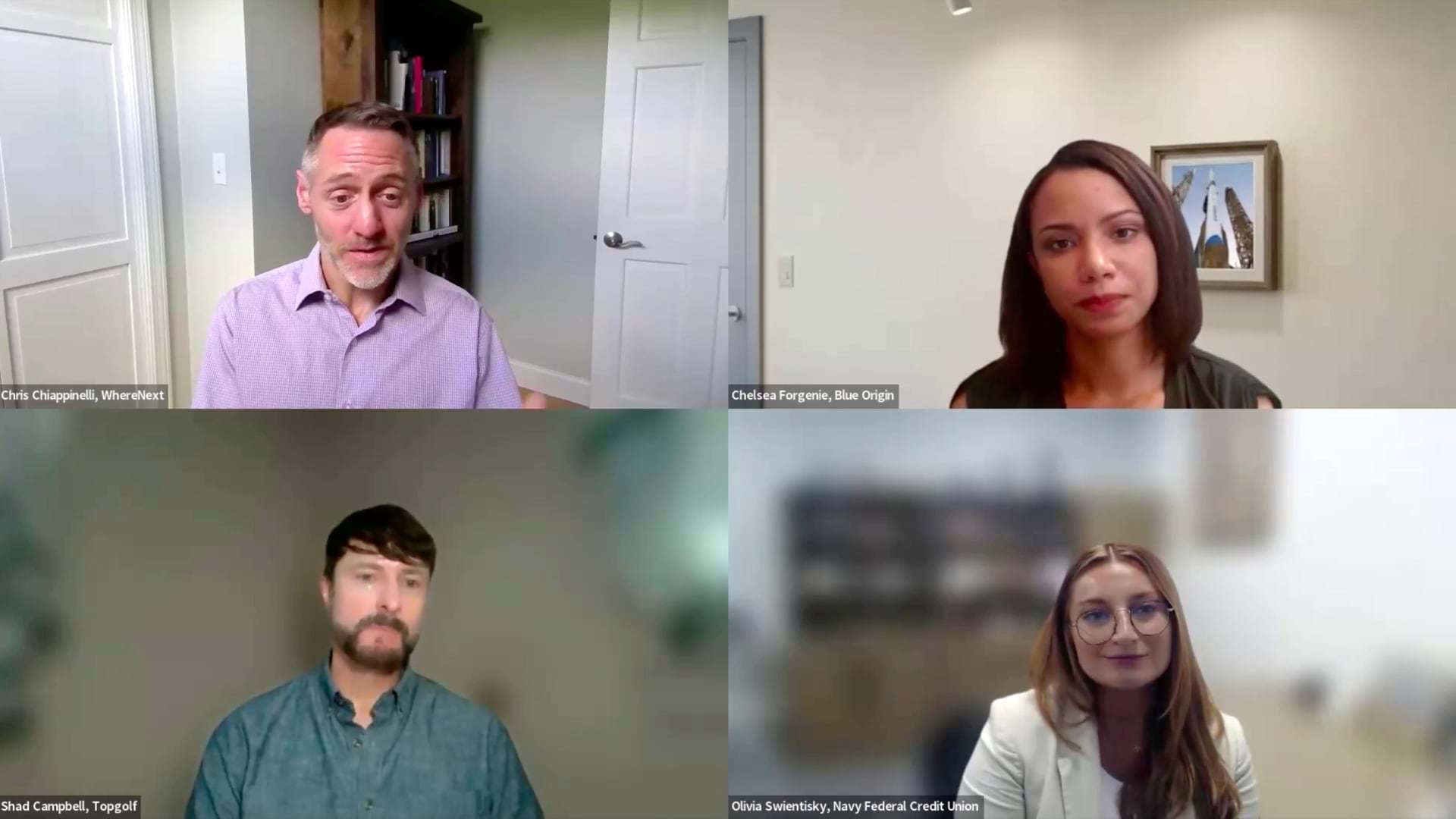
In this clip from WhereNext’s recent webcast on transformation, GIS pros from Blue Origin, Navy Federal Credit Union, and Topgolf reveal:
- What it means to shift from being a reactive to a proactive geospatial professional
- Why a GIS pro might spend more time thinking about the story data tells than the data itself
- How to stop answering one-off questions and start building processes that serve the whole organization
View the video or read the transcript below. To watch the full conversation, visit the webcast overview.
Chris Chiappinelli, WhereNext: Transformation is often spoken of in business terms, but there’s also personal transformation. I’m wondering if you can look back at the beginning of your career and tell us, what is the most important thing that is different about you now that makes you a better geospatial professional, that’s helped transform you. Olivia, what would that be?
Olivia Swientisky, Navy Federal Credit Union: Earlier in my career, I was very focused on the technical side: building the models, answering every question, giving them exactly what they needed, getting all the outputs exactly right. And what I’ve learned over time is that being effective in this space isn’t just about the analysis, it’s about how you communicate it and connect it to the business impact.
There was definitely a learning curve. I had to push myself to step out of the technical comfort zone and start engaging more directly with my stakeholders, such as our acquisition team and our facilities and management team, and really [understand] what their priorities are. What is our long-term goal? Instead of asking “Where’s this?” [asking] “What is the overall answer that I can provide?” It’s more sustainable.
Now I would say that I spend just as much time thinking about the story as I do the data. How can I make these insights clear and actionable and relevant to leadership and these end users of these products? How can I really help influence decisions and also help other teams feel more confident about their decisions and where we’re going?
I would say that that shift made me a lot stronger geospatial professional because the work doesn’t just exist; it influences the decisions and helps drive results long term.
WhereNext: That’s good input. I think that is a mark of maturity along that curve of a career—to understand not just what somebody’s asking for, but the big picture that it’s connected to. . . . Chelsea, how about you?
Chelsea Forgenie, Blue Origin: I would say, early in my career I had this struggle where I thought being a great geospatial professional meant being the person who personally answered all the requests that directly came my way. I thought my value came from someone coming to me with a specific problem, pulling up the software, doing analysis like Olivia was saying, and handing them the solution. And that is still valuable, but as I took on more and more complex tasks, I think I quickly realized that that approach just doesn’t scale.
I believe the biggest transformation for me was learning to shift my mindset from a reactive to a proactive geospatial professional. We’re trying to gradually move away from the fast-paced, ad hoc style when requests come in, and instead start to take the time to really think through our processes and understand our internal customers and recognize patterns. Like, this department requests this product or analysis every two and a half weeks, so let’s find a way to provide that information on a self-serving platform. It doesn’t mean we won’t support the urgent requests, but I think when those instances do happen, we might actually have more time to support them, when they do come in.
WhereNext: It’s that concept of slowing down to get more done, slowing down to speed up, however you want to phrase it. That’s an important adjustment there. Shad, how about you?
Shad Campbell, Topgolf: I think I’m a little unique. I came to geospatial analysis, didn’t have a background in it, didn’t have an education in GIS or anything like that. Coming straight out of school, I started in sales analytics, first in the manufacturing sector and then moved to [the] financial services sector. And a couple of years into that, I had the opportunity to step into a site analytics role. It was very interesting to me; it was something I kind of gravitated to. But I think early on I really looked at GIS as more using these tools to answer these questions. It was a very rudimentary approach to, “Here are the reports I run, here are the maps I do.” Much like Olivia and Chelsea said, you’re reacting to requests and things like that.
After doing that for a couple of years, I actually got to build a team around that process and we actually started supporting branch expansion, ATM expansion. A couple of years later I moved on to a much larger organization in financial services, where I got to learn more of the technical aspects of it in terms of the data side and what data needs to go into these GIS decisions and then how is that data used to answer questions across the organization.
Through that process, what I really learned is GIS is a unique discipline. It is very unique in almost any industry you can think of, especially in business. A lot of times, either you or your team are one of one. And I think that gives you a real advantage because you can start thinking long-term, you can start thinking strategically, and you can build processes around what’s going to serve the organization the best.
And for me, that’s been the biggest transformation—it’s installing those processes, those critical thinking paths that help support the organization and drive the organization as opposed to just reacting to requests and producing static maps and reporting. You’re not just the data guy or the map guy or the map person, you’re that functionary that reaches across the organization.
The Esri Brief
Trending insights from WhereNext and other leading publicationsTrending articles
December 5, 2024 |

January 11, 2024 |
September 22, 2026 |
May 26, 2026 |

April 7, 2026 |

June 5, 2025 |