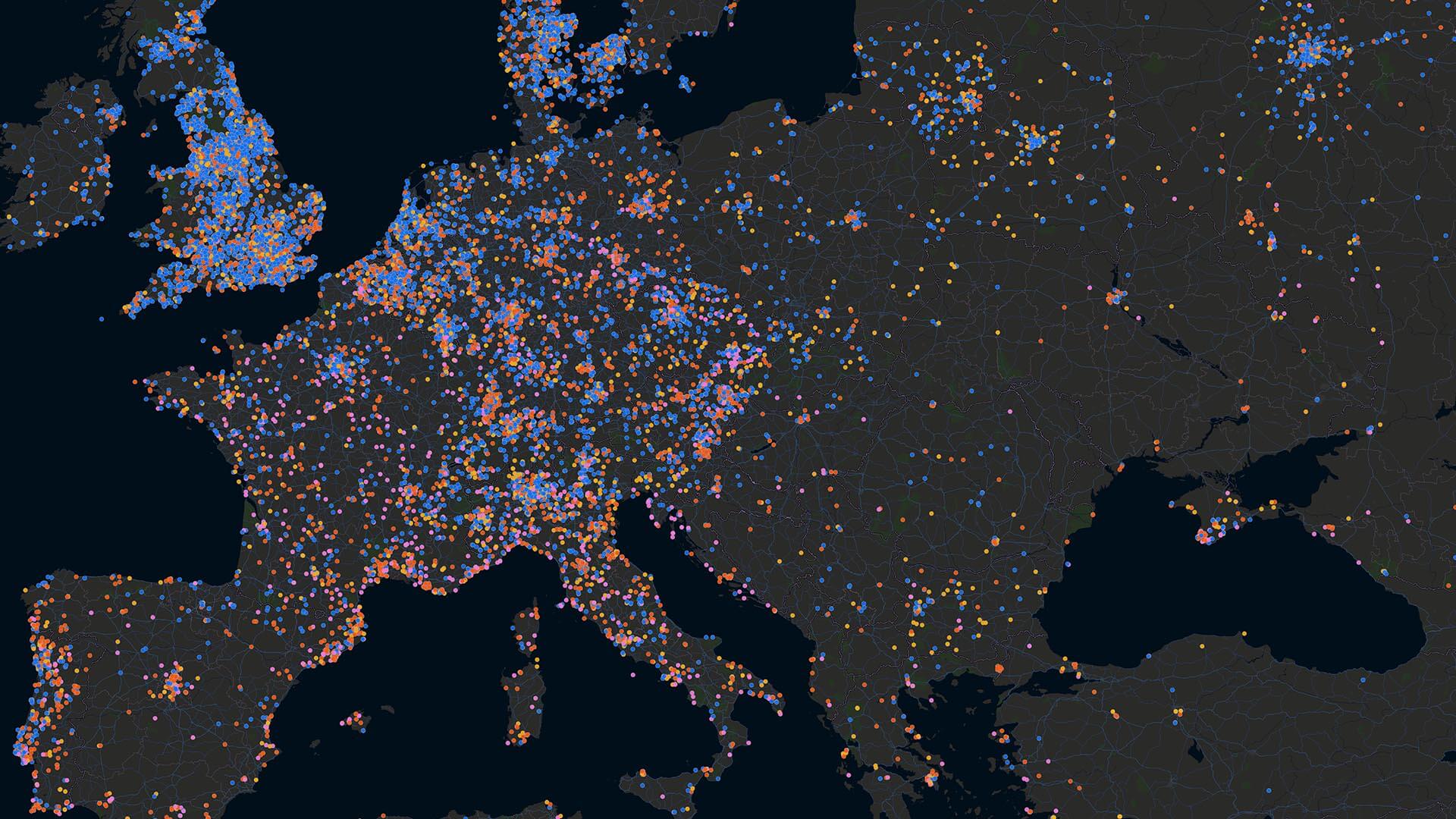
For innovation to thrive, geography matters.
That’s the core insight from a recent study, published in the journal Nature, that maps innovation networks in five of China’s largest metro areas.
The results offer a blueprint for using location intelligence to understand how and where innovation develops.
Buzz and Pipeline
The study defines innovation as a dynamic process involving the exchange of knowledge, technology, and resources. Researchers tracked how companies collaborated on patents and research papers to test a key theory proposed earlier this century: Innovation works best when two conditions exist.
First is the “buzz” factor. Companies should be clustered together geographically with other firms and institutions pursuing innovation. This creates opportunities for face-to-face interactions, knowledge sharing, and unexpected learning experiences.
Second is the “pipeline.” That’s where these local clusters connect to distant innovation hubs, bringing in outside knowledge and support.
The buzz-and-pipeline theory, developed by economic geographers in the early 2000s, suggests you need both local density and long-distance connections for innovation to flourish.
Mapping Innovation Networks
The researchers behind the Nature study mapped these innovation networks across five of China’s metro areas to see the theory in action.
They reviewed thousands of co-authored papers and joint patent applications, noting the location of each collaborator. In the Yangtze River Delta, China’s largest metro area, one collaborator might be in Shanghai, another in Nanjing.
That data allowed the authors to create maps of the buzz network for each metro area, showing which cities were the central innovation nodes and which were most strongly connected with others. Shanghai and Nanjing are the Yangtze River Delta’s most important nodes, but strong connections also exist between and among other cities such as Hefei and Hangzhou.
The authors created similar maps of the innovation networks in the other four metro areas. The result was a graphical representation of innovation buzz.
To reveal the long-distance connections that create the pipeline effect, the authors mapped collaborations that extend from one metro area to another, sometimes across hundreds of miles. The result was a large map of China’s innovation pipeline, with Beijing, Shanghai, Shenzhen, and Chengdu as the major nodes.
Innovation Networks Need Strong Buzz
The final part of the study involved analyzing and testing how well these innovation networks function and the benefits they provide for each region.
The researchers used satellite data and other analytical methods and concluded that buzz is even more important than previously thought. The pipeline effect only works when there’s already a strong foundation of face-to-face collaboration happening locally.
Applying a Geographic Approach to Innovation Prediction
Another key insight from the study: mapping makes invisible innovation patterns visible. While innovation networks sound straightforward, only geographic visualization shows how they actually work.
Businesses can apply this approach using geographic information system (GIS) technology to analyze their own innovation data.
Detailed information related to innovation in various industries across 42 nations is available in the Organization for Economic Co-operation and Development’s Innovation Indicators database.
Patent databases also allow businesses to perform analyses similar to those in the Nature study. The United States Patent and Trademark office maintains a detailed, location-tagged database with which businesses can study the cities and regions where certain types of innovation are emerging. The European Patent Office and World Intellectual Property Organization also offer extensive searchable databases.
With location-rich social media data from sources such as LinkedIn, analysts can further explore the makeup of innovation networks.
Open-source datasets that seek to predict which startups will succeed may also offer key insights. Kaggle’s Startup Success Prediction tool factors geography into its predictive model, with precise latitude and longitude coordinates for the companies it covers.
The lesson that businesses can take from the Nature study is that the spread of innovation always has a geographic component. With some creativity and tools like GIS, decision-makers can apply a geographic approach to better understand how and where innovation thrives.
The Esri Brief
Trending insights from WhereNext and other leading publicationsTrending articles
December 5, 2024 |

January 11, 2024 |
September 22, 2026 |
May 26, 2026 |

June 5, 2025 |

April 7, 2026 |