Lessons from the Past
For those of us who have a been around Artificial Intelligence (AI) for a few decades, the latest hype and hints of an impending bust bring on a strong sense of déjà vu. Today’s comments by many that AI will create mass unemployment at best or will be an existential threat to humanity at worst, border on the ridiculous while simultaneously seeming possible.
But, we have been here before, albeit with a little less hype. In the early 1980s, for example, Japan launched its 5th generation project to advance intelligent computing, setting off a wave of AI investments into new start-ups like Symbolics, Intellicorp and Inference. This era saw expert systems emerge, aiming to codify human knowledge to either boost or replace human expertise. The field quickly adopted new computing models based on symbolic processing, enabling faster knowledge codification, drawing interest from industries such as medicine, oil & gas, and manufacturing. And, because of the reliance on symbolic data, these systems were more transparent around decision making than today’s Large Language Models (LLM).
Although these systems showed potential, the era ended with an AI Winter. Expert systems were too costly to maintain and lacked flexibility, while early machine learning depended on a data infrastructure that didn’t exist. The necessary infrastructure for AI was missing, leading many—echoing the 1980’s Wendy’s commercial—to ask, “Where’s the beef?” Who better to answer that question than the agriculture industry?
Agriculture Intelligence (AgI)
So, what lessons should the ag industry take from that failed era of AI?
The first lesson is to ensure that the right data management infrastructure aligns with the inherent nature of agriculture – an industry that is built around the effective management of land. It goes without saying that land management is inherently geospatial and that GIS is ipso facto core to the agricultural data management infrastructure. Whether using drones or satellite data for precision ag or land management records, the industry could certainly benefit from a centralized geospatial infrastructure as espoused by the Federal Geographic Data Committee’s (FGDCs) National Spatial Data Infrastructure efforts.
FGDC’s efforts alone, though, cannot meet agriculture’s data management needs because the industry is highly fragmented, with different operational practices for livestock and crops and constantly facing global price pressures with unpredictable input costs. This fragmentation complicates the creation of a shared infrastructure across the supply chain, as some players focus only on processing or distribution. Meanwhile, both producers and integrators must maximize efficiency to stay competitive, a challenge intensified by climate change and geopolitical risks affecting input costs and supply chain stability.
The second lesson from the last AI winter is to ensure that these systems are trustworthy. While the last era partly failed because there was very little AI in the systems of the day, the current era with it’s fake generated content from AI, LLM hallucinations, etc. could quickly undermine the public trust, leading to a new AI winter. But for ag, producers and vertical integrators in the supply chain, trust centers less on credibility concerns and more on data interoperability that enables AI to detect and manage weaknesses, risks, and inefficiencies.
The third lesson is that while the AI market may have gone away back then, the technology did not. Much of what happened in the last AI winter, besides the loss of many start-ups and government funding, was the re-labelling or recasting of the terminology into other areas – business intelligence, data science, and so forth. In other words, the marketing “slight of hand” didn’t change the engineers’ progress towards intelligent systems, while the industry focused on simpler, higher ROI solutions.
Clearly a balance in agriculture between the opportunity AI presents and the potential concerns must be struck to prevent the mistakes from the past. We would suggest that the ag industry approach the technology with caution, perhaps referring to a set of principles under the umbrella term, Agriculture Intelligence (AgI).
So, then what is AgI? Without succumbing to the desire to ask ChatGPT, generally speaking the term is referred to as being associated with the 4th generation of agriculture, where the early generations are the neolithic (humans discover cultivation), industrial revolution (humans invent the tractor), and the green revolution (humans realize the need for conservation). The 4th generation is, hence, characterized by the use of data-driven technologies to optimize resources from both an environmental and economic perspective. In practical terms it means building out applications, both AI and non-AI, on a common infrastructure or platform. Intelligence, in this context, is more about optimization where non-AI techniques from Operations Research, for example, would be included in the definition.
Given that Agriculture Intelligence is less focused on loftier goals like Artificial General Intelligence, several guiding principles or constraints could be posited in this market as follows:
- Principle 1. Proper data management must always precede any introduction of AI.
- Principle 2. A trusted, centralized data infrastructure promotes data integrity but a federalized architecture reflects the realities of the industry.
- Principle 3. Incremental improvement strategies are preferred over disruptive paradigm shifts to ensure that technologies persist long enough for business outcomes to occur.
ArcGIS as an AgI Platform
While Principle 1 is readily understood by professionals in AI today, the imperative to manage geospatial data as a valuable and even a foundational asset is less widely recognized in the broader IT community. ArcGIS was designed to unify various geospatial communities outside of IT by doing the heavy lifting of integration of as many spatial data formats as possible governed by an intermediate layer called a geodatabase coupled with geoprocessing routines. This decades long effort resulted in the right data management infrastructure for geospatial data, where other approaches tended to pick one data paradigm to build out a full stack that requires an overuse of system integration.
Principles 2 and 3 fall easily out of Esri’s focus on standardizing around a geodatabase. When deployed in a federated architecture, for example, geodatabases provide integration points in an architectural topology that allows for easy geodata sharing. And, the geodatabase layer increases the ability to rapidly develop applications, which could initially serve as a point solutions that lead to broader, enterprise-level workflows.
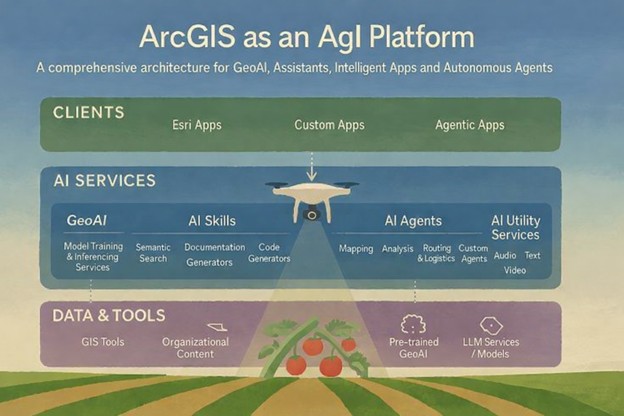
Within those enterprise workflows, integrating AI into ArcGIS becomes simpler and can take various forms (see Figure 1). Notably, adding Knowledge Graphs (KG) in ArcGIS Knowledge—referenced in “Scalable Knowledge Management to Meet Global 21st Century Challenges in Agriculture”—draws on symbolic processing traditions like the Cyc Project. When paired with geographic features extracted from the use of GeoAI, these KGs create a scalable semantic layer that can guide LLMs trained to query only the ArcGIS knowledge base. This setup limits responses to known information, reducing hallucinations and guessing. For AgI, it means prioritizing deliberate knowledge acquisition over indiscriminate data collection. Scalable KGs combined with LLMs’ common-sense traits could address the brittleness of earlier expert systems, while KGs offer users greater transparency in to how answers are generated.
The Future of Ag Intelligence
Strong knowledge management foundations and a robust, federated geospatial infrastructure—exemplified by ArcGIS—are essential for advancing agricultural intelligence in a way that supports reliable AI applications and scalable knowledge sharing. By prioritizing deliberate integration and incremental improvements, organizations can avoid past pitfalls and realize the full potential of geospatial AI in agriculture.
But, where is this all going?
As the future of agricultural intelligence unfolds, the integration of AI, high-resolution data, and geospatial analytics will continue to empower stakeholders with more precision necessary to extract even more costs out of industry inefficiencies.
But, the future is not without risk. Failures to adhere to the three discussed principles along with forces external to the industry could usher in a new AI winter, blizzard or a “bomb cyclone”. In that scenario, working with companies like Esri, who have weathered similar storms for decades, will be the best mitigator.
And, of course, what better way to manage the weather than to use a GIS?