
June 19, 2019 |
Carl Walter | Public Safety
September 22, 2026
Elizabeth Rubin has made a career of thinking five steps ahead. An epidemiologist and emergency planner for the Los Angeles County Department of Public Health (DPH), she anticipates and prepares for threats spanning Ebola to earthquakes. Her latest challenge was the largest sporting event on Earth.
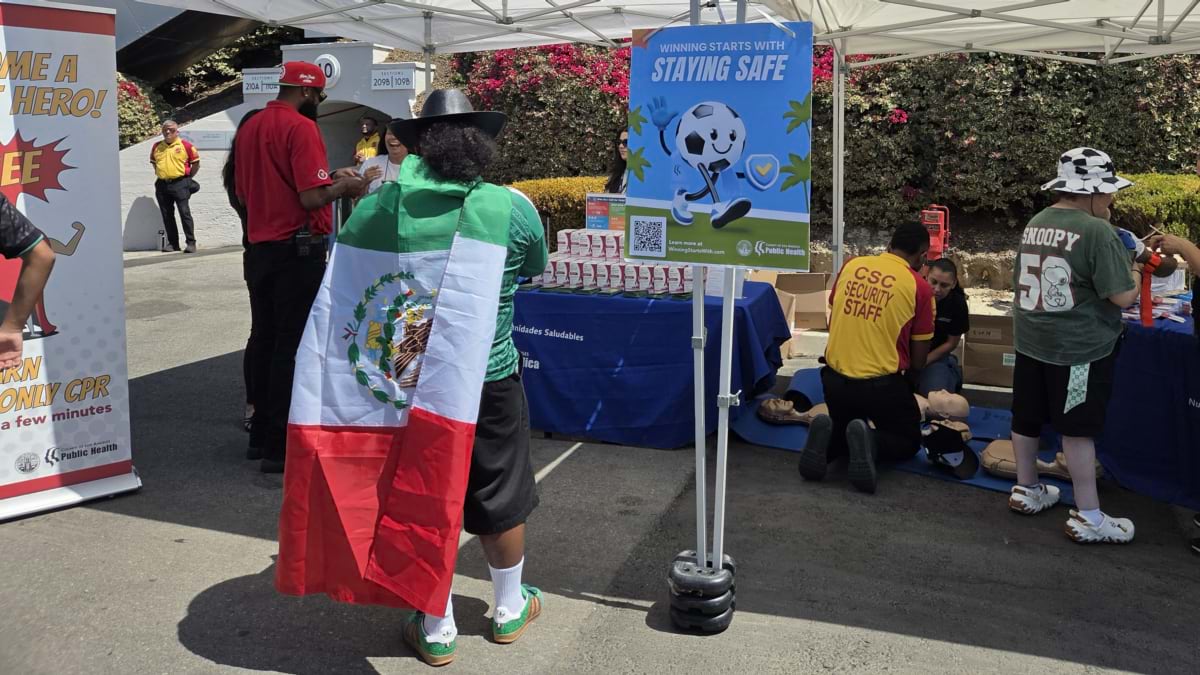
The 2026 FIFA World Cup drew billions of viewers and millions of spectators. As one of the host cities, LA welcomed athletes and fans from around the world. Special event planning was a new foray for Rubin, and the scale was unprecedented. Over 39 days, SoFi Stadium hosted eight matches and nearly 600,000 fans. Hundreds of thousands more attended FIFA watch parties throughout LA County. With 88 cities sprawled over 4,000 square miles, LA is the most populous county in the US—home to more residents than 40 individual states.
Coordinating public health operations took constant collaboration among county officials, first responders, and city governments, along with state partners and federal agencies.
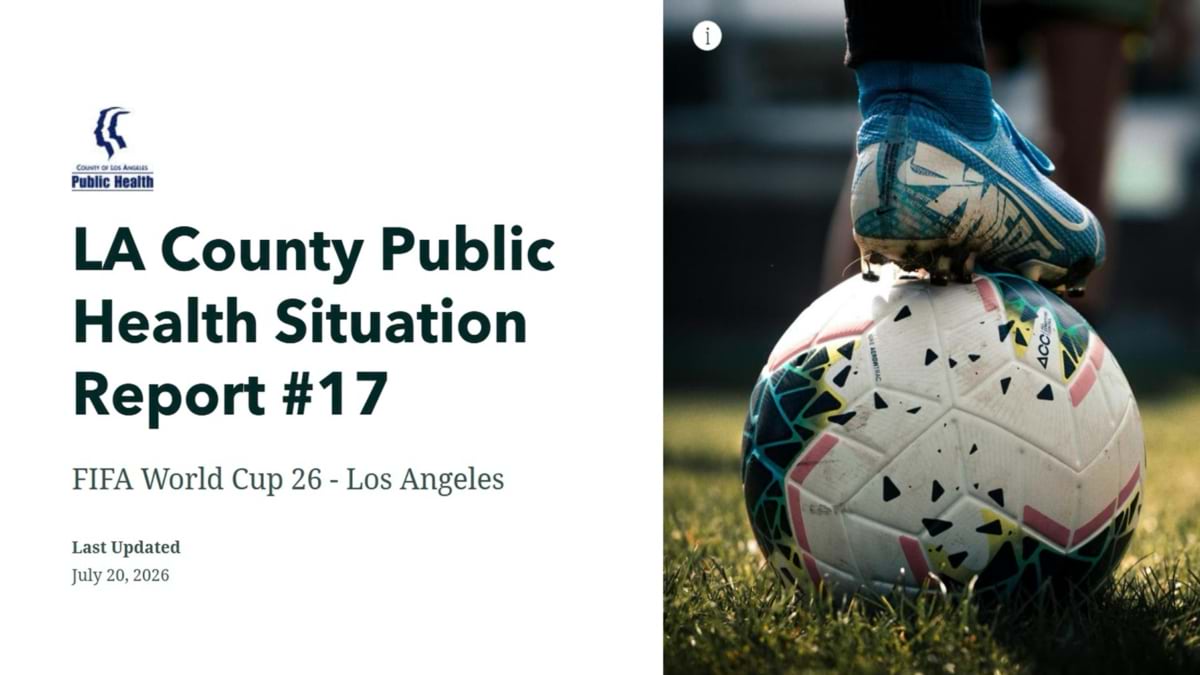
“Part of my team’s job is developing situation reports,” said Rubin, who works in the Emergency Preparedness and Response Division. “The reports give internal and external teams information on current conditions, what actions the department is taking, and any specific incidents we may need to respond to.”
Rubin and her colleagues knew the traditional approach—manually compiling data and emailing static reports—couldn’t keep pace with the World Cup. So, she led the development of a tool powered by geographic information system (GIS) technology that offers near real-time situational awareness. This gave agencies a single, continuously updated view of operational insights including weather forecasts, heat risk projections, air quality data, and disease surveillance. Collectively, Rubin’s team produced 17 situation reports from June 1, 2026, through July 17, 2026.
They also saw the World Cup as an opportunity to build and test the tools they will use when Los Angeles welcomes another international audience on an even larger scale: the 2028 Olympic and Paralympic Games (LA28).
Rubin has supported situation reporting for every major LA County public health activation since 2014, including COVID-19, the 2015 Aliso Canyon gas leak, and multiple wildfires. Creating those reports was labor-intensive and time-consuming. Teams manually gathered data (e.g., case numbers, DPH recommendations, and more), compiled it into Microsoft Word documents, converted them to PDFs, and distributed the reports by email.
In fast-moving situations, information was often outdated by the time it reached decision-makers. This shortcoming intensified during fast moving emergencies, such as the Eaton and Palisades wildfires that raged across LA County in January 2025.
“We were using this cut-and-paste method of extracting information about a fire and putting it in a PDF,” Rubin said. “That information was old and outdated and not really the right situational awareness for the moment.”

When World Cup planning began later that year, Rubin seized the opportunity to modernize. With encouragement from her supervisor, she worked with the department’s GIS team to create a new reporting solution. It combines maps, dashboards, text, hyperlinks, images, and videos in an interactive, up-to-date narrative. Agencies no longer wait for the next emailed report. They access a shared view of geographic patterns, public health trends, emergency responses, research findings, and community impacts in one place.
“We wanted to reduce manual entry and human error and have the most current information at our fingertips,” Rubin said. The report includes surveillance summaries on topics such as communicable diseases and wastewater. It also features live data from authoritative sources, including the National Weather Service and US Centers for Disease Control and Prevention (CDC). “Not having to cut and paste things like weather reports every day really saves us so much time,” she said.
Over the course of the tournament, the digital situation report gave a holistic view of major event locations. Beyond the eight matches at SoFi Stadium and official Fan Festival at the LA Memorial Coliseum, watch parties took place at 10 FIFA Fan Zones and hundreds of community events across LA County. The stadium alone holds more than 70,000 fans. Each additional location carried its own mix of risks and needed its own mix of data.
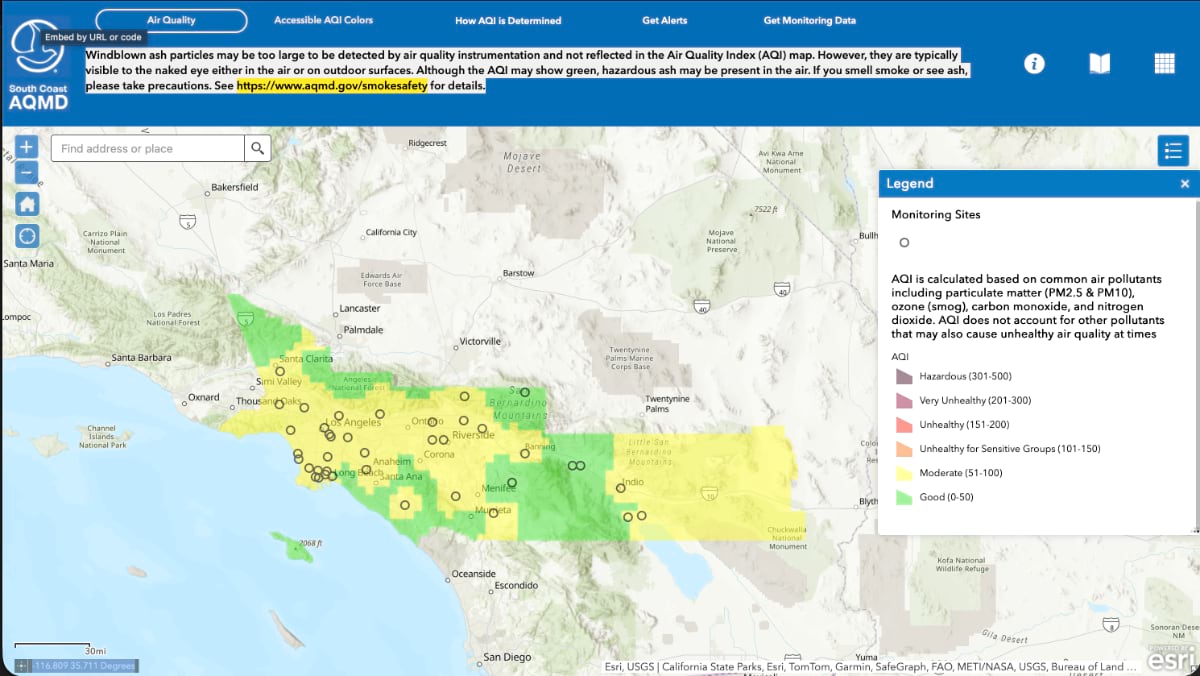
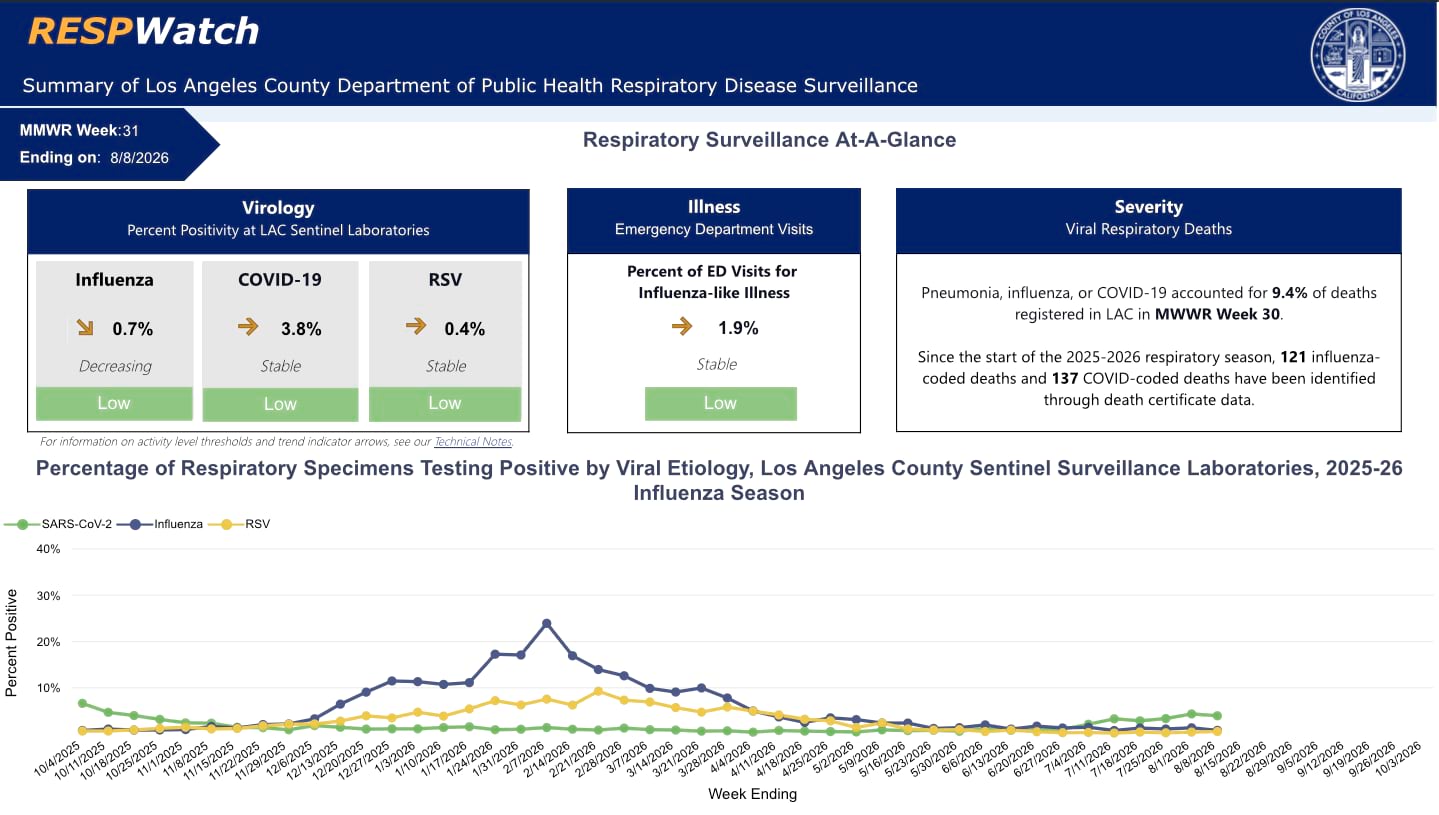
To keep pace, Rubin’s team folded a wide range of indicators into its report. These included event summaries for FIFA matches and fan events; broad domestic and international disease surveillance dashboards; respiratory illness surveillance via RESPWatch, LACDPH’s public-facing Power BI tool; local monitoring of heat-related illness and syndromic surveillance signals; and live weather forecasts and air quality monitoring that automatically updated for each venue.
With international fans and summer tourists streaming in and out of the region, infectious disease transmission was top of mind. When flu cases ticked up mid-tournament, Rubin’s team spotted it immediately: “We could see it in the surveillance dashboard very easily.”
Extreme heat was also a top concern, so they built in HeatRisk, a CDC tool for at-a-glance monitoring throughout the vast county.
“LA County has different microclimates,” said Rubin. “You can have an extreme heat warning in Pasadena, and it’s totally fine in Venice Beach.” The report let officials read conditions venue by venue. As city staff deployed to events, they knew what was happening, where it was happening, and how to prepare.
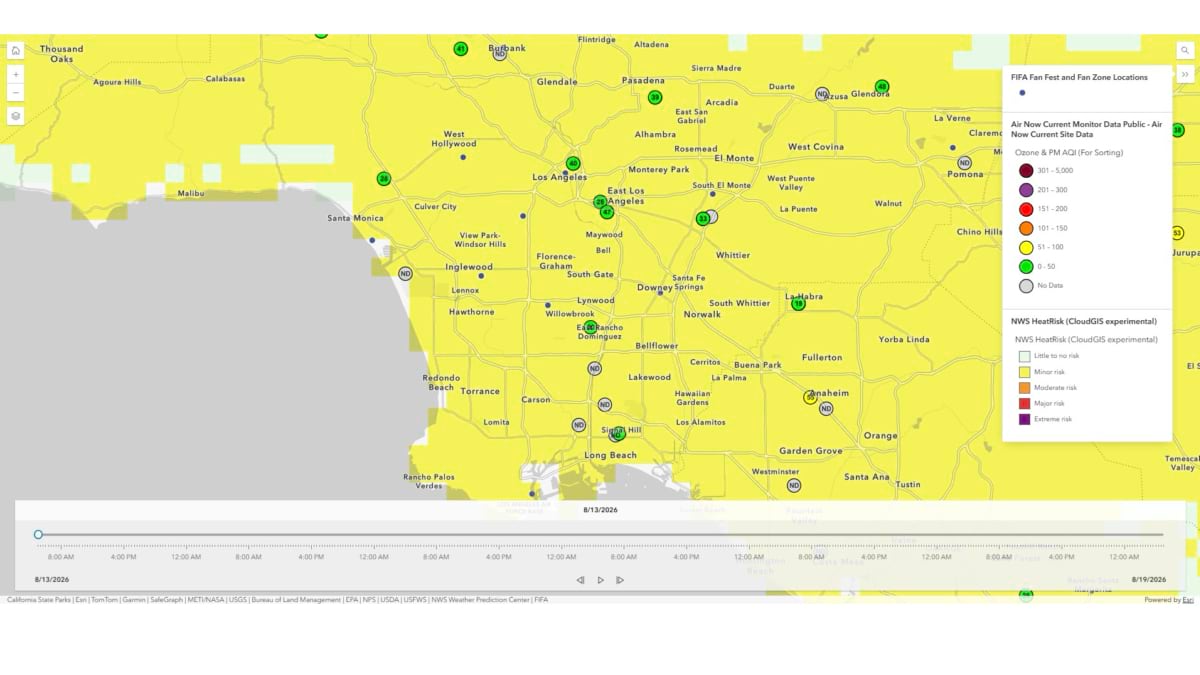
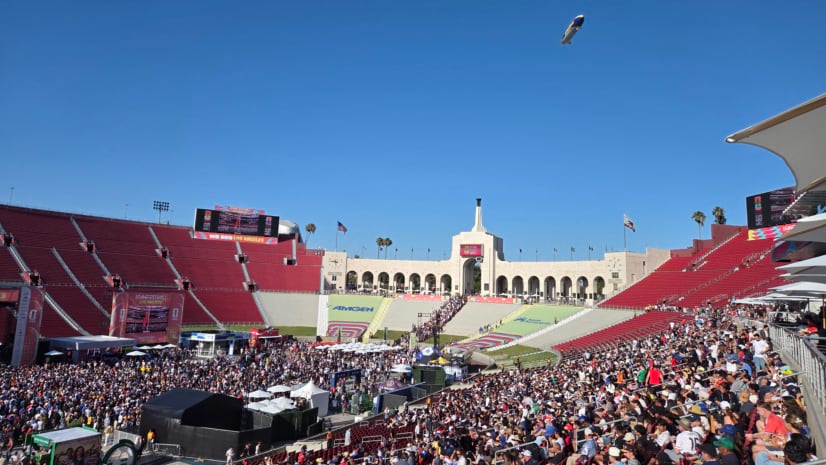
Opening weekend put that to the test. The LA Memorial Coliseum hosted the FIFA Fan Festival. The historic outdoor venue holds 77,500 people, and sweltering temperatures threatened.
“We used weather information from the report to see how warm it would be,” Rubin said. “Then we deployed environmental health inspectors to assess water availability prior to the event, community field services staff to make sure water and cups were available during the festival, that the venue had what it said they would supply.”
The situation report reached a broad network of external partners. Neighboring jurisdictions and city governments, police and fire departments, other World Cup host counties, and partners at federal agencies like the CDC and the Administration for Strategic Preparedness and Response were eager to pass the report along to their own networks. Some updates reached California Department of Public Health reports distributed statewide.
If the World Cup was a midterm, LA28 is the final exam.
LA County’s World Cup response centered on one competition venue and multiple official and unofficial fan events. The LA28 Games will span dozens of competition venues, training sites, and support facilities across Southern California—during the height of summer. Rubin’s focus is on building the data infrastructure needed to support such a monumental event.
“We want to be really thoughtful about setting up the data pipelines,” she said.
The planning group is already specifying what data teams will need and the best ways to display it. They’re also refining surveillance systems, training staff, and preparing for more robust information sharing.
“Each competition venue, training site, and Olympic Village is going to have medical clinics,” Rubin said. “The information sharing with our partners is going to be on a much larger scale than the World Cup.”
For most spectators, the work will go unnoticed. While crowds swell and world-class athletes vie for gold and glory, Rubin and countless others will be carefully monitoring conditions behind the scenes, and providing key information to decision-makers for potential health protective action.
If all goes well, as it did for the World Cup, the fans will never know. Because in public health, an event that passes without incident is exactly the goal.
Learn more about how public health workers apply GIS to reveal gaps in care, enhance workflows, and improve response.