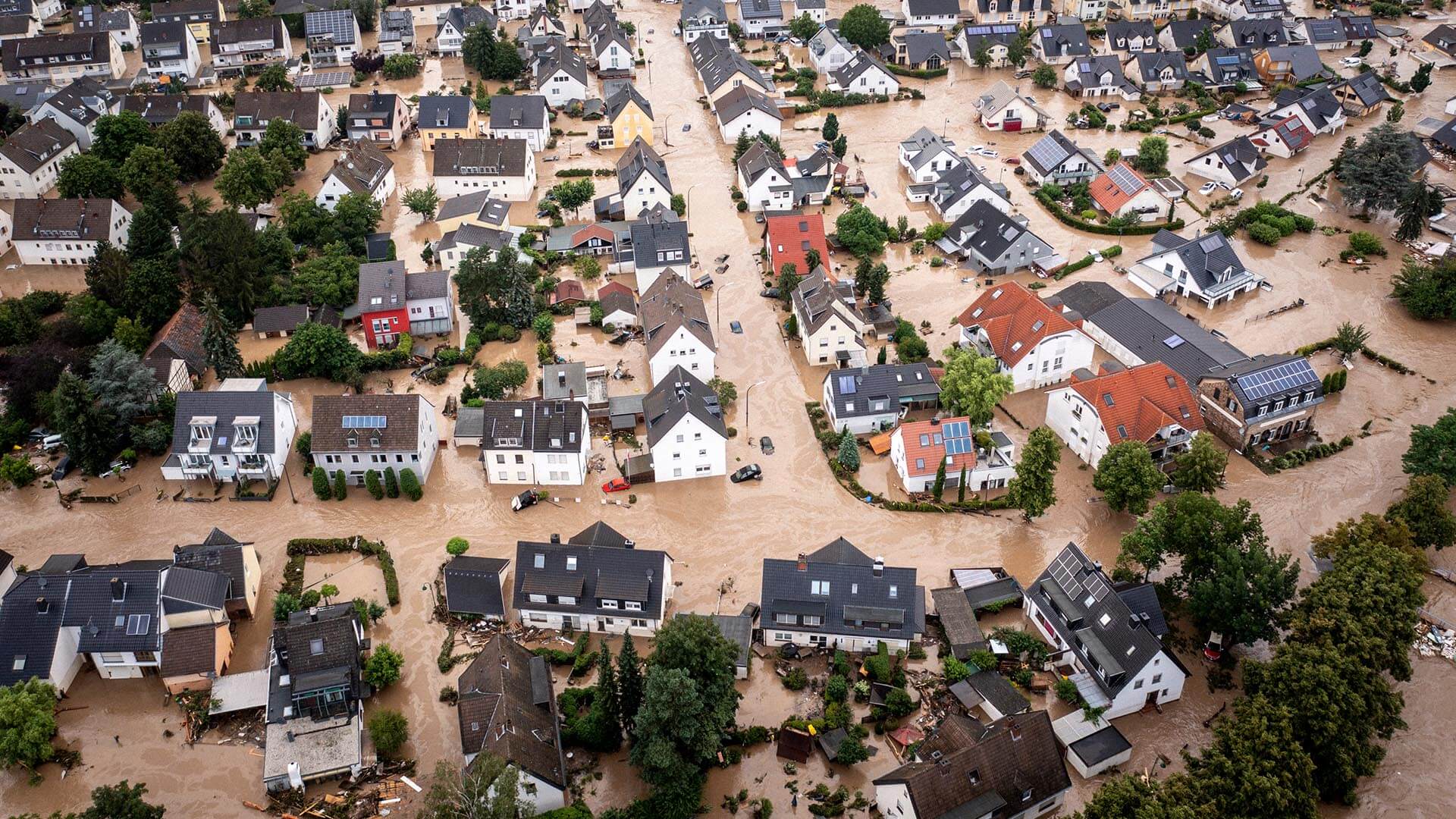
At the start of 2026, a series of major storms pushed UK rivers beyond capacity, flooding communities and damaging property in southern England, Scotland, and Northern Ireland.
As Bloomberg reported, changing weather patterns—and the growing frequency of extreme events—are pressuring home‑financing companies to demonstrate that they’re evaluating flood exposure with rigor and precision.
Weeks before the storms struck, the UK’s central bank finalized requirements for private banks to incorporate physical climate risks, including flooding, into credit assessment and risk management. Tech-savvy organizations are already using spatial analysis to understand which properties face heightened exposure.
As larger areas of the UK and the world become vulnerable to flooding, map‑based risk analysis, grounded in geographic information system (GIS) technology, is becoming a core business practice.
From Regional Risk to Hyperlocal Analysis
England’s 10-year flood action plan, issued in late 2025, underscores a global reality: Community defenses such as walls and embankments may not protect individual properties and don’t determine whether an individual property will retain its value, remain insurable, or recover quickly after a flood.
For organizations whose balance sheets depend on real estate—banks, insurers, investors, retailers, and others—a hyperlocal understanding of risk has become the gold standard.
Fannie Mae, for example, uses GIS to analyze how hazards such as flooding intersect with property location and home values. This kind of modeling can surface vulnerabilities that remain invisible in conventional datasets.
A major Dutch real estate investor applies a similar approach to its portfolio of residential, office, and retail holdings. By mapping hazards such as flooding, heat stress, and wildfire risk, the firm assesses how climate exposure may evolve over each property’s lifespan. These insights feed directly into investment decisions and portfolio planning.
Similarly, one of the world’s largest hotel chains uses GIS to gauge risks to its properties, overlaying real estate footprints with climate and weather data. This allows decision-makers to assess how threats like flooding and extreme heat may affect assets over time—and plan accordingly.
Avoiding Lock-In to Long-Term Risks
In its article on UK floods, Bloomberg noted a key asymmetry that explains why flood risk poses a particular challenge to mortgage lenders and investors.
Insurers operate on relatively short time horizons. They use hyperlocal analysis to assess risks and can adjust premiums on an annual basis—or withdraw coverage. Mortgage lenders and investors do not have that flexibility. Home loans are repaid over decades, and property that appears sound today may face very different conditions 10 or 20 years from now, particularly as weather patterns shift.
That reality makes predictive modeling essential. Banks need to understand not only where flood and other risks exist today but also how likely those hazards are to change over the life of a loan.
In a future shaped by climate volatility, risk assessment is becoming less about broad averages and more about hyperlocal analysis. By using GIS to map climate projections, flood modeling, land use, and population data, lenders can better assess long‑term exposure when making critical investment decisions.
The Esri Brief
Trending insights from WhereNext and other leading publicationsTrending articles
December 5, 2024 |

January 11, 2024 |
May 26, 2026 |
September 22, 2026 |

September 15, 2026 |

June 5, 2025 |