Authored by: Owen Mo, Pasadena Water & Power GIS Team
Empowering a Smarter Utility
Pasadena Water and Power (PWP) provides water service to nearly 38,000 households and businesses in Pasadena, California, as well as the surrounding communities of Altadena, San Marino, San Gabriel, and many others. For Pasadena Water, GIS is more than just a mapping tool; it has become a strategic platform for operational efficiency and organizational communication.
GIS Express is an integrated suite of comprehensive GIS solutions powered by ArcGIS Hub, ArcGIS Experience Builder, ArcGIS Dashboards, ArcGIS StoryMaps, and other modern web frameworks. It is a centralized, accessible and innovative platform that enhances infrastructure management, supports field operations, and increases public transparency across the Pasadena Water Division.
Pasadena Water GIS Hub: Central Access to Water Projects
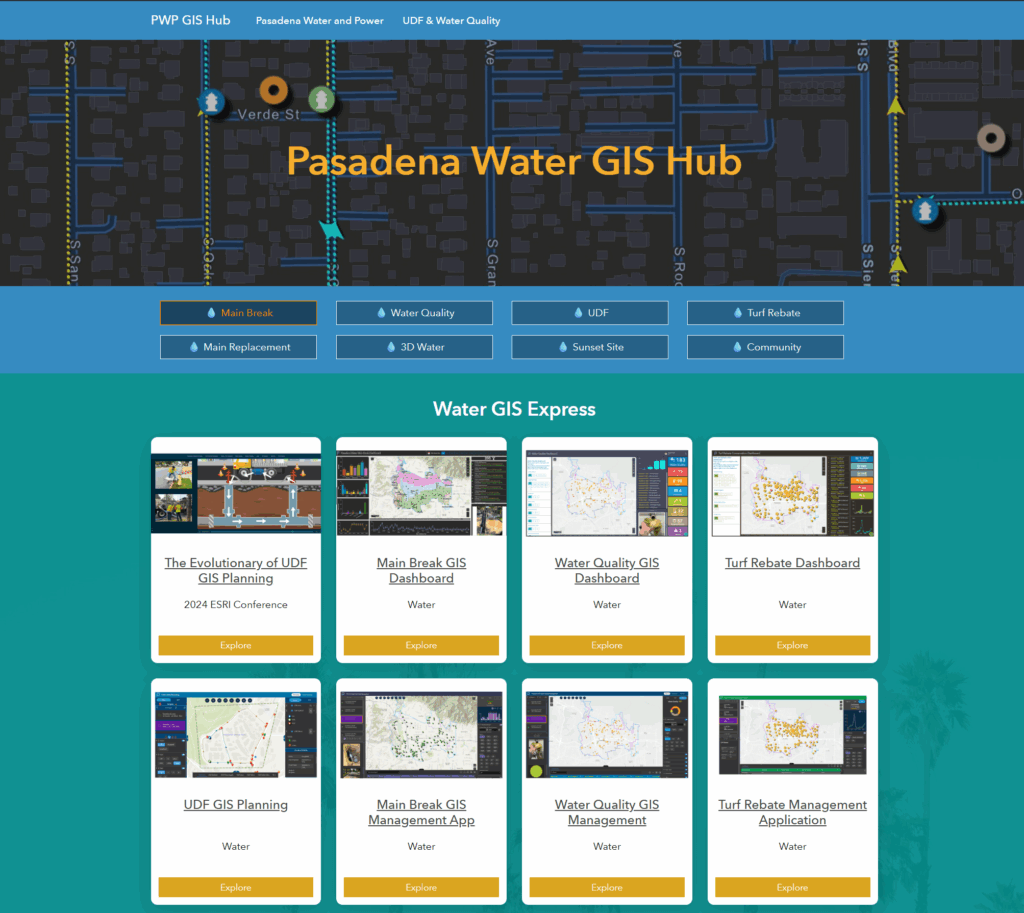
At the center of this integration is the Pasadena Water GIS Hub, an interactive platform for the public, internal teams, and cross-organizational partners to understand active projects, proposed plans, and historical records related to Pasadena Water.
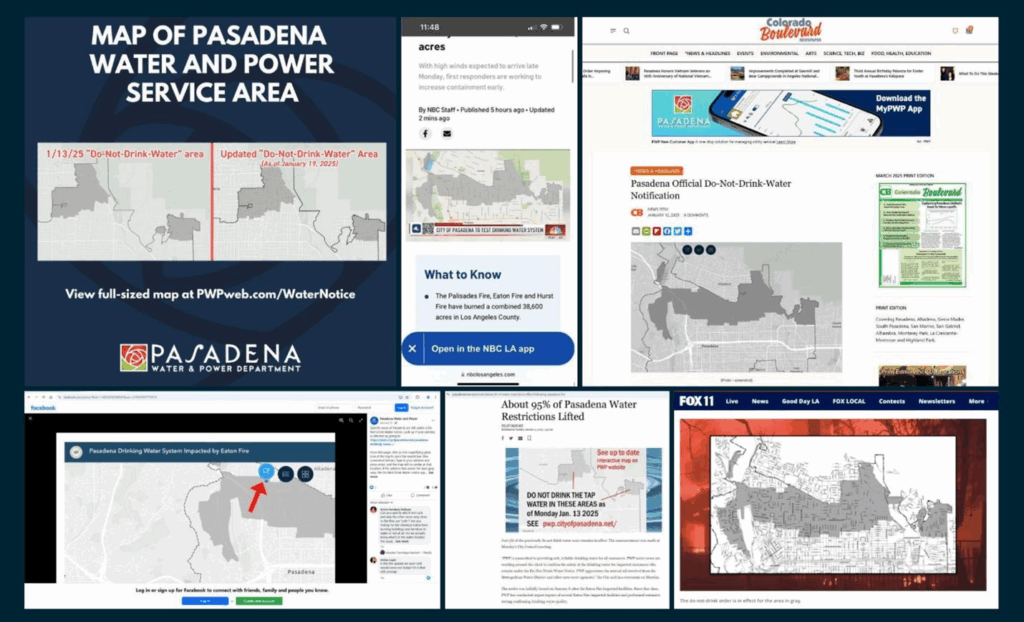
The Hub functions as both a communication and outreach channel across the community and the organization. It has served as a public gateway for sharing emergency updates such as Do Not Drink Water Advisories in the affected areas during the Eaton Fire incident.
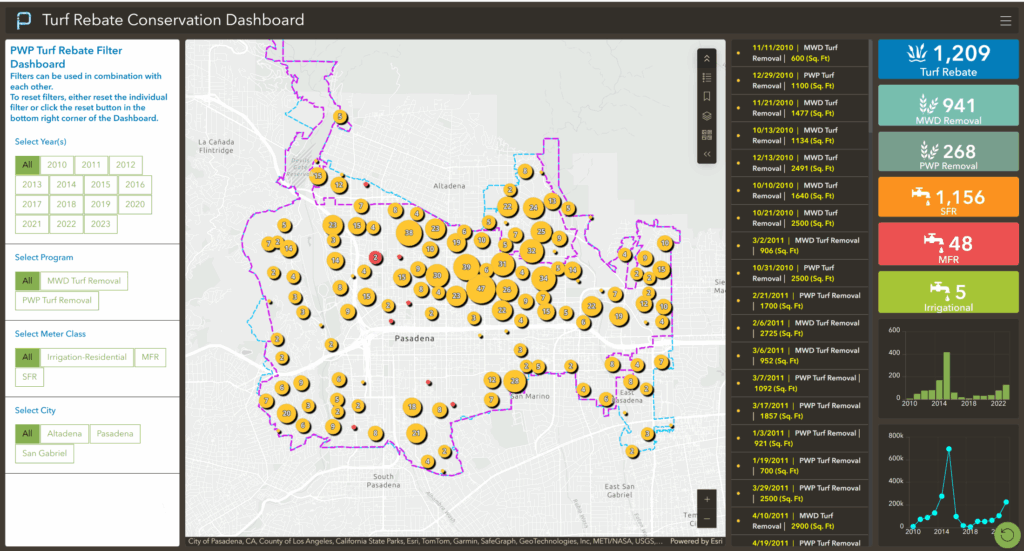
The hub delivers real-time insights into key Pasadena Water projects, including water main break analysis, water quality reporting, unidirectional flushing (UDF) operations, turf rebate water conservation programs, and 3D asset management vision. Managers, engineers, and field crews use the GIS platform to share insights, coordinate work, and address operational challenges.
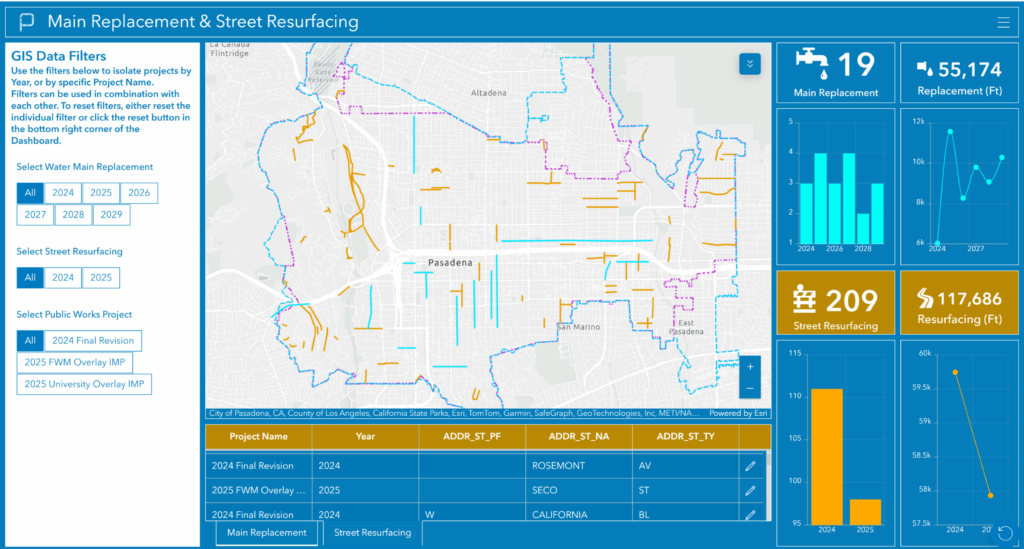
The Hub supports cross-organizational collaboration by bringing other departments together to coordinate the city’s infrastructure projects. A notable example is the Main Replacement and Street Resurfacing Partnership between PWP and Public Works (PW) departments. By planning and visualizing water system upgrades and street resurfacing together, both departments can better align schedules, reduce construction conflicts, and minimize impacts to the community.
By making GIS more accessible and increasing user engagement, the Hub has become essential to fulfilling PWP’s mission of creating public value and enhancing operational effectiveness.
Eaton Fire Incident: GIS Rapid Response
The Eaton Fire in January 2025 highlighted the critical role of GIS in emergency response and public communication. The fire damaged reservoirs, tanks, and pump stations in foothill areas of Pasadena and Altadena, raising potential water quality attention.
Within 48 hours, the PWP GIS team deployed a Do Not Drink Water Advisory application, allowing residents to search by address and view real-time service impacts. By the end of January, the application and its shared web layers had received more than 23 million views, largely due to active promotion by executive leadership and department staff, as well as the PWP website, social media, news outlets, and customer communications channels.
This response demonstrated how GIS can deliver emergency awareness to the public through a real-time, visual, and efficient process.
Water Main Break GIS Solution: Real-Time Monitoring and Analysis
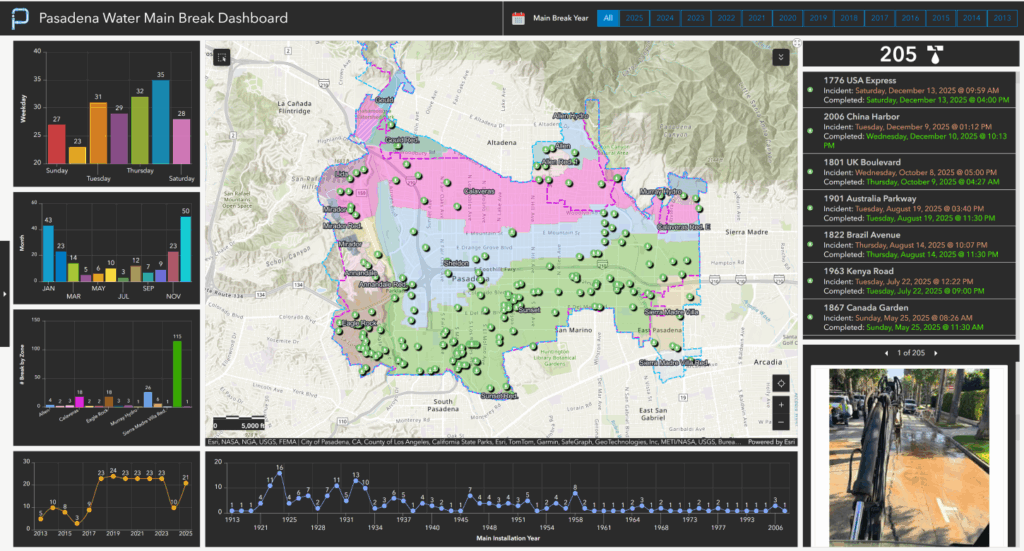
Before 2023, water main break incidents were documented using handwritten paper forms. Recognizing the need for modernization, PWP developed the Main Break GIS Solution to track, visualize, and analyze break incidents across the water distribution system.
Field crews capture main break details directly in a mobile GIS application, including incident time, pipe material, meter size, and pressure zone. The information is stored in the enterprise GIS system and is made immediately available to executives, engineers, and supervisors. The process has significantly expanded analytical capabilities, enabling engineers to visualize asset relationships throughout the water distribution network. Executives leverage ArcGIS Dashboards to monitor system performance and make strategic decisions based on key performance indicators.
This modernized approach helps PWP identify system vulnerabilities, prioritize capital improvements, and optimize overall system performance.
Water Quality GIS Solution: Complaint Mapping and Coordination
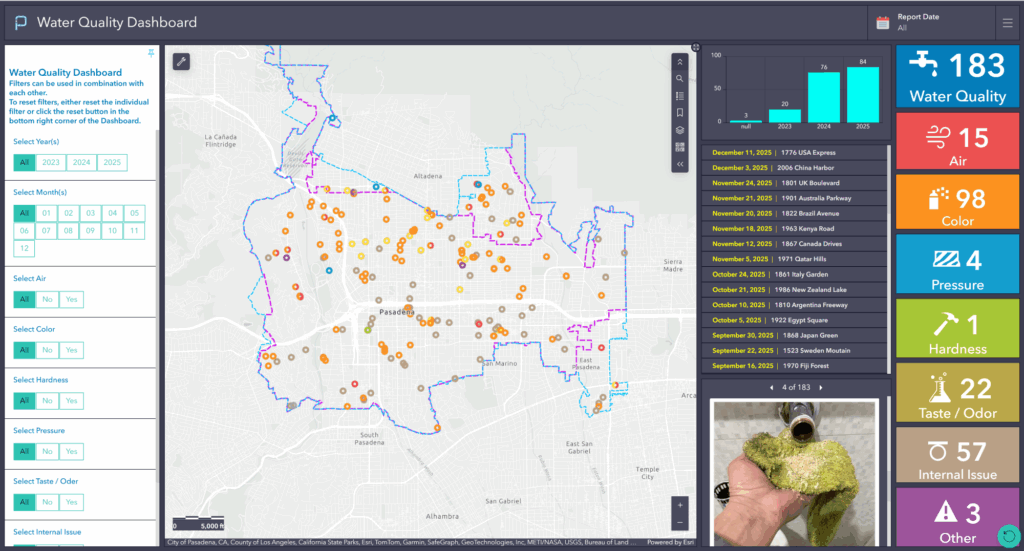
In the past, water quality complaints were manually tracked in Excel spreadsheets. In May 2023, the water quality team requested a GIS solution to map, document, and respond to customer’s concerns.
To support this effort, a dynamic donut chart symbol was designed to represent cases with single or multiple complaint types. Water quality managers, engineers, and laboratory scientists analyze complaints by month, year, or combined categories. Based on the analysis, PWP can identify spatial patterns during their investigations of complaint clusters and ultimately dispatch UDF trucks for targeted flushing.
This integrated workflow has improved response times, enhanced monitoring, and increased community confidence in Pasadena’s water quality management.
“With our new GIS Solutions, we can finally keep track of our Water Quality Complaint and Unidirectional Flushing Program records in a map-based system which allow us to easily see which areas can benefit most by flushing. This allows us to work in a more efficient and targeted manner. These GIS applications also allow us to access historical records quickly and can help us to determine how frequently maintenance should be performed or if main replacement is warranted.” —Myriam Cardenas, Water Quality Advisor
Unidirectional Flushing (UDF) GIS Solution: An Evolutionary Workflow
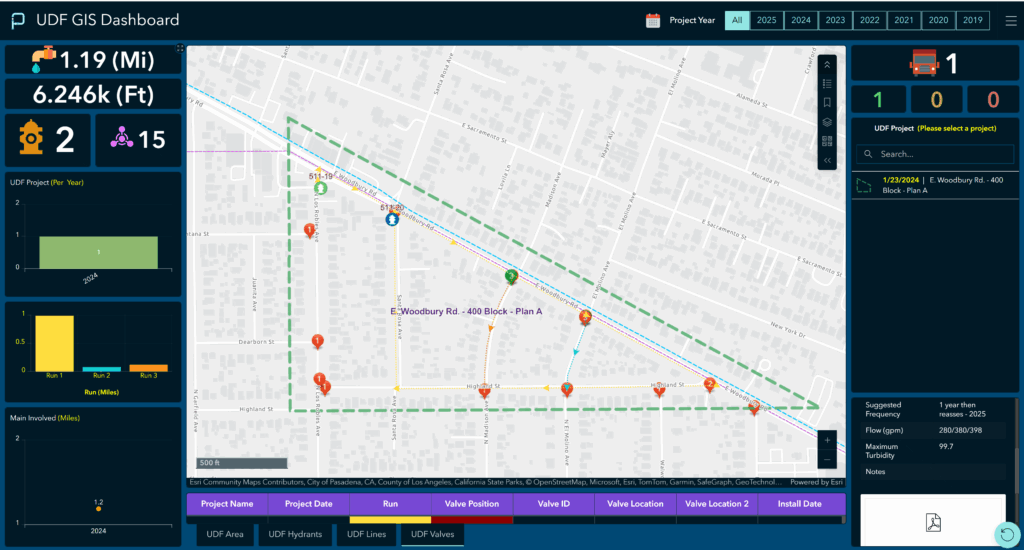
Unidirectional flushing is a water-efficient method for cleaning pipelines to improve water quality. During the operation, field crews would close valves to isolate pipeline sections, then use the UDF truck to connect two hydrants to form a controlled flushing loop to remove contaminants.
Before 2024, UDF planning relied on paper maps, manual schedules, and spreadsheet-based documentation. To innovate this workflow, the UDF GIS Solution was developed to support digital planning, execution, and monitoring.
Each UDF project is mapped, including the flushing area, associated hydrants, pipelines, and valves that need to be opened or closed during the process. Field teams execute plans using mobile applications, while engineers and supervisors track progress through live maps, applications, dashboards, and analytics tools.
The successful deployment of this solution significantly improved operational efficiency and field coordination for Pasadena Water.
3D GIS Vision for Water: A Power Visualization Perspective
The earliest known 3D map, dating back approximately 13,000 years, was constructed on the floor of the Ségognole 3 cave in France. Paleolithic residents shaped sandstone to model local landscapes, water flows, and geographic features of the Paris Basin. Using water itself to animate the model, this ancient artifact represents the earliest known hydrologic model.
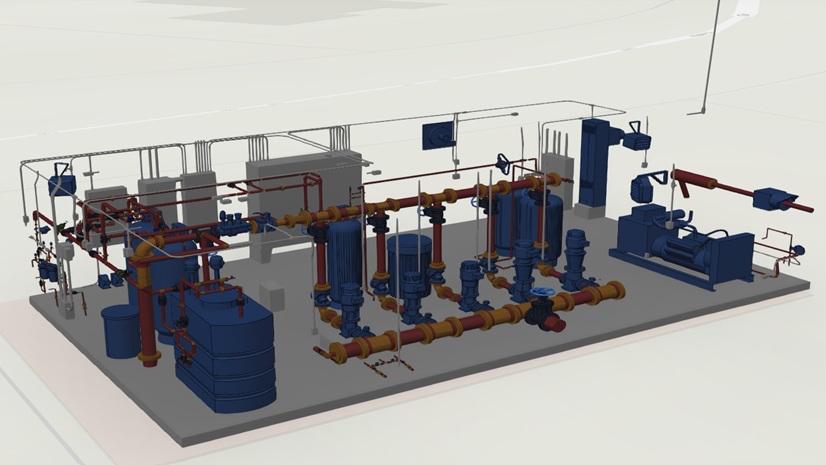
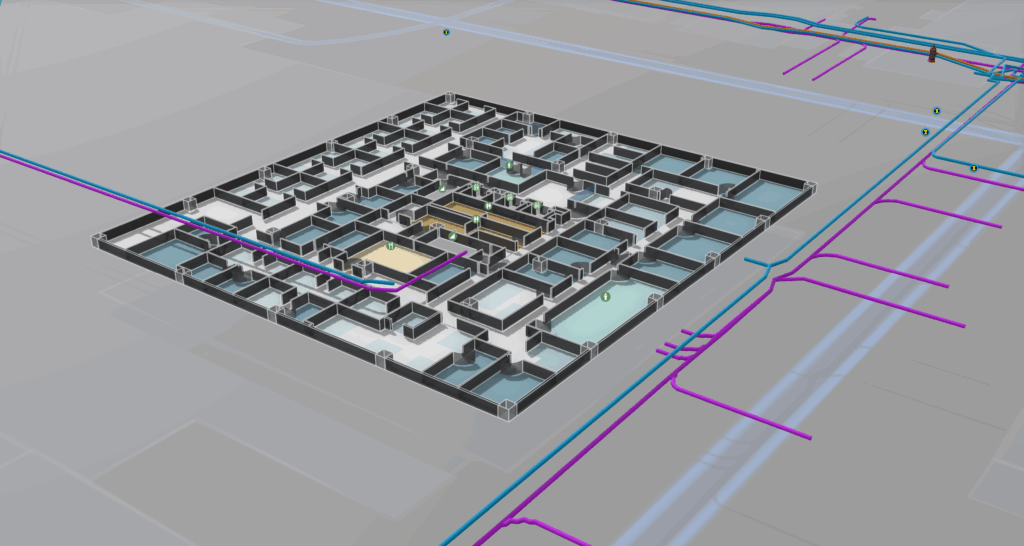
Today, PWP carries forward this legacy of 3D spatial visualization to support the design and coordination of water infrastructure in dense urban environments. The primary value of 3D GIS lies in visualizing vertical separation between water mains and adjacent below-grade utilities, including sewer mains, storm drains, electrical, gas, cable, and other underground infrastructure. Engineers can better evaluate alignments, depths, and clearances within congested utility corridors when designing new water mains and replacing aged ones.
This 3D perspective reduces design uncertainty, minimizes field conflicts, and lowers construction risk.
A Platform for the Future
GIS Express displays how PWP is using GIS as a comprehensive and enterprise platform rather than a stand-alone technology. By centralizing data, enabling real-time workflows, and supporting cross-department coordination, GIS increases operational awareness and enhances decision-making at many levels of the organization. As PWP continues to modernize its infrastructure, this platform provides a scalable foundation to support resilience, transparency, and reliable service to the community.
“GIS has been a transformative force for Pasadena Water and Power. It has modernized how we visualize our infrastructure, coordinate field work, and make informed operational decisions. By delivering real-time insights and enhancing collaboration across our utility divisions, GIS is helping us provide safer, more reliable, and more efficient service to the Pasadena community.” —Jeremy Marquette, Assistant General Manager, Water & Power Department, City of Pasadena

Stay Connected with Esri’s Water Team
ArcGIS is an extensive information system that enables modernization of workflows with easy-to-use applications for the field and office. Strengthen your organization with geospatial solutions that will increase efficiency and provide insight for decision-makers.
Visit the Esri Water Utilities web site for more information.
Join the Water Utilities Community
Follow #EsriWater on social media: X| LinkedIn
Subscribe to the Water Industry newsletter “Esri News for Water Utilities and Water Resources“