
December 15, 2022 |
Multiple Authors | Public Safety
January 15, 2026
For the first time, California can show with data, maps, photos, and reports whether taxpayer-funded wildfire mitigation projects are delivering a return on investment.
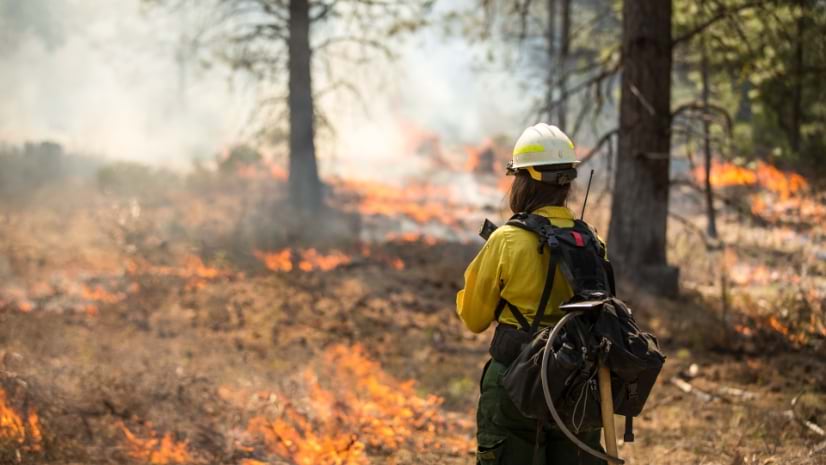
Fire managers have long considered fuel treatment to be beneficial. Their crews would clear dry brush from forests, create fuel breaks, and conduct prescribed burns. When wildfires eventually tested those treatments, oftentimes the flames moved slower, giving firefighters more time to battle the blaze.
But there was a problem. While firefighters and foresters saw the advantages on the ground, they couldn’t consistently prove those outcomes to the legislators and policymakers in charge of critical funding.
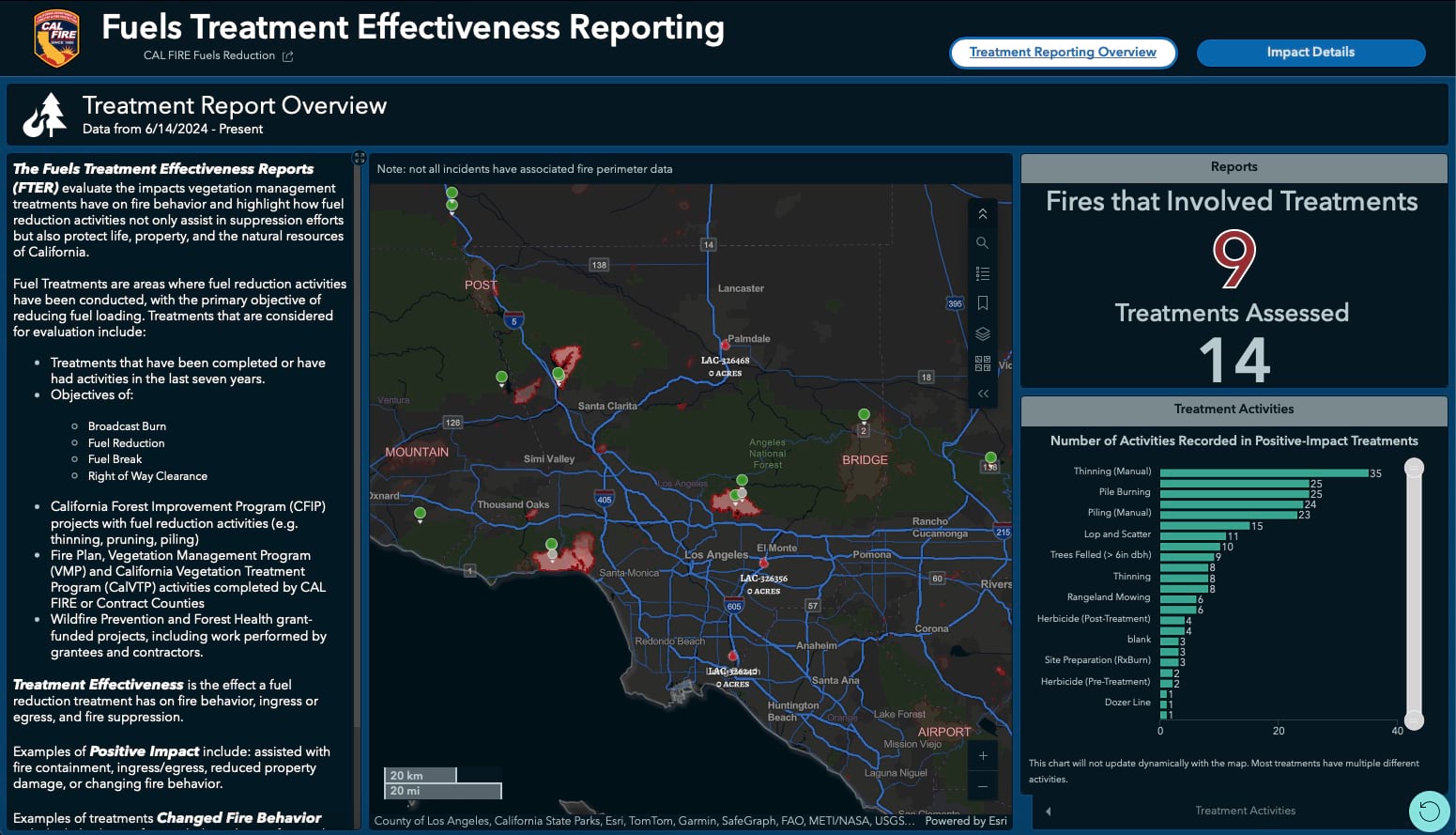
Today, the California Department of Forestry and Fire Protection (CAL FIRE) uses a new data-driven system built with geographic information system (GIS) technology to track the real-time impact of fuel treatment activities.
Frank Bigelow, deputy director for CAL FIRE’s Community Wildfire Preparedness and Mitigation Division, is quick to admit the old way of proving fuel treatment effectiveness was cumbersome and often abandoned.
“It was done on paper, and it was arduous,” said Bigelow, who oversees 22 programs, including those that deal with defensible space inspections and wildfire prevention grants. “We knew we were having positive outcomes, but being able to tell the story was where we were falling short.”
That changed when CAL FIRE tied data from its disparate systems to one GIS map.

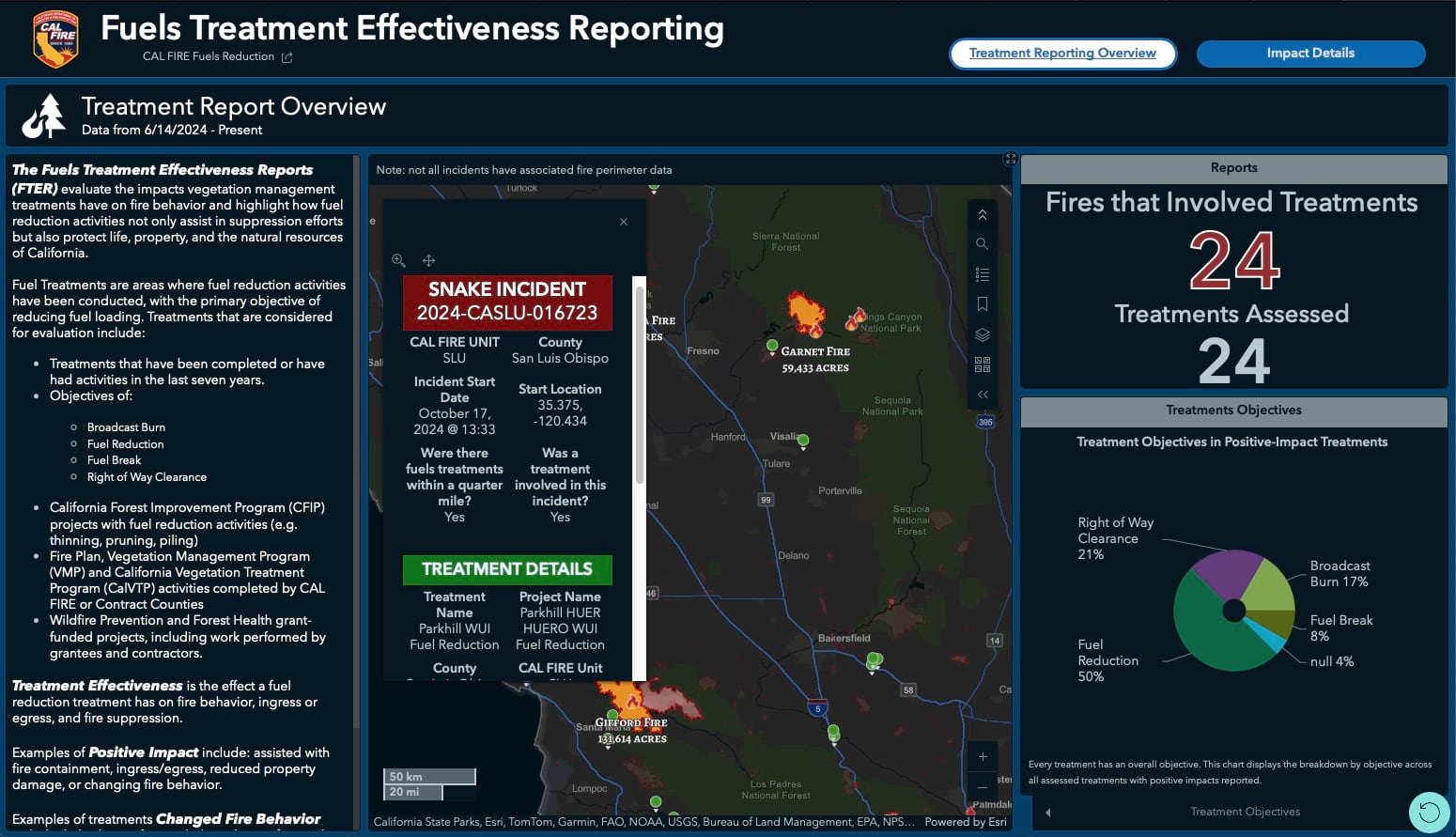
Now any time a fire starts, the incident reporting system drops a point on the map. The database automatically queries for mitigation treatments within a half mile of that location. Then the system generates a data collection survey to be used for an on-the-ground assessment.
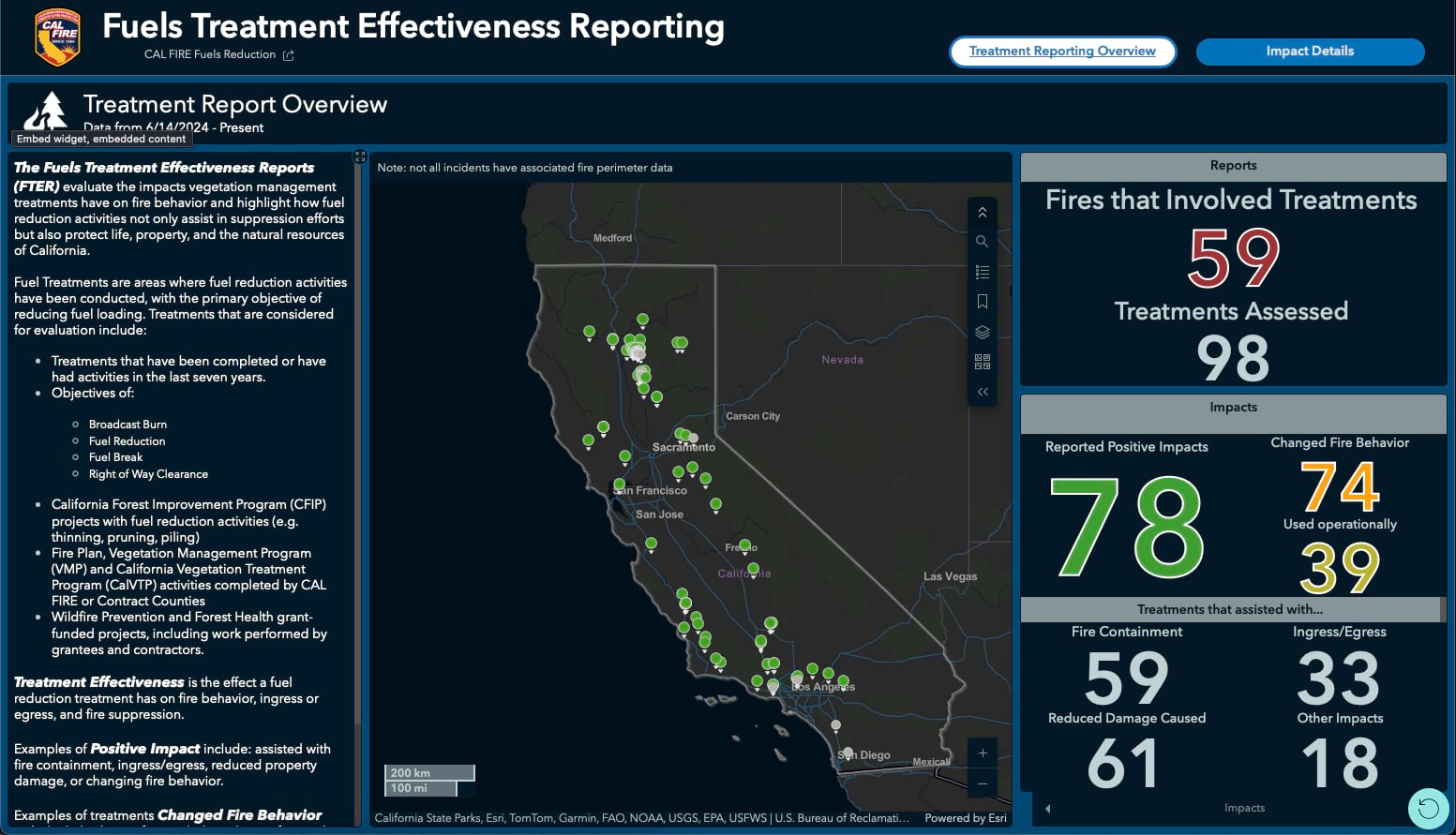
“Within days, the results are live on a public dashboard,” Bigelow said.
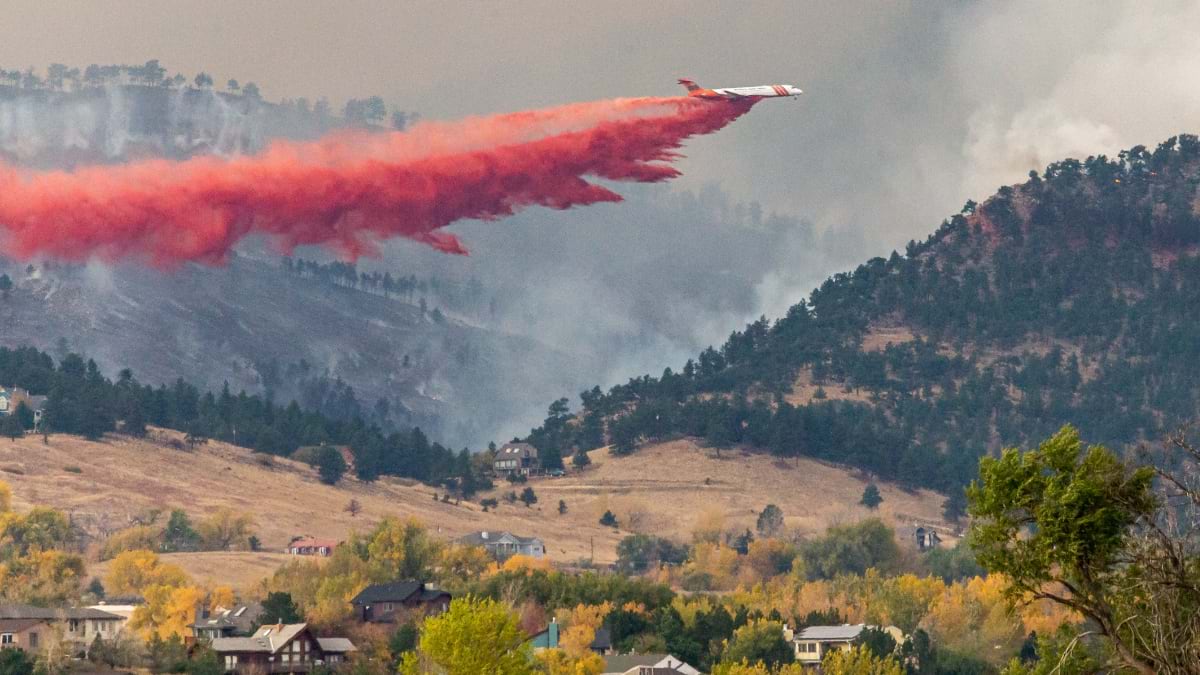
Results from the first year are eye-opening. CAL FIRE assessed 81 areas that had fuel treatment and were then impacted by wildfire. They found 61 of those areas showed positive outcomes—meaning the treatments either slowed the fire, stopped it from destroying property, improved firefighter access, or supported aircraft and firefighting effectiveness.
“More than 60 percent of the time, we’re putting treatments in the right place,” Bigelow said.
For policymakers, that statistic—along with the GIS maps, photos, and standardized reports—proves wildfire mitigation investments are paying off.
CAL FIRE’s approach builds on the foundation established by the US Forest Service’s Fuel Treatment Effectiveness Monitoring (FTEM) system, which has required federal land managers to assess treatment effectiveness since 2003. The federal system mandates that agencies complete assessments within 90 days when wildfires intersect with treatments.
“The federal FTEM system was a good start, but it relied on manual data entry and post-fire reporting,” Bigelow explained. “We took that concept and automated the entire front-end process. Instead of waiting 90 days and hoping someone remembers to fill out a form, our system identifies potential assessments the moment a fire starts and immediately sends the assessment tools to the field.”
Proactive assessment captures data while conditions are fresh and personnel are at the incident.
An additional consideration is the maintenance challenge. CAL FIRE’s data shows that after five years, most treatments lose effectiveness without maintenance.
“We’ve invested over a billion dollars in grants in the last decade, but we’ve lost many fuel breaks because we didn’t prioritize maintenance,” Bigelow said. “This year we made the decision to prioritize maintenance: If your grant application doesn’t include maintenance, it will have a tougher time being awarded.”
For agencies nationwide, this is a critical takeaway. It’s not enough to fund new projects. True return on investment depends on sustaining and maintaining treatments over time.
While fuel treatments work at the landscape level, CAL FIRE has also pioneered a comprehensive home hardening program that brings protection directly to communities. This program is a Joint Powers Authority with the Governor’s Office of Emergency Services. The program provides up to $40,000 per homeowner to retrofit existing homes with fire-resistant materials and features.
CAL FIRE codeveloped a hazard mitigation methodology with the research industry that prioritizes improvements—roof first, then siding, then vents, then windows. The department created a retrofitting standard, working with the National Institute of Standards and Technology, the Insurance Institute for Business & Home Safety, and other partners.
“Nobody had ever done this before,” Bigelow said. “There are codes that tell you how to build a new home in wildfire areas, but nothing that says what you have to do to an existing home. Collectively, we had to create that from scratch.”
So far, CAL FIRE has retrofitted 93 homes across six pilot counties, using GIS and other technologies to automate workflows from application through inspection. The home hardening program was designed to be transferable. It provides a complete toolkit others can implement using their own funding sources.
CAL FIRE is now partnering with other organizations to model where treatments will provide the most benefit in the future. By factoring in ignition history, road networks, watershed values, biodiversity, and even carbon sequestration, the models help decision-makers prioritize where to invest.
“The beauty of this system is that you can dial up different priorities,” Bigelow said. “Want to focus on communities? The model analyzes the wildfire exposure to structures. Want to emphasize environmental protection? It looks at smoke, carbon, watersheds, and ecosystem health. And it gives you the cost estimate based on real-world grant data.”
That kind of predictive, data-driven planning does more than strengthen California’s wildfire resilience. It helps to set a template and provide inspiration for every agency seeking to justify mitigation investments.
CAL FIRE’s annual operating budget has grown from under $1 million in 2004 to $4.7 billion today, and lawmakers want proof that money is being spent wisely.
“If we can’t quantify the benefits in a way they understand, we won’t continue to get investments,” Bigelow said. “We have to be able to visualize things, show outcomes, and prove ROI.”
The challenge isn’t unique to California. Federal agencies, state legislatures, and local governments are all demanding evidence-based decision-making. For wildfire agencies everywhere, the takeaway is clear: If you want to secure funding, you need to prove your treatments work, maintain them over time, and tell that story with data.
Learn more about how GIS is applied to manage wildfire risk in forests and communities.